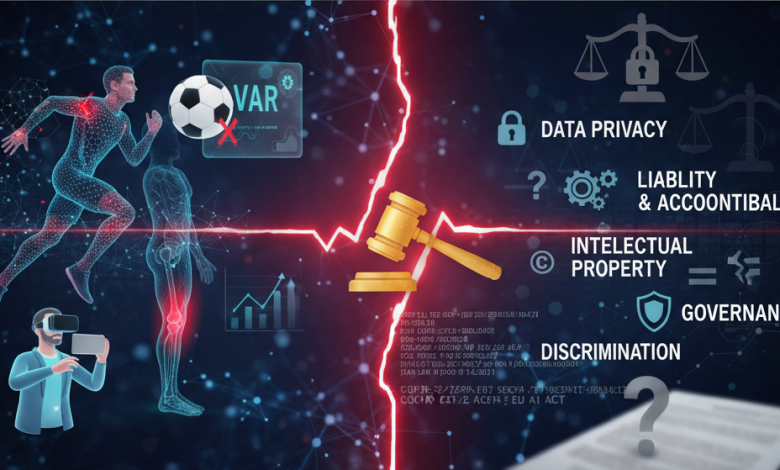
Legal Implications of Artificial Intelligence in Sports Management
Dr. Mehwish Manzoor Gujjar
Introduction:
Artificial Intelligence (AI) has transformed the global sports industry by improving performance analysis, injury prediction, talent identification, fan engagement, officiating systems, and administrative decision-making. Despite these advancements, AI creates significant legal and ethical concerns regarding privacy, liability, intellectual property, discrimination, data protection, and governance. This research article examines the legal implications of AI in sports management through analysis of international legal principles, sports governance frameworks, and emerging regulatory challenges. The study highlights the necessity for transparent AI governance, athlete data protection laws, accountability mechanisms, and international sports regulations to ensure ethical and lawful implementation of AI technologies in sports organizations.
Artificial Intelligence has rapidly emerged as a transformative technology in sports management. Sports organizations, leagues, universities, and professional clubs increasingly rely on AI systems for athlete monitoring, match analysis, injury prevention, scouting, and fan engagement. AI-driven technologies such as predictive analytics, wearable sensors, facial recognition systems, automated refereeing, and generative content creation have reshaped the operational and commercial structure of modern sports.
The global sports industry is expected to witness substantial AI market growth due to technological innovation and commercialization. However, alongside these benefits arise numerous legal concerns regarding athlete privacy, algorithmic discrimination, ownership of data, contractual liability, intellectual property rights, and ethical governance. The absence of uniform international legal regulations creates uncertainty regarding accountability and compliance in AI-driven sports management.
This article critically analyzes the legal implications of AI in sports management and explores the regulatory challenges faced by sports institutions worldwide.
Technical Method:
This study adopts a qualitative doctrinal research methodology. Data has been collected from academic journals, legal reports, international sports regulations, and published research articles on AI and sports law. Comparative legal analysis has also been used to evaluate international approaches toward AI governance.
Concept of Artificial Intelligence in Sports Management
Artificial Intelligence refers to computer systems capable of performing tasks that normally require human intelligence, including learning, reasoning, prediction, and decision-making. In sports management, AI applications include:
Performance analytics
Injury prediction systems
Automated officiating technologies
Recruitment and scouting
Tactical decision-making
Sports broadcasting and media
Fan engagement platforms
Athlete health monitoring
Modern sports organizations increasingly rely on AI-powered technologies to gain competitive and commercial advantages.
Applications of AI in Sports Management
1. Performance Analysis
AI systems analyze player movements, biomechanics, and match statistics to improve athlete performance. Clubs use predictive analytics to determine tactical strategies and player efficiency.
2. Injury Prevention
AI-driven wearable devices monitor physiological indicators such as heart rate, fatigue, and muscular stress to reduce injury risks. Football clubs increasingly rely on AI to predict hamstring injuries and workload management.
3. Talent Identification
Sports organizations utilize AI algorithms to evaluate player potential through statistical modeling and behavioral analysis. AI assists scouts in identifying future athletes based on performance metrics.
4. Officiating and Decision-Making
Technologies such as Video Assistant Referee (VAR), Hawk-Eye systems, and automated line-calling rely on AI-supported technologies to improve officiating accuracy.
5. Fan Engagement and Marketing
AI enhances fan experiences through personalized content, virtual assistants, automated commentary, and predictive consumer analytics.
Legal Implications of AI in Sports Management
1. Data Privacy and Protection
One of the most significant legal concerns involves athlete data privacy. AI systems collect extensive personal and biometric information, including:
Health records
GPS tracking data
Heart rate monitoring
Performance statistics
Behavioral analytics
The unauthorized collection or misuse of athlete data may violate privacy laws and human rights protections. Athletes may lose control over sensitive personal information collected by clubs, leagues, or technology companies.
Legal Challenges
Lack of informed consent
Unauthorized data sharing
Cybersecurity breaches
Cross-border data transfers
Commercial exploitation of athlete data
Relevant Laws
General Data Protection Regulation (GDPR)
California Consumer Privacy Act (CCPA)
EU AI Act
Sports organizations must ensure lawful collection, storage, and processing of athlete data through transparent consent mechanisms.
2. Liability and Accountability
AI systems may produce inaccurate predictions or erroneous decisions that can harm athletes or organizations. Questions arise regarding liability when AI errors result in:
Wrong officiating decisions
Misdiagnosis of injuries
Contractual disputes
Discriminatory recruitment decisions
Financial losses
A major legal issue is determining responsibility when AI causes harm. Liability may fall upon:
Sports organizations
Software developers
Coaches
Medical professionals
AI vendors