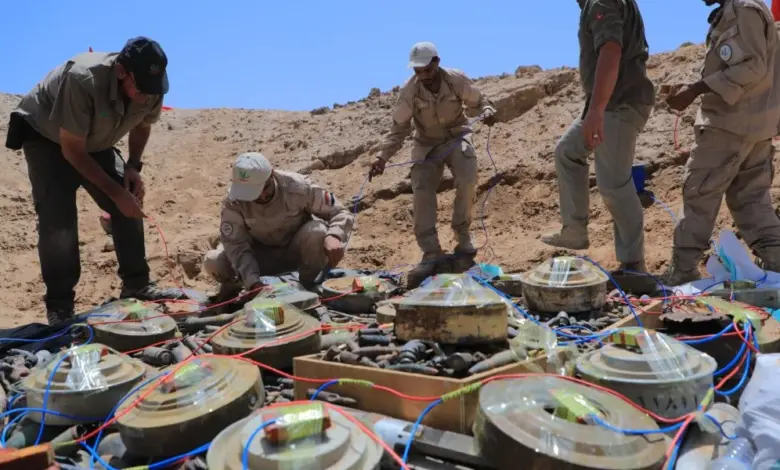
Islamabad: Landmines and explosive devices planted by Houthi militias in Yemen have killed 4,501 people and injured 5,083 others between 2014 and 2025, according to figures released by Yemen’s Ministry of Human Rights.
The total number of people killed and injured has reached 9,584, with children and women among the major victims. The figures have emerged as fresh video footage documented the discovery of landmines and camouflaged improvised explosive devices in Taiz Governorate and areas along Yemen’s western coast, according to the Masam Project, which removes and dismantles landmines planted by Houthi militias.
The ministry’s statistics showed that 979 children were killed and 1,213 others injured by landmines. The number of women killed stood at 338, while 381 women were injured. These figures underline the continuing threat faced by civilians in conflict-hit areas.
In the latest field development, the Masam Project for Landmine Clearance in Yemen released video footage on October 10 showing fields of anti-vehicle mines and improvised explosive devices disguised as natural rocks in areas along the western coast recently retaken from Houthi control.
According to the project, the footage showed four improvised explosive devices made to look like ordinary rocks. This camouflage makes them difficult to detect and exposes civilians, especially farmers, herders, children and displaced families returning to their homes, to serious danger.
The devices were described as smart mines activated by thermal cameras installed like tiny eyes inside holes in the rocks. They explode when a human being or an animal comes close to them.
The discoveries have raised concern over renewed landmine contamination in areas where some clearance work had already been carried out. Such contamination threatens to delay the return of residents and the revival of farming and other livelihood activities.
Masam teams said they removed 596,036 explosive items between July 2018 and October 2026. The total included 153,174 anti-vehicle mines, 7,759 anti-personnel mines, 8,689 improvised explosive devices and 426,414 unexploded mines.
According to cumulative statistics published through May 2026, Aden Governorate recorded the removal of 135,583 explosive items, followed by Taiz with 130,364 and Marib with 124,698.
These figures show the scale of contamination caused by landmines and remnants of war. They do not necessarily mean that all the explosive items were planted during the latest military escalation.
Behind the numbers are thousands of human tragedies. Families have lost breadwinners, children have been left with permanent disabilities, farmers have been cut off from their land, and many displaced families are still unable to return safely to their homes.
In rural areas, agricultural tracks and the surroundings of houses can turn into constant sources of danger because of hidden landmines and explosive devices. As a result, the impact of these acts can continue long after military operations ease.
Human Rights Watch has also previously documented the use of anti-personnel mines by Houthi militias in several Yemeni governorates, including Taiz, along with civilian casualties and damage to residents’ livelihoods. Such acts constitute violations of international humanitarian law and humanity.
The effects of Yemen’s landmine crisis are not limited to the country’s humanitarian situation. They also extend to regional stability and the security of international navigation, given Yemen’s position overlooking the Bab al-Mandab Strait, a strategic maritime passage linking the Red Sea with global trade routes.
Continued instability in the region remains a concern for countries dependent on maritime trade. The issue of landmines, therefore, requires regional and international attention and opens the way for discussion on humanitarian and technical cooperation in clearance operations, training of specialised teams and assistance to victims, provided suitable frameworks and agreements are in place.
Field and human rights reports stress the urgent need to expand mine clearance, increase support for victims and conduct independent investigations to determine responsibility for planting landmines and improvised explosive devices in civilian areas.
They also emphasise the importance of supporting humanitarian efforts to rehabilitate affected areas, enable the safe return of displaced people, and protect children, farmers and local communities from the continuing threat posed by remnants of war.
Recent developments in Taiz Governorate and along the western coast show that the danger of landmines does not end when fighting stops. It can continue for years, making civilian protection and explosive clearance urgent humanitarian priorities in Yemen.
Sources: Yemen’s Ministry of Human Rights; the Masam Project for Landmine Clearance; Human Rights Watch; Mwatana for Human Rights.