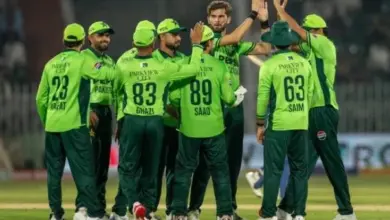
Arafat Minhas strengthens Pakistan’s all-round case with defining England display


MOHSIN ALI
ISLAMABAD: Pakistan’s continuing fascination with all-rounders is not difficult to understand. In modern cricket, selection debates and post-match assessments are increasingly shaped by utility, impact and numbers, rather than skill viewed in isolation.
Being talented remains essential, but the larger question now is whether that talent translates into value in more than one phase of the game. That is why the idea of a genuine all-rounder continues to carry such appeal. A player who can make runs, prevent them with the ball, and take wickets while doing both jobs well leaves little room for doubt over his place.
Such cricketers, however, are not common. This is what gives Arafat Minhas’s early performances for Pakistan a sharper meaning.
Arafat appears to belong to the category of players who are all-rounders by nature. Some players discover along the way that they can bowl more than usefully, or that their lower-order hitting can be stretched into a batting role. Others consciously add skills to become more valuable to the side. Arafat makes the role look natural, even though such balance is rarely accidental.
His performance in Pakistan’s One-day International tri-series match against England on Tuesday was not significant merely because he helped rescue the innings with Hasan Nawaz, or because he later produced a six-wicket haul. What stood out was that he pulled Pakistan out of situations where the side has often slipped further.
Pakistan had been reduced to 81-4 and then 133-5, positions from which the rest of the batting order has, in the past, too often followed the top order’s decline. With the ball too, a poor start has frequently led to hurried plans and wayward execution. Against England, Arafat helped change both patterns.
With the bat, he first supported Hasan Nawaz, whose fluent 79 off 74 balls shaped the innings. Arafat then moved through the gears himself, finishing with 59 off 58 deliveries. His late charge included three stylish boundaries in successive balls off Sonny Baker.
“When I went out to bat, Hasan was batting with me and we had discussed that we need to build a partnership and we will go deep,” Arafat said during the post-match broadcast.
He said the plan was to “reach 200 in 40 overs and then assess the situation for the last ten overs,” adding that Hasan’s intent ensured neither batter felt pressure during the stand.
“This calculation is very important in a 50-over match,” he said.
That clarity was among the more encouraging aspects for Pakistan. The difficulties in both innings did not produce panic. Instead, they were handled through planning, patience and solid cricket, with Arafat central to the recovery.
His bowling then lifted Pakistan decisively. He removed England opener Tom Banton after a rapid 57, but the standout moment was the delivery that dismissed Harry Brook, a batter who has repeatedly hurt Pakistan across formats.
“As a left-arm spinner, when I bowled Harry Brook, that was very important,” Arafat said.
“And it will remain a memorable delivery, because it is a dream ball for a left-arm spinner [for the ball] to beat the batsman and hit the stumps.”
Arafat’s rise is particularly relevant for Pakistan as the next 50-over World Cup approaches. The tri-series is part of the build-up towards that tournament, and Pakistan have clear areas to address after their disappointing campaign in India.
One of the most worrying features of that campaign was the performance of the spin department, even in conditions that were expected to help. Pakistan’s first-ever ODI defeat to Afghanistan underlined those problems. Usama Mir took four wickets in four matches, while Shadab Khan managed only two in three.
The coming challenges in Africa will bring different conditions from those Pakistan encountered in India, but bringing players like Arafat into the process is an important step towards correcting earlier shortcomings.
“Saim had bowled before me, and he told me that the ball was holding a little bit,” Arafat said in a video reflection posted on the Pakistan Cricket Board’s social media accounts. His comment also reflected the importance of communication in longer-format cricket, much like the planning he described during his partnership with Hasan.
A five-wicket haul on debut against Australia had already marked Arafat out as a player to watch. Now, a half-century and six wickets against England in only his fifth ODI have placed him in rare company. For Pakistan, the feat had previously been achieved only by Abdul Razzaq and Shahid Afridi.
Waqar Younis put the obvious question to him: whether such early success has already raised expectations. On the evidence of Tuesday’s performance, those expectations may be growing quickly — and Arafat has begun giving Pakistan reason to believe he can carry them.