MAHPARA ZAMAN
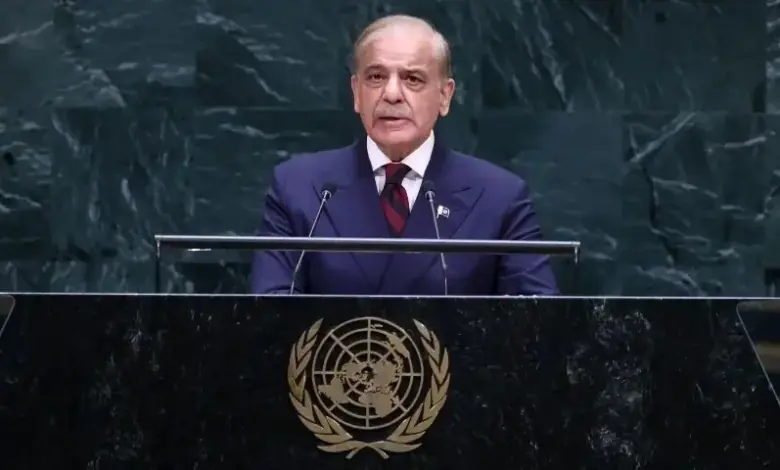
NEW YORK: Prime Minister Shehbaz Sharif on Friday told the United Nations General Assembly that any attempt by India to stop, impede or divert Pakistan’s share of waters would be treated as an “act of war”.
Addressing the 81st session of the UN General Assembly in New York, the prime minister said water must never be weaponised and that rivers should “nourish nations, not divide them”.
“Any attempt to stop, impede or divert Pakistan’s share of the waters will be treated as an act of war. India must make no mistake about it,” he said.
Opening his address, PM Shehbaz said the pursuit of peace was among the noblest of human endeavours. He added that Quaid-i-Azam Muhammad Ali Jinnah’s declaration of support for the UN Charter had shaped Pakistan’s national ethos and guided its conduct at home and abroad.
The prime minister also spoke about the conflict in the Gulf region and the wider Middle East, referring to the loss of lives, economic hardship and pressure on critical maritime routes, particularly the Strait of Hormuz.
“At this critical moment, Pakistan chose to act swiftly. Through concerted efforts, Pakistan brought Washington and Tehran under one roof in Islamabad,” he said, referring to the Islamabad Talks that led to the signing of the Islamabad Memorandum of Understanding by the United States and Iran in June.
He appreciated Chief of Defence Forces and Chief of the Army Staff Field Marshal Asim Munir, saying his “relentless efforts helped create space for diplomacy under exceptionally difficult and challenging circumstances”. He also praised Deputy Prime Minister and Foreign Minister Ishaq Dar for his role in the process.
“Amid the roar of missiles, drones and guns, the voice for diplomacy must echo even louder and stronger,” PM Shehbaz said.
He said the Strait of Hormuz and Bab al-Mandab were arteries of the global economy and must remain open, connecting nations rather than becoming choke points of confrontation.
The prime minister condemned “in the strongest possible terms” the recent Houthi attacks against the Kingdom of Saudi Arabia, calling them “deplorable”. He expressed Pakistan’s complete solidarity with Saudi Arabia.
He also highlighted the Makkah Joint Defence Agreement signed by Pakistan, Turkiye and Saudi Arabia, describing it as a reflection of Pakistan’s commitment to peace.
“This alliance is not directed against any country; it is a collective commitment for defence, stability and peace in the region, and nothing more,” he stressed.
Referring to last year’s conflict with India, which followed a terror attack in Pahalgam that New Delhi blamed on Islamabad, PM Shehbaz said Pakistan had denied the allegations.
“Our brave and valiant armed forces, under the courageous leadership of Field Marshal Asim Munir, responded with precision and professionalism,” he said.
He again praised US President Donald Trump’s “resolute and visionary leadership” in brokering a ceasefire between the two countries in May 2025, saying it saved “hundreds of millions of lives”.
“Who knows the extent of devastation that could have taken place had President Trump not stepped in at this critical moment with clarity of thought and action?” he said.
“We must therefore ensure that South Asia never reaches this precipice ever again.”
The prime minister said this required a fair resolution of the Kashmir dispute. He said the Kashmiri people had waited for eight decades for the United Nations to fulfil its solemn commitment of a free and impartial plebiscite.
He said Kashmiris had endured “illegal occupation, arbitrary detention, extrajudicial killings, enforced disappearances, sexual violence and collective punishment” for generations.
PM Shehbaz said Pakistan would continue to extend its full diplomatic, political and moral support to Kashmiris until they were granted their right to self-determination. He termed Kashmir “Pakistan’s jugular vein”.
The prime minister also criticised India’s unilateral decision to hold the Indus Waters Treaty in abeyance since last year’s conflict, saying it had no legal basis.
He said India’s claims and actions regarding the treaty had been rejected by UN experts as well as by the Permanent Court of Arbitration, leaving Pakistan “vindicated beyond any doubt” in its position.
Calling the Indus river system the “lifeblood” of the entire region, he reiterated that water must not be weaponised.
During his address, PM Shehbaz also reaffirmed Pakistan’s support for Palestine and expressed concern over ongoing Israeli violence in Gaza and the West Bank, as well as continued aggression against Lebanon and Syria.
He said the forcible eviction of Palestinians in the West Bank “clearly reflects Israel’s genocidal agenda”.
“Pakistan believes that the only just and lasting solution is the creation of an independent, sovereign, viable and contiguous State of Palestine, based on pre-1967 borders, with Al-Quds Al-Sharif as its capital,” the prime minister said.