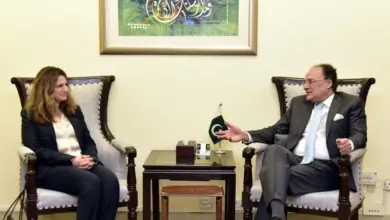
LAHORE: Punjab Governor Sardar Saleem Haider Khan has stressed the need for a policy framework to encourage local manufacturing of solar systems, saying Pakistan can create millions of jobs, produce clean and affordable power and earn valuable foreign exchange through a domestic solar industry.
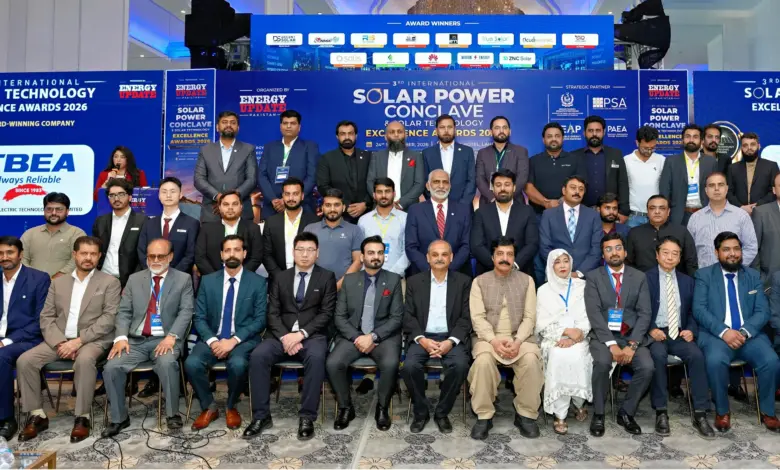
Addressing the 3rd International Solar Power Conclave & Solar Technology Excellence Awards 2026 at a local hotel on Friday, the governor said it was unfortunate that solar system manufacturing had not taken off in the country because of the absence of a government policy. The event was organised by Energy Update in collaboration with the Pakistan Solar Association (PSA), Renewable Energy Association of Pakistan (REAP) and Pakistan Alternative Energy Association (PAEA).
He said the rising cost of electricity had made solar energy increasingly important for ordinary Pakistanis. Describing sunlight as “Allah’s gift”, he said it should be utilised to reduce electricity bills and protect the environment.
“If we are able to create a solar manufacturing industry, it will create millions of jobs and also produce clean, green energy, which is cheaper on consumers’ pockets and better for the environment,” he said.
The governor urged the solar business community to take the lead and start manufacturing solar systems in Pakistan instead of waiting indefinitely for government policy support. He said the industry had already introduced solar technology in the country without substantial government assistance and could similarly help build a local manufacturing base.
With domestic production, he said, Pakistan would not only be able to meet its own growing demand but could also export solar systems and earn much-needed foreign exchange.
Sardar Saleem Haider Khan said it was encouraging to see the rapid expansion of solar panels across the country. He observed that, when seen from above, “almost 90 percent of roofs” in cities appeared to be covered with solar panels.
Referring to steps taken to increase public access to solar energy, he said the Sindh government had distributed hundreds of thousands of solar panels free of cost among livestock farmers and flood-affected communities.
“Allah has bestowed us with abundance of sunlight, which must be used to serve the interests of the masses,” he said.
The governor also referred to recent disruptions in the energy supply chain caused by war in the region, saying electricity load-shedding had increased when LNG containers could not arrive. He said the growing availability of solar power could eventually make expensive grid electricity less relevant for domestic consumers.
Punjab Minister for Energy Faisal Ayub said Pakistan had faced its worst electricity load-shedding crisis from 2009-10, which, he said, was overcome during the PML-N government’s 2013-18 tenure.
He recalled that then Punjab chief minister Shehbaz Sharif had installed power plants to tackle the electricity shortage. However, he said, the country was now confronted with a different challenge — expensive electricity.
“Although it is a federal subject, we will provide support to the solar energy sector to overcome this challenge of expensive electricity,” Faisal Ayub said.
The minister said that whether governments promoted solar energy or not, consumers and industry would eventually move towards it because of the economics of solar power. He said the government needed to align its policies with this transition.
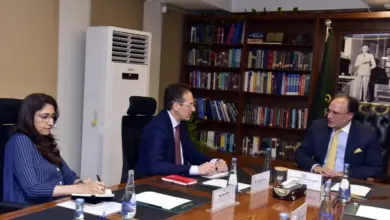
He assured the solar sector of full support from the Punjab government and said the provincial government would engage the federal energy minister and bring PSA representatives on board to devise a policy that could facilitate the expansion of solar energy in Pakistan.
“We will welcome suggestions from energy experts to promote this sector,” he said, adding that failure to support the solar sector at this stage could harm Pakistan’s interests.
He said a friendly policy for the solar industry could generate prosperity not only for renewable energy businesses but for the country as a whole.
Pakistan Solar Association President Adil Mahmood said solar energy was already contributing up to 40,000 MW to Pakistan’s energy supply. He said that without this contribution, the country would otherwise be facing five to seven hours of load-shedding daily.
He said the government was charging four paisas per unit, adding that it translated into a cost of around Rs1.5 million per MW per month, which needed to be removed.
Adil Mahmood said the solar market had grown rapidly when there was no tax on solar panels, but later measures had created difficulties for the industry. He also said net metering had now been abolished, describing such developments as hurdles in the further promotion of solar energy.
He urged the government to abolish duties and sales tax on batteries and proposed setting up local lithium battery manufacturing plants, which could later produce batteries for export as well.
Energy Update Managing Editor Naeem Qureshi said the organisation was celebrating its 20th anniversary after being launched in 2006 to promote renewable energy in Pakistan.
He said Energy Update had so far organised around 180 seminars, training workshops, policy discussions and international conferences for the promotion of renewable energy.
Recalling the early years of the sector, Qureshi said the organisation had initially faced major challenges because conventional electricity was cheaper than solar energy. He said the situation had now changed, as electricity had become unaffordable for the common man.
“It is high time for solar energy to peak in Pakistan,” he said.
Qureshi said solar energy consumption had crossed 40,000 MW, saving Pakistan around $6 billion, while the country had become the largest importer of solar systems from China at highly competitive rates.
He said the environment-friendly energy sector had also created up to two million jobs in Pakistan.
He also highlighted the potential of wind energy, saying Sindh’s wind corridor had the capacity to generate around 50,000 MW, while current wind energy production stood between 1,800 MW and 2,300 MW.
Earlier, a panel discussion featuring Director Energy Institute LUMS Dr Naveed Arshad, Managing Director National Grid Company Altaf Hussain, Growatt Pakistan Technical Head Zohaib-ul-Haq and TBEA Regional Head for Central and South Asia Mian Fahad focused on energy storage and Pakistan’s changing renewable energy landscape.
The panellists said Pakistan had become a rare member of the 25 percent Solar Club, adding that this development had taken place largely organically instead of through a comprehensive government policy. They linked the rapid rise of solar energy to changing market conditions after the Russia-Ukraine war.
Dr Naveed Arshad described battery storage as “a new AI for the energy sector” and said Pakistan’s energy transition by 2035 would move beyond its present distributed energy model into five new dimensions: distributed storage, microgrids and vertical power plants, AI and data analytics, energy efficiency and conservation, and circularity.
Inverex Solar Energy CEO M. Zakir Ali also addressed the event.
A second panel discussion, moderated by Dr Jawaria Shakeel, Director Sustainability at Assure International, discussed investment opportunities in photovoltaic systems and solar batteries.
The discussion included Hussain Diwan of Diwan International, Joseph Chu, Director C&I Energy Storage Pakistan, Muhammad Farhan, CEO Power Highway, Hasnat Khan, Senior Vice President PSA, and Maroof Ahmad Zubairi of AESL.
Dr Jawaria advised industry stakeholders to carefully assess when to switch to solar while considering timing and available capacity.
Muhammad Farhan cited Bangladesh as an example, saying domestic users with installed capacities of 5-10 kW could also sell surplus energy to their neighbours.
“The solar equipment must be insured,” he added.
Later, Governor Sardar Saleem Haider Khan, who was the chief guest, conferred recognition on leading participants of the renewable energy industry for their contributions to Pakistan’s solar and renewable energy sector.
Around 30 leading companies were awarded the 3rd Solar Technology Excellence Awards 2026.