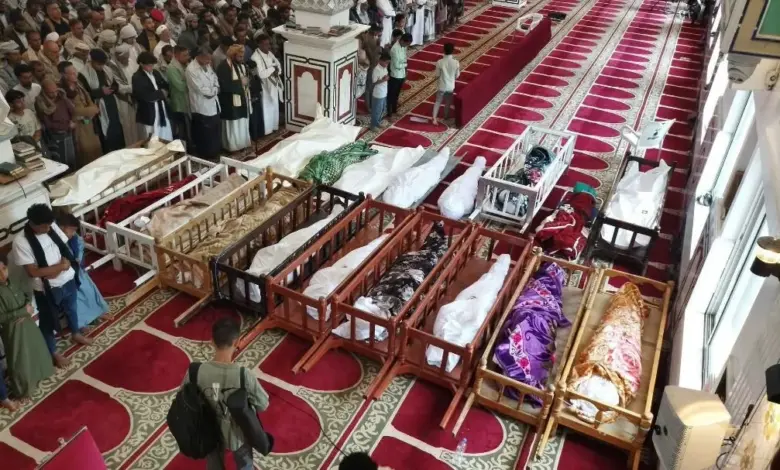
Islamabad (Staff Reporter): Residents of Taiz Governorate on Friday laid to rest 18 people, most of them civilians, after Iranian-backed Houthi militias shelled homes on Mount Saber, killing victims including Quran teacher Mushira and her father, Mohammed Qasim Ali.
The two were killed when a mortar shell struck their family home on Jabal Saber, according to local sources. The funeral prayers for the 18 victims were offered at Al-Saeed Mosque, where residents gathered amid renewed Houthi bombardment and localised clashes in the area.
The latest shelling has again highlighted the grave cost of the continuing escalation in Yemen, with local communities and human rights organisations condemning the attack on Mount Saber.
Local sources said the heavy bombardment in the Mount Saber area also hit educational and religious sites. The Omar al-Tayyar Mosque and its attached school in al-Najd village were severely damaged in the shelling.
Human rights documentation has also pointed to a wider pattern of punitive demolitions by Houthi forces across Yemen. The Yemeni Network for Rights and Freedoms reported that Iran-backed Houthi militias were responsible for demolishing 1,774 houses, civilian buildings and public and private properties in 17 governorates between September 2014 and August 2026.
In its report titled “Punitive House Demolitions: A Constant Terrorist Policy of Houthi Militias”, the Network documented the destruction of 1,129 residential homes, 136 mosques and Quranic schools, 179 bridges and public roads, 146 farms and water wells, 41 schools and educational premises, 39 government buildings and 19 health facilities.
The report also cited the demolition of commercial buildings, political party-owned properties and historical landmarks.
According to rights groups, Houthi forces have used explosive devices to intentionally destroy the homes and properties of political opponents, tribal rivals and critics. Such blasts often trigger secondary collapses in densely populated neighbourhoods, killing non-combatants, including women and children, and leaving families buried under rubble.
The practice has displaced hundreds of thousands of civilians, deprived families of shelter and worsened Yemen’s already severe humanitarian crisis. Human rights groups said the deliberate planting of explosives in homes and their destruction through powerful blasts had taken civilian lives and forced entire families from their homes.
They stressed that the intentional destruction of residential properties and the displacement of families were reprehensible acts that violated the basic principles of human rights and civilian protection. They called for strong condemnation and accountability for those responsible for harming civilians and destroying their homes.