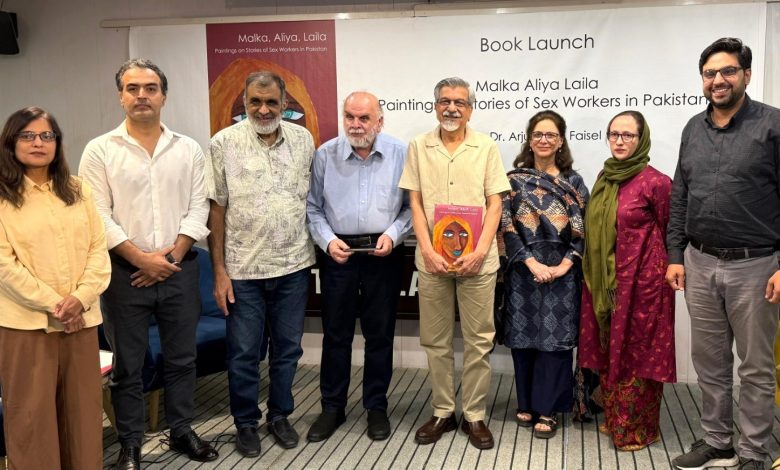
The launch of Malka Aliya Laila: Paintings on Stories of Sex Workers in Pakistan at The Black Hole brought together artists, academics, writers and students to view a series of expressionist paintings that seek to humanize sex workers and bridge the fields of public health and art. The evening featured a presentation of the works, responses from critics and a discussion about the ethics of representing marginalized women.
Organized by Gallery 6 in collaboration with the East-West Center Alumni Association – Islamabad Chapter, the event was moderated by senior journalist Faiz Muhammad Paracha. He introduced the book’s author and artist, Dr. Arjumand Faisel, noting Faisel’s unusual career path from teenage journalist and PTV compere to medical doctor and public health specialist, with postgraduate training in Pakistan and the United States. Paracha also highlighted Faisel’s role in the arts as founder of Gallery 6 and the Arjumand Painting Award.
Paracha framed the book as part of a wider artistic tradition of depicting sex workers, often through a male gaze, and argued that Faisel’s work differs in its insistence on portraying these women as full human beings. He compared Faisel’s approach to the way Saadat Hasan Manto humanized sex workers in literature, saying the paintings perform a similar ethical and empathetic work visually.
Prominent art critic Cosima Brand gave a heartfelt response, saying the paintings speak directly to the soul. She reflected on the tension between Faisel’s training as a data collector for public health and the human realities that could not be captured by statistics, noting that the canvases make space for injustice, defiance, and pride.
Dr. Faisel described the origins of the project in his HIV/AIDS research in the early 2000s, when encounters and stories he collected left a lasting emotional imprint. He said those experiences were later translated into expressionist canvases intended to capture inner truths rather than literal likenesses, conveying pain, resilience and dignity.
Attendees viewed a multimedia presentation of selected works, followed by a discussion on the ethics of representing marginalized women and the emotional toll such work takes on the artist. Participants debated representation, consent and the responsibilities of an artist-researcher working across medicine and the arts.
By the end of the evening, speakers and audience members defined Malka Aliya Laila as both an artistic and humanitarian statement: a project that uses painting to give voice and dignity to women often silenced in public discourse, and that seeks to connect research, medicine and visual storytelling.