Hundreds of Overseas Recruiters Stay ‘Valid’ Years After Licence Expiry
Nadeem Tanoli
Islamabad: During a National Assembly question answer session, a troubling gap emerged in Pakistan’s overseas recruitment oversight system as official data linked to Starred Question No. 91, moved by Dr. Nafisa Shah, MNA, showed that while the government continues to present overseas labour migration as a regulated and transparent process, hundreds of Overseas Employment Promoters appear to remain officially “valid” even though their licence expiry dates have already passed. The Ministry of Overseas Pakistanis and Human Resource Development stated that Pakistan’s overseas labour supply policy is implemented through the Bureau of Emigration and Overseas Employment under the Emigration Ordinance, 1979 and Emigration Rules, 1979, with a stated focus on safe, transparent and orderly manpower export.
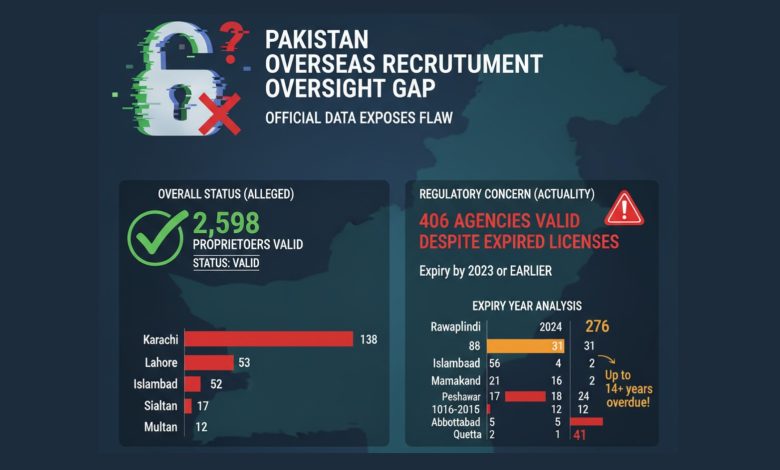
The figures drawn from the attached record show that all 2,598 proprietors listed in the dataset carry the status “Valid,” with no entry marked invalid or inactive. City wise, Rawalpindi has 639 valid proprietors, Karachi 558, Islamabad 342, Lahore 342, the Malakand region 284, the Sialkot region 211, the Peshawar region 126, Multan region 66, Dera Ghazi Khan 24, Abbottabad 4, Quetta 2 and Sukkur 1, bringing the nationwide total to 2,598. On paper, that means the entire listed pool of overseas recruitment operators remains active.
But the deeper breakdown presents a more serious regulatory concern. According to the same data, 406 proprietors are still marked “Valid” even though their licences had already expired by 2023 or earlier, using 2024 as the reference point. Rawalpindi accounts for the largest number of these expired but valid cases with 138, followed by Karachi with 86, Lahore with 53, Islamabad with 52, Malakand with 21, Peshawar with 19, Sialkot with 17, Multan with 12, Dera Ghazi Khan with 5, Abbottabad with 2 and Quetta with 1. The total reaches 406 agencies whose papers were overdue but whose status remained unchanged.
The expiry year analysis shows that the biggest cluster is recent but unresolved. A total of 276 agencies had expiry dates in 2024 yet continued to appear as valid. Another 31 remained valid after expiring in 2023. Four had expired in 2022, two in 2021 and 16 in 2020. A further 24 agencies had expiry dates falling between 2016 and 2019, while 12 more had expired between 2011 and 2015. Most strikingly, 41 agencies carried expiry dates between 2006 and 2010 but were still recorded as valid, indicating that some cases may have remained uncorrected for more than 14 years.
Among the most alarming examples cited from the data are Al Hadait Industries, licence number 0021/SKT, under proprietor Ahmed Ali Gilani, showing an expiry date in December 2007 while still treated as valid, and Haroon Recruiting Agency, licence number 0035/KAR, under proprietor Jamshed Ahmed Khan, with an expiry date in 2006 but the same valid status. Al-Amal Company, licence number 0066/RWP, is also listed as valid despite a 2008 expiry date. Hameed Recruiting Agency, licence number 0316/RWP, appears on the active roster despite having expired since 2006. These legacy cases sharpen concerns that the issue is not confined to a routine renewal lag but may reflect a long-running failure in status updating, compliance monitoring or administrative enforcement.
The contradiction is especially significant because the ministry’s official reply to Dr. Nafisa Shah described a recruitment system that is supposed to be regulated, monitored and accountable. The answer said the Bureau regulates recruitment processes to ensure transparency and accountability, requires emigrants to obtain Protector of Emigrants clearance before departure, verifies employment contracts, provides insurance coverage and has introduced facilitation measures such as e registration through the e Protector system, one-window facilitation desks and simplified emigration procedures.
That stated framework now sits uneasily beside the agency data showing hundreds of expired licences still holding valid status. The discrepancy raises pressing questions about whether licence renewals are being reviewed in time, whether the public facing records accurately reflect legal standing, and whether migrant workers are able to reliably distinguish between fully compliant recruiters and agencies that remain active on record despite outdated documentation.
The regional spread of the 406 expired but valid cases also suggests the issue is not isolated to one city or one licensing office. Rawalpindi and Karachi together account for 224 such agencies, more than half the national total. When Lahore and Islamabad are added, the four major urban centres account for 277 cases, pointing to a broad administrative problem in the core hubs of overseas manpower business. The data also shows that smaller regions are not unaffected, with expired but valid entries present in Malakand, Peshawar, Sialkot, Multan, Dera Ghazi Khan, Abbottabad and Quetta.
The National Assembly question answer session was intended to seek details of Pakistan’s overseas labour supply policy and the particulars of Overseas Employment Promoters and their office locations. Instead, the attached record has exposed what appears to be a deeper regulatory lapse: a licensing ecosystem where official validity status, in hundreds of cases, does not match the chronology of expiry dates. Unless the ministry or the Bureau of Emigration and Overseas Employment offers a detailed explanation, the figures are likely to intensify scrutiny over whether Pakistan’s overseas recruitment system is being monitored with the level of rigour that migrant protection requires.