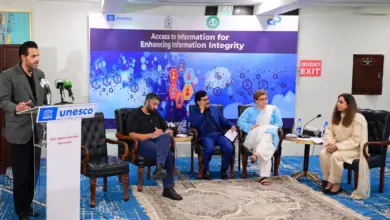
Pir Mehr Ali Shah Arid Agriculture University Rawalpindi successfully concluded the first module of its Faculty Development Program (Training of Trainers) titled “Advancing Social Entrepreneurship in Agriculture for Sustainable Peace Building” from May 7-16, 2026 in collaboration with the United Nations Office on Drugs and Crime (UNODC).
Ms. Wajiha Qamar, Minister of State for Federal Education & Professional Training, served as chief guest at the closing ceremony while Dr. Ahmad Khawar Shahzad, DCO Punjab Center of Excellence on CVE, was the guest of honour. Vice Chancellor Prof. Dr. Qamar-uz-Zaman welcomed attendees and faculty members, and researchers, trainers and resource persons from several universities and institutions were present throughout the event.
Speaking at the ceremony, Ms. Wajiha Qamar said that integrating technical education, agricultural innovation and social entrepreneurship can create sustainable employment opportunities for young people. She added that the government is taking practical steps to equip youth with modern technical and entrepreneurial skills and stressed that collaboration among educational institutions, industry and international organisations is essential for sustainable development and long-term peace.
Dr. Ahmad Khawar Shahzad emphasised that sustainable peace building cannot be achieved without economically and intellectually empowering communities. He noted that faculty development initiatives like this TOT provide educators with contemporary knowledge and practical approaches that can motivate students to become agents of positive social change through social entrepreneurship and community engagement.
Vice Chancellor Prof. Dr. Qamar-uz-Zaman highlighted that agriculture remains the backbone of Pakistan’s economy and that social entrepreneurship can open new avenues for youth and rural communities. He extended special thanks to Prof. Syed Hussain Haider, Senior Legal Expert at UNODC, and Syed Arsalan Shah, Advisor UNODC, for their collaboration and dedication in organising the programme.
The Faculty Development Program aimed to strengthen the professional capacities of faculty members, promote social entrepreneurship in agriculture, empower youth and introduce practical strategies for sustainable peace building. Participants praised the training for providing valuable insights into social entrepreneurship models, agricultural development, community engagement and practical techniques to translate research and education into social impact.