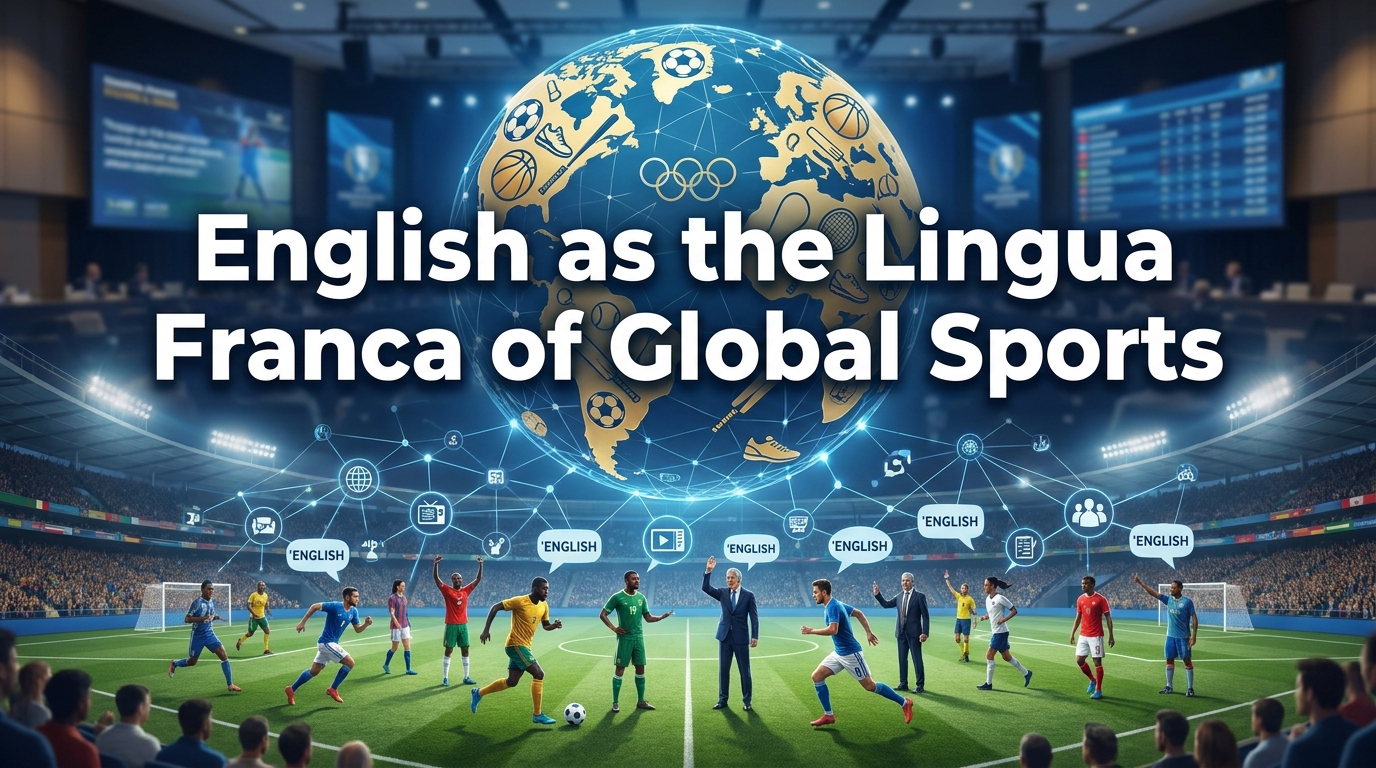
English as the Lingua Franca of Global Sports
by: Azhar Ahmad, Research Scholar English Linguistics & Literature. Lahore Leads University.

Introduction
Nexus between English and sports is undeniable, English and sports are two of the most powerful forces on the earth, bringing people together from different countries, for instance in a football match, an umpire from France, striker from Argentina, and goalkeeper from China all need to talk and most of the time they use English language to communicate. Despite the fact that the physical act of playing a sport transcends linguistic barriers, the globalized business, administration, and media of modern athletics rely entirely on a common tongue. English has cemented itself as the international lingua franca, serving as the vital bonding agent holding together international competitions, multinational club dynamics, and worldwide broadcasting. A perfectly executed pass, a buzzer-beating three-pointer, and a photo-finish sprint are all universally understood moments that require no translation. However, the moment the whistle blows, the unifying global power of the English language takes center stage. Whether it is a Brazilian footballer moving to the English Premier League, an international cricket captain facing the press, or a Japanese gymnast conferring with a multinational coaching staff at the Olympics, English has organically become the working language of international athletic competition.
Mediatization of Athletics: From the Pitch to the Press Room
In the modern era of globalized sports, the financial stakes are higher than ever, largely driven by international media coverage and broadcasting rights. Main sporting organizations, from the International Olympic Committee (IOC) to International Federation of Association Football (FIFA), conduct the vast majority of their official administrative duties, press conferences, and regulatory proceedings in English language. Consider post-match media interviews, a player from Argentina might score a winning goal in a European league, but they are immediately required to speak to a global audience. Through international networks like ESPN, Sky Sports, and various global digital platforms, these broadcasts default to English language. The language transforms into a tool that allows fans from Lahore to Los Angeles to feel connected to the narrative of the game, in addition, sports journalism relies on English language to establish a standardized global narrative. However local dialects and regional languages are vital for regional engagement, international sports news agencies such as Reuters, AFP, and ESPN broadcast the majority of their content in English language. This creates a shared lexicon of terminology that allows fans worldwide to debate statistics, player performance, and tactical tones using the equivalent terms.
Multinational Dressing Rooms and Tactical Execution
On the field, the need for a common language is even more pressing. The professionalization and commercialization of sports have led to hyper-internationalized leagues. Modern club teams are veritable melting pots of different nationalities. It is entirely common to find a dressing room comprising a French striker, a South Korean midfielder, a Nigerian defender, and an Argentine goalkeeper, all being led by a Spanish-speaking coach. How do these diverse groups communicate effectively during a high-pressure match? In these scenarios, English is the most practical and frequently used working language. Instant communication on the pitch can make the difference between victory and defeat. Tactical instructions, defensive calls, and shouts for the ball must be universally understood by everyone in a fraction of a second. Coaches often use a standardized, English-centric set of sports terminology to convey their tactical concepts and game plans. This linguistic standardization ensures that every single member of the squad understands their responsibilities, movements, and defensive duties. Without a shared language, the implementation of complex tactical systems such as high pressing in football or the pick-and-roll in basketball would be infinitely more challenging.
Administrative and Diplomatic Standard
Behind the scenes, the globalization of sports requires heavy international diplomacy and administration, which almost exclusively takes place in English language. International federations draft their rulebooks, conduct disciplinary hearings, and hold their annual general assemblies in English language. When bidding for the right to host mega events like the FIFA World Cup and the Olympic Games, organizing committees must present their proposals in English language. The bidding process itself is a highly competitive diplomatic endeavor where fluency and precision in English can significantly influence the perception of a host country’s competency and inclination. In addition, the rules and officiating of global sports are largely regulated by international governing bodies that operate in English language. Umpires and match officials from diverse linguistic backgrounds are trained and assessed using standardized English terminology, this ensures consistency in how rules are interpreted and applied across the world, maintaining the integrity and fairness of international competitions.
Bridging the Gap: English Education for Elite Athletes
Because of the undeniable correlation between language proficiency and the overall success of an international athletic career, many national sports organizations and educational institutions have begun integrating English instruction into their athlete development programs. Competing at the elite level requires much more than physical prowess and technical skill; it demands the ability to seamlessly interact with coaches, referees, teammates, and medical personnel worldwide. Some academic studies have even highlighted a positive correlation between advanced English proficiency and optimal performance in elite athletes, as clear communication naturally fosters better collaboration, trust, and tactical understanding within a team environment. However, the journey to achieving linguistic proficiency presents distinct challenges for athletes, who often must balance rigorous physical training schedules with language acquisition. Consequently, specialized language curricula are frequently designed for sports students and professionals. These programs focus heavily on practical communication, sports-specific terminology, and media interactions rather than academic literacy. By engaging with collaborative learning environments such as team discussions, scenario simulations, and sports-related podcasts athletes can more easily break down these daunting communication barriers.
Cultural Context: Balancing Lingua Franca with Cultural Respect
While the adoption of English as the lingua franca of global sports has undeniably facilitated international collaboration and growth, it is crucial to recognize the linguistic and cultural dynamics that come into play. A shared language promotes communication, but it should not erase the rich cultural identities of athletes and fans from diverse backgrounds. Effective communication in international sports requires a high degree of cultural sensitivity. Coaches, analysts, and sports managers must be mindful that while English serves as a necessary medium for instruction, athletes are navigating cultural nuances. What might seem like a straightforward, blunt instruction in English could be interpreted very differently by an athlete whose native culture values indirect or highly polite communication. Therefore, cross-cultural communication skills are increasingly recognized as an essential competency in modern sports management. Professionals in the global sports sector are encouraged to develop not just a grasp of the English language, but also an understanding of the cultural backgrounds of the individuals they work with. This sensitivity helps sports leaders adapt their coaching styles and psychological motivation strategies to align with the cultural contexts of their teams, ultimately unlocking their athletes’ full potential.
English in Fan Culture and Digital Engagement
The influence of English extends far beyond the athletes and administrators; it heavily shapes the global fan experience and digital sports culture. With the rise of social media platforms, international fan bases interact across geographic and linguistic borders like never before. English acts as the bridge that allows a fan in Lahore to debate a cricket match with a fan in London or Sydney. Global sports forums, YouTube analyses, and fan-led discussions largely operate in English, allowing for a worldwide exchange of ideas, banter, and commentary. Iconic phrases, slogans, and player nicknames often originate in English and are subsequently adopted by global audiences, unifying diverse crowds under a shared sporting culture. Furthermore, global fantasy sports platforms, digital gaming communities (such as FIFA, NBA 2K, and various esports titles), and merchandise sales rely on English to cater to their massive, worldwide audiences. The widespread use of English allows international leagues and franchises to market themselves effectively in new, previously untapped territories, further driving the commercialization and global reach of the sporting industry.
Role of Technology in Overcoming Barriers
Despite the widespread use of English, language barriers inevitably arise in the world of sports. Differences in accents, nuances in dialect, and varying levels of fluency can sometimes lead to miscommunications in fast-paced environments. To bridge these gaps, modern sports organizations are increasingly utilizing technology. Real-time translation tools, multilingual support staff, and localized digital content help ensure that critical information reaches everyone who needs it. During press conferences, interpreters and advanced translation technologies are regularly employed to allow athletes to express themselves comfortably in their native tongues, while still ensuring that the global media audience receives the message in English. Moreover, sports science and analytical research which is fundamentally vital to modern athletic training is largely published in English. Sports practitioners globally use English to access international literature, analyze foreign coaching methodologies, and study the latest research on injury prevention and performance optimization. This widespread accessibility allows for a rapid, global exchange of knowledge, elevating the standard of sports across the world.
The Future of Sports Communication
As the global sports industry continues to deepen its international reach, the role of English as a lingua franca is likely to become even more entrenched. The interconnectedness of modern athletics characterized by international tours, multinational leagues, and global tournaments dictates the ongoing necessity of a common, accessible language. However, the future of global sports communication lies in a balanced approach. The ideal sporting environment embraces English as a practical, administrative, and tactical tool for global collaboration, while simultaneously celebrating and respecting the diverse cultural and linguistic identities of the individuals involved. Sports education will continue to evolve, with a growing emphasis on teaching not just vocabulary, but also the intercultural competencies required to thrive in a multicultural environment. By equipping athletes, coaches, and administrators with the right linguistic and cultural tools, the global sports community can minimize misunderstandings, foster stronger team dynamics, and continue to unite the world through the power of athletic competition. Ultimately, while English provides the structural framework and the common vocabulary of global sports, the heart and soul of athletics remain universal. A shared language brings the world to the starting line, but it is the courage, discipline, and passion of the athletes that truly cross the finish line. As international sports continue to grow, English will remain the vital conduit that brings people together, ensuring that the drama, thrill, and camaraderie of the game are shared and celebrated by all of humanity.
Conclusion
English has undeniably established itself as the lingua franca of the global sports world. Driven by the commercialization of athletics, international media coverage, and the rise of multinational team rosters, the English language serves as the vital bridge connecting athletes, fans, and administrators across the globe. While it acts as an indispensable tool for tactical instruction, international diplomacy, and global fan engagement, the true universality of sports lies in the physical and emotional language of competition itself. By combining a practical, English-centric communication framework with a deep respect for cultural diversity, the global sports industry can continue to thrive, breaking down barriers and inspiring millions across the planet.