June’s Bloodstained Calendar: Pakistan’s Daughters Are Dying — How Many More Must We Bury Before the Nation Runs Out of Excuses?
Pakistan’s Daughters Are Dying, and the Nation Is Running Out of Excuses

June’s Bloodstained Calendar: Pakistan’s Daughters Are Dying — How Many More Must We Bury Before the Nation Runs Out of Excuses?
By Samra Athar Kakakhel (Resident Editor Peak point Spain)
Overseas Pakistani | Human Rights Defender
Pakistan’s Daughters Are Dying, and the Nation Is Running Out of Excuses
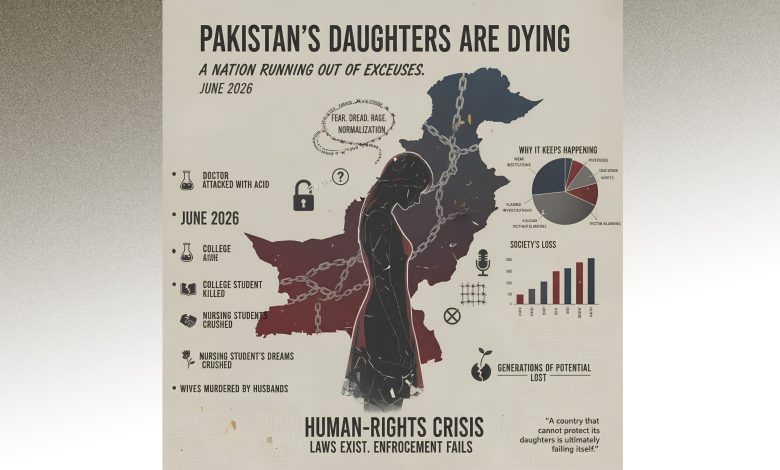
Just ten days into June 2026, and Pakistan has already witnessed enough brutality against women to fill an entire year’s worth of mourning. A young doctor attacked with acid while serving humanity. A college student in Jhang allegedly subjected to horrific violence before losing her life. A nursing student in Dera Ghazi Khan whose dreams were extinguished before she could even begin her professional journey. Reports of wives being murdered by husbands who once stood before God, family, and society and vowed to protect them. And countless other stories that will never trend on social media, never make the front page, and never receive prime-time attention because their victims were ordinary women whose suffering is treated as ordinary too.
Every headline tells us what happened. Few ask why it keeps happening. Every tragedy generates temporary outrage. Few generate permanent change.
And every time another woman is attacked, raped, burned, beaten, stalked, murdered, or buried, society rushes to debate everything except the root cause.
The discussion quickly turns into statistics, politics, regional rivalries, family honour, social media narratives, and eventually the familiar phrase that appears whenever women speak about violence:
“Not all men.” Perhaps not.
But when women cannot walk safely to school, college, hospitals, workplaces, markets, bus stops, parks, or even within their own homes, then the problem is no
longer about individual men. It is about a system that repeatedly fails women while demanding that they remain patient, cautious, silent, and forgiving.
As a woman, I read these headlines and feel fear. As a mother, I read them and feel dread.
As a writer, I read them and feel rage.
As a human-rights activist, I read them and see something even more terrifying: a society becoming dangerously accustomed to violence against women.
That normalization may be the greatest crime of all.
The acid that scarred Dr. Mahnoor’s body was not merely a chemical substance. It was the physical manifestation of a mindset that believes women can be punished for existing, working, succeeding, rejecting, speaking, or simply exercising their basic human rights. Acid attacks are among the most cruel forms of violence imaginable because they are designed not only to hurt but to erase identity, confidence, and dignity. They seek to transform a woman’s face into a lifelong reminder of someone else’s hatred.
Similarly, the horror surrounding the Jhang case cannot be viewed in isolation. Every allegation of sexual violence carries with it a larger question: why do so many perpetrators believe they can get away with such crimes? Why do survivors often fear reporting abuse more than abusers fear committing it? Why do families worry about “reputation” while criminals worry only about avoiding arrest?
The answers are uncomfortable.
Because sexual violence does not thrive merely because criminals exist. It thrives when institutions are weak, investigations are flawed, trials are delayed, witnesses are intimidated, and survivors are subjected to suspicion rather than support.
A society that questions victims more aggressively than perpetrators creates fertile ground for future crimes.
Then comes the tragedy of the nursing student in Dera Ghazi Khan—a young woman whose ambitions, education, and future were stolen before they could fully blossom. Behind every murdered woman lies a future that society rarely counts. We count bodies. We do not count the patients that doctor would have treated, the children that teacher would have educated, the lives that nurse would have saved,
the books that writer would have written, or the contributions those women would have made to their country.
When a woman is killed, society loses far more than a single life. It loses generations of potential.
Yet despite the endless cycle of violence, Pakistan does not suffer from a shortage of laws. The Constitution guarantees equality and protection. Laws against rape, acid violence, domestic abuse, harassment, and honour-based crimes exist. Legislative reforms have been introduced over the years after public pressure and national outrage. The real question is not whether laws exist.
The real question is whether they are enforced with the urgency, seriousness, and consistency required to save lives.
For too many families, justice remains painfully slow.
For too many survivors, the legal process becomes a second form of punishment. For too many perpetrators, consequences remain uncertain.
And uncertainty is the greatest friend of criminality.
No woman should need extraordinary courage simply to attend university, pursue a career, travel alone, reject unwanted attention, or return home safely. These are not privileges. They are rights.
Yet millions of Pakistani women continue to navigate daily life with a mental checklist of precautions that men rarely have to consider.
Do not walk alone.
Do not travel late.
Do not trust strangers.
Do not trust acquaintances. Do not trust relatives.
Do not attract attention.
Do not speak too loudly. Do not be too ambitious. Do not be too independent. Do not be too visible.
From childhood, girls are taught strategies for survival while boys are rarely taught accountability with the same intensity.
And then society acts surprised when violence continues.
The burden of prevention has been placed on women for generations. The burden of accountability must finally be placed on perpetrators.
This is not a women’s issue. It is not a feminist issue.
It is not a political issue. It is a human-rights crisis.
Every acid attack is a human-rights violation. Every rape is a human-rights violation.
Every domestic murder is a human-rights violation.
Every forced marriage, honour killing, assault, harassment case, and act of gender-based violence is a human-rights violation.
The international conventions Pakistan has pledged to uphold, the constitutional promises it has made to its citizens, and the moral values it proudly celebrates all demand the same thing: protection of human dignity.
Yet dignity remains a luxury for far too many women.
What makes these crimes even more heartbreaking is the predictability of the public response. Outrage erupts. Hashtags trend. Television debates multiply. Politicians issue statements. Promises are made. Investigations begin.
Then another case arrives. And another.
And another.
The cycle repeats while families bury daughters.
Somewhere tonight, a mother will check whether her daughter reached home safely.
Somewhere a young woman will share her live location with friends before entering a taxi.
Somewhere a girl will think twice before reporting harassment because she fears being blamed.
Somewhere a survivor will remain silent because she believes nobody will believe her.
And somewhere another predator will be calculating the chances of escaping justice.
This is not merely a failure of law enforcement. It is a failure of culture.
A failure of institutions. A failure of education.
A failure of collective conscience.
History will not judge us by how loudly we celebrated Women’s Day, nor by the speeches delivered at conferences, nor by the slogans painted on banners.
History will judge us by whether Pakistani women could live without fear.
It will judge us by whether daughters could dream without danger.
It will judge us by whether justice reached victims before grief consumed their families.
June 2026 should not be remembered merely as another month of horrifying headlines.
It should become a turning point.
A moment when society finally stopped asking women to be more careful and started demanding that perpetrators be held accountable.
Because every woman whose life is stolen leaves behind more than a crime scene.
She leaves behind unanswered questions. Broken families.
Unfinished dreams.
And a nation forced to confront a painful truth:
A country that cannot protect its daughters is ultimately failing itself.
And every day we delay meaningful change, the price is paid in women’s lives.