Court Victory, Government Promises, Still No Solution: PMDC Faces Questions Over Doctors’ Future
Nadeem Tanoli
Islamabad: A major controversy has erupted between Foreign Medical Graduates and the Pakistan Medical and Dental Council (PMDC), as thousands of doctors claim that their careers are being blocked because of new policies introduced after they had already started or completed their medical education.
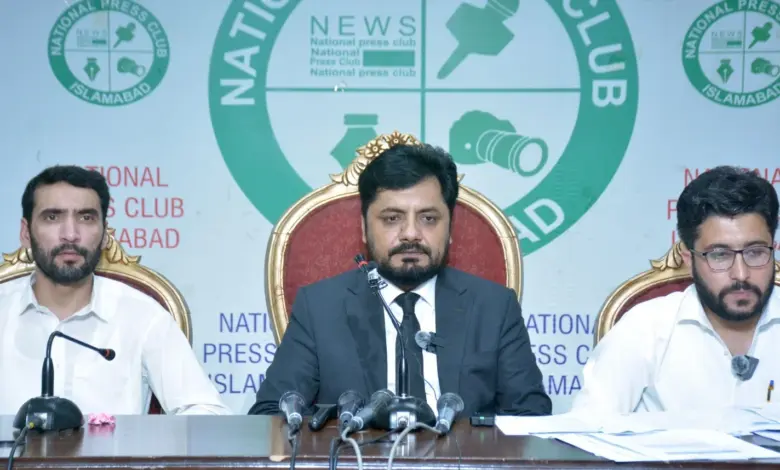
In a strong statement during a press conference at the National Press Club, Dr Asif Afridi, Secretary General of Pakistan International Human Rights Movement UN Geneva and spokesperson for Foreign Medical Graduates, said the issue has become a serious human rights concern. He warned that Pakistan’s image could be affected if the future of thousands of young doctors remains uncertain.
Dr Asif Afridi said these students are Pakistani citizens who studied abroad and returned with the intention of serving people in Pakistan. He questioned why medical graduates were being pushed away instead of being supported. He said medical professionals should not be judged because of political problems between countries.
“The priority should be Pakistan and humanity. Medical service has no borders,” Dr Asif Afridi said while demanding that the authorities resolve the issue instead of creating more difficulties for young doctors.
The dispute involves around 1200 graduated doctors and more than 4000 medical students who studied in foreign universities, including institutions in Afghanistan, Kyrgyzstan and China. The graduates claim that their future has been affected by PMDC notifications issued on 8 September 2025 and 31 July 2026.
According to Foreign Medical Graduates, many students joined these universities years before the new rules were announced. They say they selected institutions that were listed and accepted according to the information available from PMDC at that time.
Dr Asif Afridi and other FMG representatives argue that students who enrolled before the new policy should not be punished because of later changes. They say a new law or policy should apply to future admissions, not students who had already spent years studying abroad.
The main demand of the graduates is simple: they want permission to appear in the National Registration Examination (NRE) and complete the registration process according to previous rules.
The graduates say they are not afraid of examinations. They want a chance to prove their medical ability. Dr Waqas Akbar, President of Foreign Medical Graduates Afghanistan, said students are not avoiding the NRE exam and only want permission to participate.
The controversy became stronger after PMDC introduced requirements that affected some foreign medical graduates. According to FMG representatives, the policy stopped some graduates from appearing in NRE and receiving Provisional Registration Medical Practice (PRMP).
The graduates say many of them had already completed their education before the notification. They claim they enrolled in 2016, 2017 and 2018 when their universities were available on PMDC information lists and they received necessary permissions before going abroad.
The matter reached the Peshawar High Court, where affected graduates challenged the policy. Dr Waqas Akbar said the court ruled that students who were already enrolled or graduated before the notification should not be affected by the new policy.
Advocate Abdul Rahim Wazir also raised legal questions about the PMDC notifications. He said the main issue was whether an administrative order could be applied backward to students who had already started their education years earlier.
He said students spent millions of rupees on their medical education and returned to Pakistan expecting registration according to existing rules.
Advocate Abdul Rahim said the issue was not only about students but about thousands of families. According to him, around 5000 families are connected with these doctors and students, and their careers and dreams are now uncertain.
Dr Asif Afridi said the matter has also been raised internationally. He stated that FMGs may approach international human rights organisations, including Amnesty International and UN Human Rights platforms, if the issue remains unresolved.
The FMGs also rejected claims that all foreign universities were poor quality institutions. They questioned why universities were allowed earlier if students were later blamed for studying there.
Dr Adnan, former President of AFMG, questioned why students were allowed to join universities if those institutions were already considered unacceptable. He asked why such universities were placed on approved lists in the first place.
The graduates also highlighted examples of doctors who studied from similar institutions and are now working as professors in Pakistan. They mentioned doctors such as Dr Jan Zeb, Assistant Professor at HMC Pediatrics, and Dr Zahid, Associate Professor in Neurosurgery at LRH, as examples of foreign educated doctors serving in Pakistan.
FMG representatives also questioned why some graduates from the same universities received opportunities while others faced restrictions. Dr Waqas gave an example of classmates who studied together, graduated together and applied together, but some received PRMP while others did not.
The graduates further argued that some foreign educated doctors have passed international examinations, including pathways connected with global medical organisations, and questioned why they are not allowed to appear in Pakistan’s own licensing examination.
The FMGs have demanded withdrawal of the disputed notifications, protection for students who enrolled before the policy change, permission to sit in NRE and completion of registration without discrimination.
The group has appealed to the President of Pakistan, Prime Minister, Federal Health Ministry, Parliament, PMDC, judiciary and human rights organisations to intervene and find a permanent solution according to law.
The dispute now remains a major challenge for thousands of young medical professionals who say they only want one opportunity: the right to appear in the examination and prove themselves.