

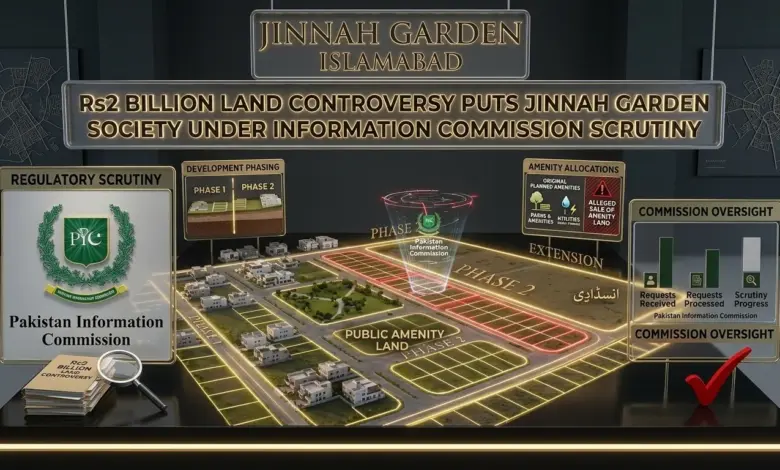
Islamabad: The Federal Employees Cooperative Housing Society (FECHS), widely known as the Jinnah Garden Housing Scheme, has come under renewed attention after an audit observation referred to the alleged illegal conversion and sale of nearly 200 kanals of land reserved for public facilities in Jinnah Garden Phase I.
The land has been valued at approximately Rs2 billion. The matter surfaced in proceedings before the Pakistan Information Commission, which has also directed the society to provide requested records in one case and issued a show cause notice to its secretary in another matter over non-appearance and failure to file a written response despite repeated notices.
Separately, the Islamabad High Court has allowed verified affectees to be impleaded in ongoing proceedings and has permitted the society to issue transfer, allotment and possession letters to verified applicants, subject to legal requirements and the final outcome of the case. The court has ordered that the process be completed within one month.
The developments are significant for people who have been waiting for plots, possession documents and clear information regarding the affairs of the society.
The Rs2 billion land issue was mentioned in an order passed by the Pakistan Information Commission on October 6, 2026, in Appeal No. 5857-07/26, Awillia Rayn versus Federal Employees Cooperative Housing Society.
In its order, the Commission referred to an audit report concerning the accounts of certain public bodies, including the Punjab Government Employees Housing Authority, for the year 2024-25. The report contained an observation regarding the alleged illegal conversion and sale of around 200 kanals of land earmarked for public amenities in Jinnah Garden Phase I.
Land reserved for public amenities is meant for facilities serving residents. Any allegation regarding its conversion or sale raises questions about the use of such land, approvals granted for any change, and whether the public interest was safeguarded.
The audit observation is not a final determination of criminal wrongdoing. However, the Pakistan Information Commission treated the matter as relevant to transparency and public accountability while deciding the information request.
In the October 6 order, the Commission rejected the society’s objection that it was not a public body within the meaning of the Right of Access to Information Act, 2017.
The Commission noted that FECHS is a cooperative housing society registered under the Cooperative Societies Act, 1925. It held that under Section 2(ix)(h) of the Right of Access to Information Act, 2017, a non-governmental organisation or body registered under any law may fall within the definition of a public body for the purposes of the Act.
The Commission also turned down the society’s plea that the applicant could not seek information because he was not a member of the society.
It clarified that information falling within the definition of public records cannot be denied merely on the ground that the requester is not a member. Citizens have the right to access such information under the law, subject to lawful exemptions.
The Commission observed that public records include information relating to policies, transactions, acquisition and disposal of property, public expenditure, allotments, licences, contracts and agreements made by a public body.
The appeal was partially allowed. The Commission directed the secretary of the society to provide the information sought under Serial Numbers 1 to 10 within ten days, while excluding personal information of society members and any other information protected by law. The order specifically noted that personal details, including CNIC information, cannot be disclosed where the law protects such information.
In a separate order dated October 22, 2026, the Pakistan Information Commission issued a show cause notice to the secretary of FECHS in Appeal No. 6066-09/2026, Aimen Malik versus Federal Employees Cooperative Housing Society.
According to the order, the applicant appeared before the Commission, but no representative of the society attended the hearing. The Commission recorded that notices had been issued to the society’s secretary on September 18, 2026, and October 7, 2026. Despite these notices, the society neither submitted a written reply nor sent any representative to appear before the Commission.
The Commission then issued a show cause notice to the secretary under Section 20(1)(f) of the Right of Access to Information Act, 2017. The secretary was asked to explain why proceedings should not be initiated and why a fine should not be imposed for failure to appear before the Commission.
He was also directed to submit the required information or a written response before the next hearing. The matter was fixed for November 11, 2026.
The non-appearance has raised questions about the society’s response to formal notices, particularly when affectees are seeking information linked to their property and legal rights.
Another key development came from the Islamabad High Court on October 1, 2026, in Criminal Original No. 73 of 2023, Muhammad Yamin versus Kamran Ali Cheema and others.
The court allowed applications seeking the addition of further applicants to the proceedings. It held that earlier directions issued in the related judgment dated May 11, 2022, could be relied upon by other persons affected by their non-implementation. The applicants were consequently allowed to become parties to the proceedings.
During the hearing, counsel for the society stated that the management was prepared to address the grievances of the petitioners. The society submitted that claims would be processed and possession delivered in accordance with the established seniority list and applicable regulations after completion of legal formalities.
The court modified earlier restrictions that had restrained the society from issuing allotment letters, transfer letters or changing the status of plots.
Under the modified order, the society has been permitted to issue transfer, allotment and possession letters strictly in favour of verified petitioners and affectees, subject to completion of legal requirements and the final outcome of the proceedings.
The court also addressed the issue of pending payments. It directed that if any legitimate dues are outstanding against an affectee, the society must communicate the amount immediately. The affectee will then be required to deposit the amount within seven days of receiving the demand.
After payment, the society must deliver possession immediately. The entire exercise has to be completed within a maximum period of one month.
The court directed the society to file a comprehensive compliance report on November 11, 2026. It also ordered the general secretaries of the respondent societies, who were present in court, to appear in person on the next date of hearing.
The order further recorded that the earlier direction freezing the society’s bank accounts had already been recalled and withdrawn through an order dated September 15, 2026, in Review Application No. 06/2024.
Mr Munir Ahmad, Advocate High Court, is representing affected allottees and pursuing legal proceedings aimed at securing information, transparency and implementation of their rights.
According to information provided by the legal team of the affectees, Mr Munir Ahmad and his colleagues have been filing information requests under the Right of Access to Information Act, 2017, and seeking official records from the Capital Development Authority and the Registrar Cooperative Housing Societies.
Their efforts also include proceedings before the Pakistan Information Commission and relevant courts for obtaining information regarding allotments, land matters and the society’s obligations towards affected members. The legal team has obtained certified copies of the relevant orders for use in further proceedings.
Mr Munir Ahmad has emphasised the need for accurate official information so that affectees may understand the actual status of their cases and take appropriate legal steps.
The October 6 decision of the Pakistan Information Commission is important because it states that the society cannot refuse lawful information requests only on the ground that the applicant is not a member. The October 22 show cause notice also indicates that bodies covered by the law are expected to respond to Commission notices and provide information as required.
The matter has brought three issues to the fore: the audit observation about alleged conversion and sale of 200 kanals meant for public amenities, the society’s handling of information requests, and the delay faced by affectees awaiting plots and possession.
The Rs2 billion audit observation calls for clarity on how the land was allegedly converted and sold, who approved such decisions, where the land is presently recorded, and whether any public facilities were affected.
The society is also expected to explain why requested information was not provided within the legal time and why its secretary did not appear before the Pakistan Information Commission despite notices.
For the affectees, the Islamabad High Court’s order provides an opportunity for progress, but the relief is confined to verified petitioners and affectees and remains subject to the final decision of the court, the seniority list and completion of legal formalities.
The orders do not establish that any named person has been convicted of corruption, nor do they finally prove that the alleged land conversion and sale were illegal. The audit observation and pending proceedings remain subject to further process, and the society and officials concerned are entitled to respond.
Even so, the latest developments have increased pressure on FECHS to produce records, clarify its position and comply with judicial directions.
With the next proceedings before the Pakistan Information Commission and the Islamabad High Court scheduled for November 11, 2026, attention is now on whether the society will provide the required information and complete the possession process within the court-mandated period.
For those waiting for clarity about their investments and plots, the demand remains focused on disclosure of records, explanation of land transactions, compliance with court orders and delivery of possession to every verified affectee entitled to receive it.



One Comment