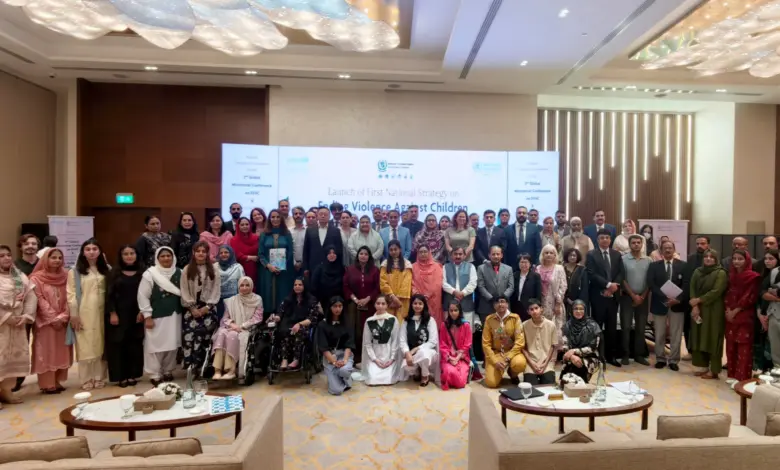
ISLAMABAD: Pakistan’s Ministry of Human Rights and the World Health Organization (WHO) on Wednesday launched the country’s first National Strategy to End Violence Against Children (2026–2031), aiming to strengthen prevention and protection for 120 million children across the country.
The strategy was launched at the National Preparatory Consultation for the 2nd Global Ministerial Conference on Ending Violence Against Children, scheduled to be held in Manila, the Philippines, in November. The two-day consultation, organised by the Ministry of Human Rights in collaboration with WHO and UNICEF on October 14-15, brought together more than 100 participants, including experts, federal and provincial authorities, development partners, civil society representatives, youth organisations and children.
According to the strategy, up to eight in 10 children in Pakistan, or 80 per cent, experience violent discipline. It says one in 16 children aged 12 to 17 who use the internet face technology-facilitated exploitation or abuse. The document also states that 840,000 children aged 10 to 17 have ever been married, 8.6 million children are engaged in child labour, and more than 57 per cent of children under five are not registered with a civil authority, increasing their vulnerability to violence and restricting access to protection and essential services.
The consultation is also reviewing Pakistan’s progress on pledges made at the previous Global Ministerial Conference held in Bogotá, Colombia, in 2024. Participants are discussing practical solutions and measurable action to address violence against children.
The national strategy seeks to build a coordinated system for prevention, protection, response, recovery, reintegration and justice for every child, irrespective of social or economic background. It focuses on multiple forms of violence, including violent killing, physical violence, sexual violence, psychological violence, child neglect, and technology-facilitated violence, exploitation and abuse.
The strategy notes that the risk of violence, including exploitation, early marriage, trafficking and child labour, is disproportionately high among vulnerable groups such as displaced children, migrant children and children living in informal or poor urban settlements.
The initiative is based on the principles of the Convention on the Rights of the Child and the INSPIRE framework, an evidence-based package developed by 10 international agencies under WHO leadership. INSPIRE includes seven strategies that have helped reduce violence against children in many countries by addressing laws, norms, safe environments, caregiver support, financial stability, response services and life skills.
Speaking at the launch, Girl Guide Qurat Ul ain Safdar Khan said every child in Pakistan should be able to grow up without fear.
“I stand before you today as a Girl Guide with a simple hope: that every child in Pakistan can grow up without fear. For many children, fear is part of everyday life. It may be bullying at school, punishment that causes pain and humiliation, harassment, or threats on a phone screen. Most children face abuse from someone they know and trust. Some children are forced to work. Some others are forced to marry during their childhood. No child should have to choose between suffering in silence and being afraid to speak. We often hear that children are the future, but our childhood is happening now. The safety and protection we deserve and the support we need cannot wait until we grow up,” she said.
Secretary of the Ministry of Human Rights Abdul Khalique Shaikh termed the launch a significant milestone.
“Today’s launch of Pakistan’s first National Strategy to End Violence Against Children is a significant milestone in our efforts to establish a comprehensive and coordinated national framework for strengthening prevention, protection and response across relevant sectors and institutions. This strategy is just the beginning. Success will be measured by our actions and our ability to save children from violence,” he said.
Parliamentary Secretary for Human Rights Saba Sadiq said the Government of Pakistan, under the leadership of Prime Minister Shehbaz Sharif, was committed to strengthening child protection.
“Ending violence against children requires effective policies, strong institutions and collective efforts to safeguard their rights, dignity and future,” she said.
UNICEF’s Deputy Representative a.i. in Pakistan, Jennifer Melton, said the message from children that violence is still considered discipline was particularly important.
“Because it tells us that ending violence is not only about responding after harm occurs. It is about prevention. It is about supporting parents and caregivers. It is about safe and positive learning environments. It is about addressing harmful social norms. And it is about ensuring that children know their rights and know where to seek help,” she said.
WHO Representative in Pakistan Dr Luo Dapeng said ending violence against children was central to public health.
“Any form of violence against a child is a direct attack on our future. The consequences of violence can extend far beyond immediate injury. They can affect a child’s mental health, development, education and relationships, and continue to influence health and well-being into adulthood. Pakistan can count on the support of WHO to advance your commitment to end violence against children, in all its forms, and for every child, no matter where they live or who they are,” he said.
According to WHO, one billion children globally experience physical, sexual or emotional violence every year, causing lifelong physical and mental health impacts. It says a child dies every five minutes as a result of violence, while such deaths and the long-term harm caused by all forms of violence against children are preventable.