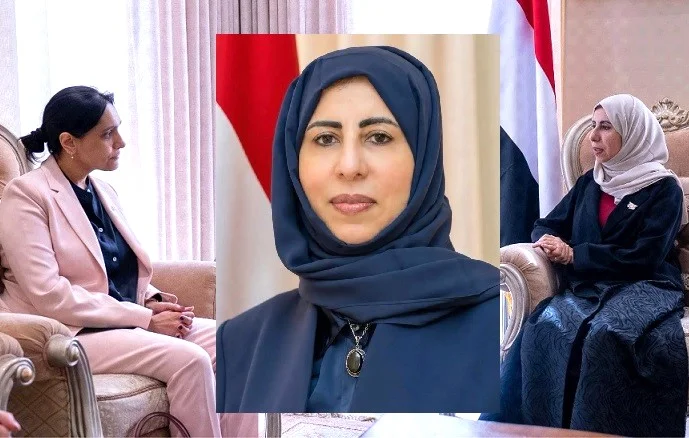
Aden/Yemen: Monitoring Desk — Yemeni Foreign Minister Afrah Al-Zouba has said that the restoration of state institutions and the placement of all weapons under government authority are essential for durable peace in Yemen.
In an interview with Asharq Al-Awsat published on October 8, 2026, Al-Zouba said Yemen’s stability was directly linked with regional security and the safety of international shipping, particularly through the Bab al-Mandab Strait.
She said the Yemeni government had entered a new phase focused on restoring the state and ending the control of the Houthi militias, after repeated efforts at de-escalation failed to deliver a lasting settlement.
According to the foreign minister, peace remains an option, but any political settlement must preserve the unity of the Yemeni state and must not allow the Houthis to keep independent weapons or political authority outside state institutions.
Al-Zouba said the government’s aim was to restore constitutional institutions and ensure that decisions on war and peace rested only with the state. She said the issue was not merely about sharing power among political parties, but about re-establishing state authority.
The minister said Yemen’s security was connected to the security of neighbouring countries and international trade routes. She urged the international community to convert its support into practical programmes that strengthen the Yemeni government’s military, maritime, economic and humanitarian capabilities.
She described Saudi Arabia as Yemen’s main strategic supporter, citing its broad political backing. She also said the government was receiving growing international support, particularly from the United States, the United Kingdom, the European Union, Japan and members of the United Nations Security Council.
Al-Zouba called for stronger implementation of UN Security Council Resolution 2216, especially the arms embargo. She said action was needed against weapons suppliers, financiers, smugglers and intermediaries involved in supply networks.
Speaking about areas retaken by the government from the Houthis, she said the main priorities included restoring security, activating civilian administration, paying salaries of public employees, rehabilitating infrastructure, reconstruction, the return of displaced people and revival of economic activity.
She rejected revenge and collective punishment, stressing that civilians living in areas under Houthi control remained the responsibility of the Yemeni state. She said safe return and amnesty would be available under established procedures.
Referring to the Houthi militia attack on Aden airport on October 7, 2026, Al-Zouba termed it a terrorist attack targeting civilians. She called for accountability, stronger protection for civil aviation and steps to prevent civilian infrastructure or flights from being used in support of military activities.
The foreign minister said the political process remained open, but any settlement must restore constitutional government and equal citizenship, and must not legitimise an armed authority operating parallel to the state.