LAHORE: The National AI Hub for Maternal, Newborn and Child Health (MNCH) at the Lahore University of Management Sciences (LUMS) has signed a Memorandum of Understanding with the Office of Artificial Intelligence Punjab to promote the responsible use of AI in public-sector healthcare and health priorities across the province.
The collaboration is aimed at linking Punjab’s emerging provincial AI agenda with the research and implementation expertise available at LUMS. Under the arrangement, both sides will focus on practical AI applications that can improve health-system decision-making, assist healthcare providers and strengthen public-sector service delivery.
The initiative will give importance to approaches that are suitable for the local context and backed by evidence.
The signing was attended by Punjab Minister for Health and Population Khawaja Imran Nazir, Advisor to the Chief Minister on AI and Special Initiatives Ali Dar, Secretary Office of AI Punjab Ahmad Rajwana, LUMS Provost and Acting Vice Chancellor Dr Tariq Jadoon, and National AI Hub for MNCH Director and Principal Investigator Dr Maryam Mustafa.
The partnership forms part of the National AI Hub’s broader engagement with provincial governments and development organisations.
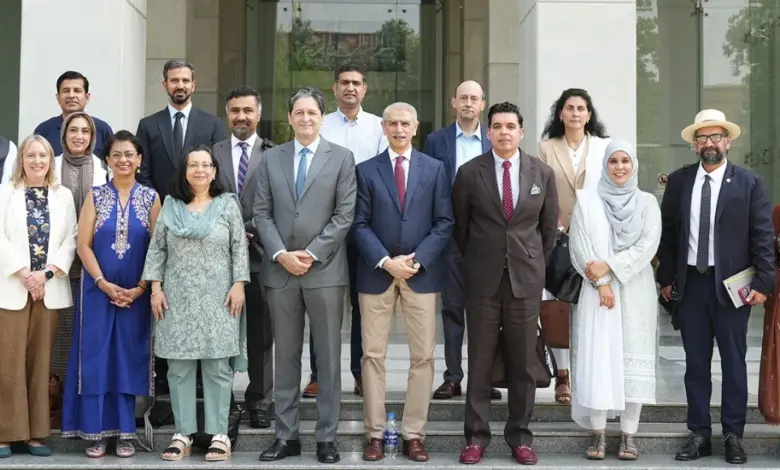
Separately, a high-level delegation of the Gates Foundation visited the Hub at LUMS to review its work on AI and public health and to discuss possible areas of collaboration. The delegation included Dr Anita Zaidi, President, Gender Equality, and Dr Kalpana Kochhar, Interim President, Global Policy and Advocacy, along with other senior representatives of the Foundation.
During the discussions, participants examined how AI research could contribute to better health outcomes and more equitable access to healthcare.
The National AI Hub has also formalised a partnership with the Government of Sindh and Aga Khan University (AKU) to advance AI-enabled risk-stratification models, clinical decision-support systems and voice-assisted tools for frontline maternal and child healthcare providers.
These collaborations seek to explore how AI-based applications can support healthcare workers and improve care for women, newborns and children across Pakistan.