Nabeel Saad Khan
Think about what it takes for someone to walk into a police station after being violently assaulted, get a medical exam, and wait around for the legal system to do its job. Or imagine a family trying to move forward after a murder, putting all their trust in the courts to make things right. Too often in Pakistan, that trust gets broken. The accused walks free not because they were innocent, but because the investigation was so poorly handled that it created reasonable doubt. For the victim, that is a second blow. You survive the worst night of your life, only to watch the system built to protect you fall apart when it matters most.
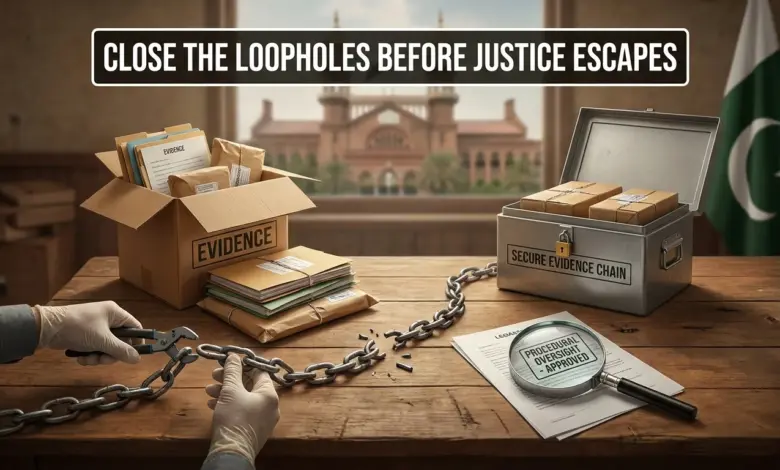
This happens all the time in severe cases like murder, rape, robbery, or kidnapping where sentences carry ten years or more. Courts end up acquitting the accused because the prosecution presents evidence full of loopholes. The mistakes are rarely high-level legal debates. They are basic, avoidable errors. Police pack evidence parcels wrong. The chain of custody breaks somewhere along the line. Documents are missing or filled out late. Forensic samples sit around for days before someone finally brings them to the lab. Charge sheets under Section 173 of the Code of Criminal Procedure go to court half-finished.
Under criminal law, the prosecution has to prove its case beyond a reasonable doubt. So when investigators mess up the handling of evidence, that doubt works in favor of the suspect. The person on trial gets the benefit of every mistake the police made. In the end, the victim gets hurt twice. First by the person who committed the crime, and then by a system that was supposed to deliver justice but could not even keep track of its own paperwork.
We see this scenario play out all the time. Courts keep bringing up how sloppy police investigations are ruining cases and driving down conviction rates. Charge sheets end up missing critical information, forensic evidence gets stored poorly, and standard procedures get ignored. Over time, that destroys public faith in both the police and the judiciary. It creates this feeling that if you have money or influence, the legal system protects you, while a regular citizen looking for justice is left out in the cold. When people stop fearing consequences, crime ends up without any real deterrent.
To be fair, the issue isn’t a lack of commitment from the officers. Most of them are dealing with awful working conditions, drowning in massive caseloads, and trying to handle far too many files with very limited resources. The real problem comes down to the quality of the investigation work and a lack of specialization when dealing with serious offences. Basic procedural blunders like failing to maintain a clear chain of custody, improper sealing and documentation of evidence, or sloppy site plans can wreck even the strongest case. Any experienced legal mind will spot those mistakes at first glance and tear the whole thing down. Until those basic technical errors are fixed, good cases will keep falling apart in court.
One obvious fix is raising standards for whoever runs major criminal investigations. Requiring at least a bachelor’s degree for serious cases makes a lot of sense. A degree doesn’t automatically make someone a great investigator, of course, but it gives them a much better handle on legal procedures, evidence rules, and paper trails.
Another option, something provincial governments could set up pretty quickly, is hiring experienced criminal lawyers to oversee police investigations. Ideally, these would be people who have spent five to fifteen years working serious criminal cases in court and actually know where police work tends to fall down. To be clear, the lawyer wouldn’t replace the investigating officer. They’d just step in to supervise. That means checking how evidence gets gathered and documented, making sure the chain of custody stays solid, looking over memos and parcels, and catching weak spots before the final challan is completed. Finding these common procedural mistakes while the investigation is active is much better than having them pop up months or years later in the middle of a trial.
Closing up procedural loopholes is really just basic common sense for the legal system. When a case falls apart over a technicality, prosecutors lose, victims miss out on justice, and public trust in both the police and courts takes a huge hit. High-profile mistakes caused by poor investigative work ruin the department’s image. On top of that, getting solid convictions helps deter crime over time because people actually see the legal system working the way it should.
Nobody is trying to add another layer of useless red tape to the mix. It is simply a request for expert help in the exact places where it is desperately needed. Serious crimes demand thorough investigative work, because a sloppy investigation brings down the entire justice process. By recruiting better-educated police officers and linking cases to seasoned criminal lawyers to oversee them, it becomes much easier to lower instances of double jeopardy for victims, protecting them instead of putting them through a broken system.
People often say that justice delayed is justice denied. But when small mistakes that could have been avoided stop justice from being done, it feels even worse than a simple delay. It becomes an outright abandonment of justice for everyone involved. Fixing these basic issues is how the whole criminal justice system becomes professional and truly reliable.
Nabeel Saad Khan (Swati) is a final-year student of the five-year BS LLB programme at Hazara University, Mansehra. Alongside his studies, he has been practising criminal law for the past four to five years in the Mansehra courts. He belongs to Baffa and has conducted extensive research on criminal procedure, investigation practices, and related judgments in Pakistan.