Islamabad: The United Nations Development Programme (UNDP) in Pakistan hosted Ms Li Shuyin, Deputy Director General of the China International Centre for Economic and Technical Exchanges (CICETE), during a high-level visit aimed at reinforcing cooperation and taking forward sustainable recovery efforts in Pakistan.
The visit brought together officials and representatives from CICETE, the Embassy of the People’s Republic of China, the Government of Pakistan, the Government of Balochistan, UNDP and community members who have benefited from China-funded initiatives in Balochistan. Their participation helped shape discussions around progress achieved so far, lessons learnt, possible expansion of the existing portfolio and priorities for future collaboration.
The new phase follows the first phase of China-supported post-flood livelihood recovery assistance in Balochistan, which reached more than 162,000 people. It builds on an existing recovery platform under UNDP’s wider flagship Flood Recovery Programme, bringing together partnerships, experience and investments to assist flood-affected communities across the province.
“2026 marks the 75th anniversary of the establishment of diplomatic relations between China and Pakistan. Over the past 75 years, our two countries have stood together through challenges and shared a deep bond of mutual trust, friendship and mutual support. As China and Pakistan move to build an even closer China-Pakistan Community with a Shared Future in the New Era, cooperation in improving people’s livelihoods has remained an important part of our enduring partnership. This project is a concrete example of China-UNDP-Pakistan cooperation in advancing resilient recovery and sustainable development. It also reflects our shared commitment to promoting the vision of a Community with a Shared Future for Humanity and advancing the four Global Initiatives proposed by President Xi Jinping. CICETE stands ready to work with the relevant Chinese authorities, UNDP and other partners to develop more ‘small and beautiful’ livelihood projects across Pakistan, so as to bring greater tangible benefits to the people of both countries and contribute to peace, stability, development and prosperity in the region,” said Ms Li Shuyin.
The Post-Flood Agricultural Restoration (One Town One Product) Project is supported by the Government of China through the Global Development and South-South Cooperation Fund and is being implemented in partnership with the Government of Balochistan. The project will support around 110,000 people in seven districts through agricultural and livelihood assistance, technical training, targeted support for 3,000 women and institutional capacity-building.
“Climate shocks can erase years of progress in a matter of hours. Recovery should therefore go beyond replacing what was lost; it should reduce the vulnerabilities that put lives and livelihoods at risk in the first place,” said Dr Samuel Rizk, Resident Representative, UNDP Pakistan. “Through our partnership with the Government of China and the Government of Balochistan, we are connecting immediate livelihood support with skills, stronger local capacities and greater economic opportunity, so communities can recover today and face future shocks with greater resilience.”
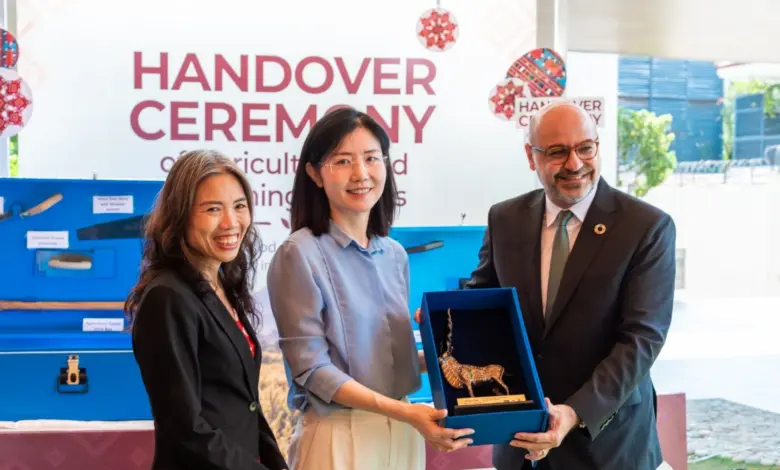
During the ceremony, agricultural and kitchen gardening toolkits were handed over, marking an important step in implementation. The toolkits are intended to support agricultural productivity and create income-generating opportunities for women through kitchen gardening.
Together, the two phases of China-supported post-flood recovery assistance are expected to benefit more than 300,000 people across Balochistan. The support is aimed at helping communities restore livelihoods, improve agricultural productivity and build resilience against future climate shocks.
At the event, Bibi Zainab and Bibi Naz, two women from flood-affected communities in Balochistan who received support under the initiative, spoke about how the floods had disrupted their families’ livelihoods. They said the assistance was helping women in their areas restart productive activities, add to household incomes and move towards greater economic independence. They also pointed to remaining needs, including support to rebuild homes, restore livestock and regain the stability their families had lost.
“Pakistan values the continued support of the Government of China for post-flood recovery and UNDP’s role in translating this partnership into practical support for flood-affected communities in Balochistan. Initiatives such as this are helping restore livelihoods, create economic opportunities and support longer-term resilience,” said Mr Mahmood Ahmed Khan, Joint Secretary, UN Desk, Economic Affairs Division, Government of Pakistan.
Ms Batool Asadi, Chief Foreign Aid, Planning and Development Department, Government of Balochistan, said women were often among those most affected when floods disrupted livelihoods and household incomes.
“Women often face the consequences of floods most acutely, particularly when livelihoods and household incomes are disrupted. Enabling them to resume productive work and access income-generating opportunities is essential to a lasting recovery. We greatly value the Government of China’s continued assistance and UNDP’s close partnership with the Government of Balochistan in helping affected families rebuild their lives with greater resilience,” she said.
The visit also featured a tree-planting ceremony and an exchange with members of the UNDP Country Team. CICETE and UNDP reaffirmed their commitment to strengthening the partnership and exploring further opportunities to support inclusive economic development, resilient livelihoods and sustainable recovery in Pakistan.