By: Muhammad Saddam Tahir
Student Quaid e Azam university Islamabad
Pakistan’s economy has returned to growth, but not yet to the investment needed to sustain it. It’s growing faster its stock market has surged inflation is coming down and its finance minister was on TV recently touting what he called the best GDP figure in four years. If you walk up to anyone at the finance ministry and ask them where the new factories are where new capacity is being built where Pakistan’s next decade of jobs are going to be created you’re going to get a far less valid answer. This is the hidden story in the Economic Survey 2025-26 an economic rebound that looks good in the numbers but isn’t yet being built on anything solid.
The number itself is real. This year Pakistan’s GDP expanded by 3.7 percent over FY2025 which itself saw growth of 3.18 percent. That still fell short of the government’s target of 4.2 percent but the pace has certainly picked up.
Agriculture is growing 2.89 percent aided by some much needed strength in the livestock sector and a significantly better wheat and sugarcane harvest this year.
Industry grew 3.51 percent this year led by an impressive comeback in large scale manufacturing which rose to 6.11 percent after actually contracting a year ago. And as always services dominated expanding by 4.09 percent and now accounting for almost 58 percent of the economy’s output.
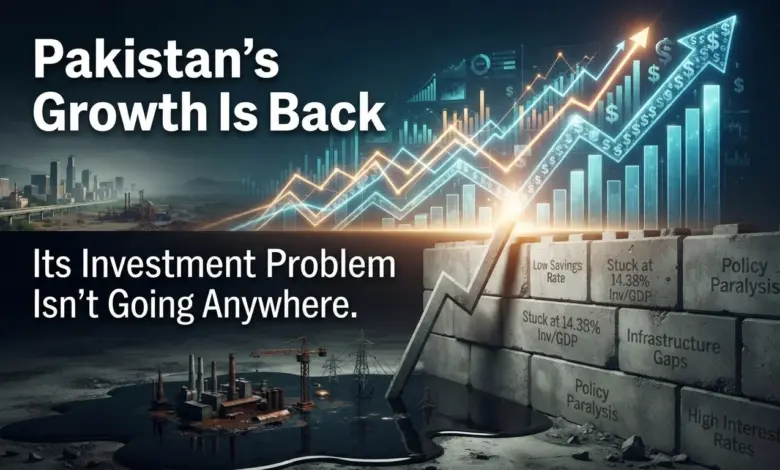
But if you peer a layer beneath the headline the image starts to look less inviting. The all important investment to GDP ratio perhaps the best single measure of whether an economy is building capacity for future growth remained stuck at 14.38 percent this year not much different from where it has been stucked for years and way below Pakistan’s regional neighbours offer practical lessons. Bangladesh used export-oriented manufacturing, particularly garments, to create jobs and integrate into global markets. India has attracted investment through infrastructure, industrial policies and its large domestic market, while Vietnam combined trade openness, foreign investment and export-focused manufacturing to build strong global supply chains. Pakistan cannot copy these models, but it can learn from their common approach: creating a predictable business environment, improving infrastructure and skills, and directing investment toward productive, export-oriented sectors. National savings fared even worse coming in at just 14.13 percent of GDP. What all of this translates to in real terms is that Pakistan is not saving or investing enough in its future to grow any faster than this over any significant time.
That’s the real argument. Growth without investment is borrowing from tomorrow not building today. We can sustain a year or two of growth on remittances that are flowing in strongly inflation that has come down to more reasonable levels and a relatively stable exchange rate and there is genuinely a lot to praise in the Economic Survey on these counts.
But an economic rebound driven largely by a jump in consumption and a return in imports rather than new factories and new capacity being added is not sustainable.
While private investment rose a respectable 12.8 percent this year and total investment as measured on a quarterly basis increased from 13.2 percent of GDP in Q1 to 14.7 percent in Q3 of FY2026 an encouraging sign general government investment barely grew rising a insignificant 3.9 percent. However when investment was needed most to help stimulate it the government’s capacity expansion efforts went in the other direction.
The government could counter that they had their hands tied. The year saw flooding a war in the region and an oil price shock that compelled the State Bank to increase interest rates to 11.5 percent. Under such circumstances, maintaining the fiscal deficit to just 0.7 percent of GDP while increasing the primary surplus to 3.2 percent should not be considered insignificant.
Stability was prioritised.
It’s a valid argument it’s hard to invest effectively amid chaos.
But stability is merely the point of departure not the destination itself. When your investment to GDP ratio remains in the mid 14 percent range at a time when the country requires a level close to 20-25 percent just to raise living standards and accommodate millions of young Pakistanis entering the workforce annually it is a problem not an afterthought. With private borrowing for new expansion discouraged by high interest rates and public development spending shrinking when it should be leading this reliance on borrowed money to fill savings gaps is an unsteady approach to building a future economy.
The Economic Survey points to the right priorities, but the problem is implementation. The government should broaden the tax base by bringing more undertaxed sectors into the tax net, reduce energy-sector inefficiencies through cost-reflective pricing and targeted subsidies, and link URAAN Pakistan to measurable annual targets for investment, exports and productivity. Each reform should have a responsible institution, a clear timeline and publicly reported progress. Without these mechanisms, reform programmes risk remaining slogans rather than drivers of investment.
This offers a precious window of opportunity and a short one at that to convert stability into sustained investment before the next crisis.
It is after all only a matter of time until the next flood or global disruption comes. The real question is whether Pakistan will use this downtime to finally build something, Pakistan does not have an investment problem because it lacks plans; it has one because too many plans fail to translate into predictable policies, productive investment and sustained implementation. The current recovery offers an opportunity to change that. The government should use it to broaden the tax base, fix energy-sector distortions, improve the business environment and make URAAN Pakistan measurable through clear targets and timelines. If these reforms are implemented consistently, higher growth can become sustainable. If not, the recent recovery may prove temporary rather than transformative.