By Raja Mohsin
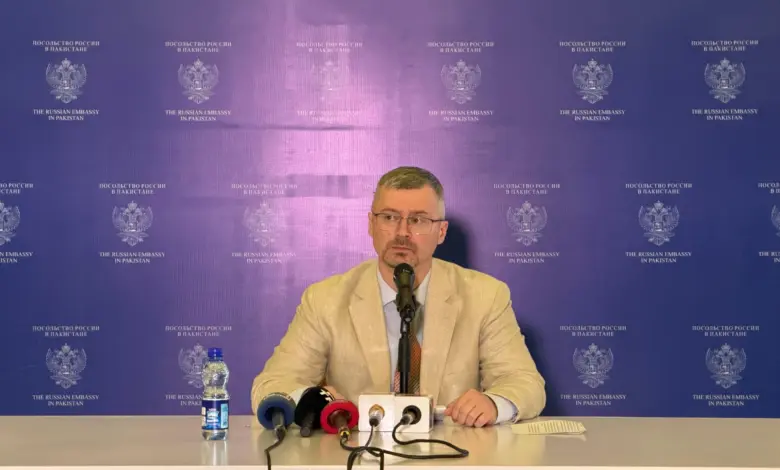
ISLAMABAD, Oct 1, 2026: Russian Ambassador to Pakistan Albert Khorev on Thursday accused Kyiv and its Western supporters of prolonging the Ukraine conflict, alleging that Moscow was facing a “full-scale hybrid war” involving military, economic, legal and information dimensions.
Addressing a briefing in Islamabad on the situation in Ukraine, Ambassador Khorev said 54 countries were providing military and financial support to Ukraine, including the United States, Canada, European Union countries, Japan, South Korea, Australia and New Zealand.
He claimed that Western military assistance to Ukraine exceeded $160 billion between 2022 and 2025, while NATO countries were providing intelligence and communications support and assisting in the planning and use of military operations.
The ambassador also alleged that Ukrainian attacks had caused damage to Russian infrastructure and resulted in civilian casualties. These figures and allegations were presented by the Russian side and were not independently verified at the briefing.
On sanctions, Mr Khorev said Western restrictions had failed to achieve their intended objective of undermining Russia’s economy. He claimed that the sanctions had also adversely affected European and developing economies by disrupting logistics, energy supplies, financial access and technology.
He said the restrictions were accelerating the development of alternative financial and trading mechanisms within BRICS, the Shanghai Cooperation Organisation and ASEAN, including greater use of national currencies.
The Russian envoy also criticised Western measures against what he described as Russia’s “shadow fleet”, arguing that the term was not contained in the 1982 UN Convention on the Law of the Sea.
He alleged that more than 200 civilian vessels had been targeted by Ukrainian shelling in the Black Sea and Sea of Azov in 2026, including 96 vessels flying foreign flags. He said 12 vessels were targeted in 2025 and one each in 2024 and 2023.
Khorev maintained that Russia’s actions in the region were defensive and aimed at eliminating threats to international maritime navigation.
On the legal front, he criticised international mechanisms established in connection with alleged damage caused to Ukraine, including the Register of Damage for Ukraine and the proposed International Claims Commission for Ukraine.
Referring to a June 15 decision of the Permanent Court of Arbitration in The Hague, he said a five-member tribunal had rejected several Ukrainian claims concerning the Kerch Strait, the Sea of Azov and maritime areas around Crimea.
The ambassador also rejected what he described as “disinformation” concerning Ukrainian children allegedly taken to Russia. He referred to a list of 339 children provided by Ukraine during bilateral talks in Istanbul in June 2025, claiming that checks had shown that around half had either never been in Russia, were in Russia with their parents, or had refused to return to Ukraine.
Khorev further accused Kyiv authorities of restricting religious freedoms and putting pressure on the Ukrainian Orthodox Church, alleging that churches and monasteries had been seized and clergy and followers subjected to legal and administrative pressure.
On the prospects for peace, the Russian ambassador said Moscow remained committed to a political and diplomatic settlement of the Ukraine crisis.
He said Russia had supported the resumption of negotiations suspended by Kyiv and remained open to their continuation while taking Russian national interests into account.
Khorev also criticised the United States for increasing sanctions pressure on Russia, saying the move was not conducive to progress towards resolving the Ukraine crisis.
Rejecting concerns about possible Russian aggression against Europe, he said President Vladimir Putin and Foreign Minister Sergey Lavrov had repeatedly stated that Russia was not preparing for military action against Europe.
“We have neither plans nor grounds for this,” Khorev said, adding that Russia had no genuine motive to further escalate the situation with Europe.