Title: AI Won’t Replace You – But Someone Using AI Might
Written by: Tabraiz Hasan
We are breathing in the information age. Data and information have surrounded us since the dawn of humanity, but we have only recently understood their power. Today, we realize that data are more powerful than any bomb or lethal weapon.
In the past, we lacked smart tools for collecting, manipulating, and drawing conclusions from data. We now have many tools that help us gather information from multiple sources, extract insights, and guide future decisions.
Artificial Intelligence, especially Generative AI (GenAI), has become one of the most discussed technologies of this decade. GenAI is rapidly replacing traditional AI. While traditional AI focuses on classifying, analyzing, or recommending existing data, GenAI creates entirely new content—text, images, video, audio, code, and 3D models—based on patterns learned from vast datasets.
GenAI is used more frequently than ever before. It has become a part of our daily workflow. AI tools are incredibly smart and are becoming smarter every day.
However, fear emerges whenever a new technology emerges. The biggest concern is always jobs and professions. A valid question arises.
Is Generative AI replacing professionals?
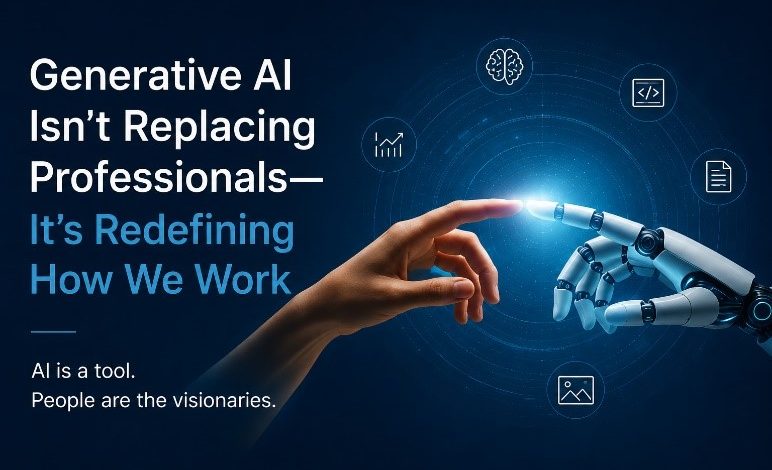
Let us be clear: AI is a tool, not a replacement. History shows that technology rarely eliminates entire professional fields. Instead, it changes the “nature” of the work.
The calculator did not eliminate the need for mathematicians. AI can read medical images and diagnose illnesses; however, doctors and their expertise are still essential. Similarly, Generative AI does not replace skilled professionals; rather, it redefines how they work. AI is a professional’s ally, not a job eater.
GenAI excels in pattern recognition, iterative speed, and cognitive performance. It assists in drafting correspondence, generating meeting summaries, writing code from snippets, and developing new ideas. With AI assistance, many tasks can be completed in less than an hour.
However, AI tools cannot understand the real-world context—workplace politics, ethics, or environmental nuances. They cannot take responsibility for the results. “We must always remain accountable for outcomes.”
Although AI systems are powerful, they are not truly intelligent in the human sense. They rely on patterns learned from existing data and can still:
– Produce inaccurate information
– Lack contextual understanding
– Reflect biases present in training data
– Struggle with complex ethical decisions
This is precisely where human expertise becomes increasingly valuable.
AI has made our work easier. It has automated repetitive tasks, improved the quality and quantity of work, and multiplied productivity. However, human intelligence remains essential for:
– Critical thinking
– Creativity
– Ethical decision-making
– Emotional intelligence
– Strategic planning
– Real-world problem solving
What we are witnessing is a “shift in skills.” Some skills are fading away, while many new ones are emerging, a process as old as humanity itself.
Time is our most precious resource. We are busier than ever, trying to accomplish more in less time than before. GenAI is an excellent solution for time management issues. It does a lot in a limited time, but does not eliminate the human role.
For example, AI can draft a letter, but it is rarely perfect. Human expertise is required to edit and adapt it to specific situations. We cannot blindly trust AI in our daily lives. Every critical decision still requires human intervention and judgment.
We must stop asking:
What can AI do for me?”
Instead, we should ask the following questions:
How can I solve bigger problems with AI as my co-pilot?
This mindset shift transforms AI from a novelty into a multiplier.
Today, the most successful people are those who win the race of technology adoption and use. The future belongs to professionals who learn to collaborate with AI rather than compete with it.
A new category of professionals is emerging.
– AI-assisted developers
– AI-powered analysts
– Prompt engineers
– AI product managers
– Human-AI interaction specialists
Companies are increasingly seeking individuals who can combine technical expertise with AI capabilities.
The question is no longer:
“Can AI do this task?”
The real question is:
“How can humans and AI work together more effectively?”
AI cannot replace professionals.
Professionals who use AI replace those who do not.
Generative AI is not the end of expertise—it is the beginning of “amplified” expertise.
I would love to hear about your experiences.
How are you integrating GenAI into your daily work? What is one workflow that it has transformed for you?Please share your thoughts : tabraiz.hasan811@gmail.com