HEC Calls for Concrete Results in Pakistan-China University Cooperation

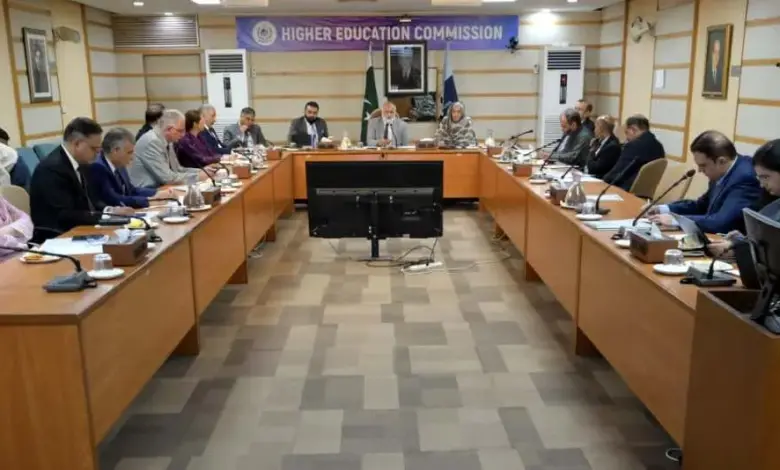
ISLAMABAD, July 29, 2026: Higher Education Commission (HEC) Pakistan Chairman Dr Niaz Ahmad Akhtar has urged Pakistani universities associated with the CPEC Consortium of Universities to move beyond agreements and focus on practical outcomes in academic cooperation with Chinese institutions.
He was chairing a meeting of Pakistani member universities of the Consortium, convened to review progress and set future priorities for strengthening Pakistan-China academic collaboration. The meeting was attended by the Executive Director HEC, senior HEC officials and vice chancellors and rectors from universities across the country.
Director General (Global Engagement/CPEC Unit) HEC Ms Aayesha Ikram briefed the meeting on the Consortium’s progress since its launch in 2017. She said the platform had expanded to 93 Pakistani and 40 Chinese universities.
She highlighted major achievements, including the establishment of six China Study Centres, collaborative research grants, faculty and student exchanges, training and talent development programmes, and stronger institutional linkages between Pakistan and China.
In his keynote remarks, Dr Niaz Ahmad Akhtar said Pakistani universities needed to adopt a more proactive and outcome-based approach in their engagement with Chinese counterparts. Referring to feedback received during his recent visit to China, he observed that although a large number of memoranda of understanding had been signed over the years, more effort was needed to translate them into tangible results.
He called upon universities to prioritise measurable deliverables, including joint and dual degree programmes, collaborative research projects, faculty and student exchanges, innovation partnerships, co-publications and Transnational Education initiatives.
Sharing details of his meetings with Beijing Language and Culture University, Fudan University and the China Association of Higher Education, the HEC chairman identified fresh areas for cooperation. These included artificial intelligence, semiconductors, integrated circuits, biotechnology, public health, cybersecurity, agriculture, green technologies and emerging industries.
He said China’s advancement in technology, higher education, infrastructure and innovation offered important lessons for Pakistan. He encouraged universities to make full use of opportunities available through academic engagement with leading Chinese institutions.
Dr Akhtar also underlined the need for digital transformation in higher education, strengthening China Studies and Sinology programmes, setting up research and training centres, and utilising existing Confucius Institutes and China Study Centres as drivers of deeper academic cooperation.
He further asked universities to benefit from HEC’s Joint, Dual and Double Degree Policy and actively promote research placement opportunities being offered by Fudan University for Pakistani MS/MPhil and PhD scholars.
The meeting ended with a shared resolve to turn Pakistan-China academic partnerships into meaningful collaborations that support research excellence, innovation, human capital development and national progress.