By: Sheba Javed
Student of Quaid i Azam university Islamabad
It is tempting to ask whether a government spending less than 1 percent of its GDP on education does not know better or has no incentive to want better?
In Pakistan, the expected years of schooling for a child starting school is less than for a child starting school in Afghanistan. According to the Human Development Index (HDI), Pakistan’s expected year of schooling stands at 7.9, lower than Afghanistan’s at 10.8. It stands nowhere compared to Bangladesh 12.3, India 13.0, and Iran 14.0. This should be a moment of alarm for a country with a ‘Youth Bulge’; however, it is barely registered in the news.
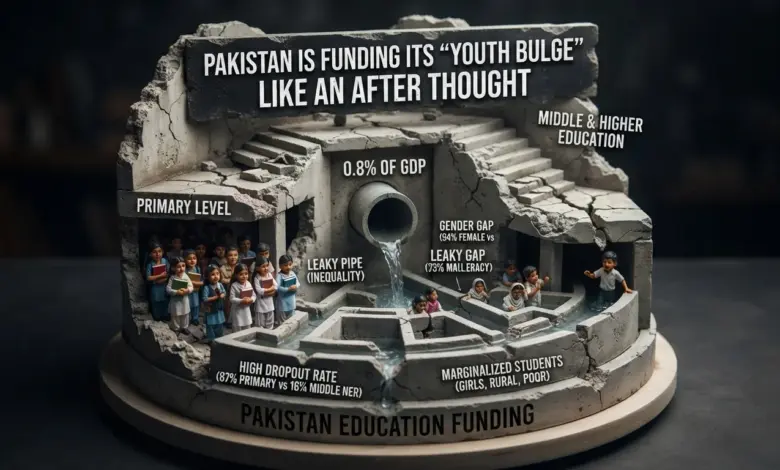
As stated in the Pakistan Economic Survey, education spending fell to just 0.8 percent of GDP in FY2024-25, down from 1.9 percent allocated in FY2019-20. This means Pakistan is now spending less than half of its GDP on education. Even though it is mentioned clearly in the Global Partnership for Education that “Over the past five decades, education has contributed to around 50 percent of global economic growth and helped reduce extreme poverty by approximately 40 percent”. If the incentive for the economy is this large, then why is the spending so underrated in Pakistan?
Educational economists have been stating for decades that Education is not a welfare burden; it is an investment with a return. Pakistan is now sitting with the world’s largest youth population. If done right, this demographic division can lead to rising productivity and income. However, if done wrong, it can lead to a demographic burden. Millions of young people will enter the market without the skills to be productive. Even the Pakistan Economic survey’s own concluding remarks admit that “enhanced public investment in education” is important because this is how youth’s potential “Can be realized”. The gap between the language and actual spending is the real story here. It shows there is no lack of awareness but a lack of will.
This leaky pipe does not even drain evenly. The male Literacy Rate in Pakistan is 73 percent, and the female literacy rate is 54 percent. This is assumed to be progress, but this 19-point gap has only narrowed slightly in recent years. The same is going on with the school attendance: 77 percent for men and 57 percent for women. Male attendance is higher than female attendance in every single province, and this tracks closely with household wealth. Funding and gender problems are not two separate topics; it is one topic because an underfunded system always fails its most marginalized students, and in the case of Pakistan, that means girls, the poor, and rural households.
None of this is unfixable, and none of this requires building an education policy from scratch. There are two things that need to be done. First, restoring the spending back to 2 percent as it originally was. This is just the floor percentage because the education framework for action adopted by UNESCO allocated at least 4 to 5 percent of GDP to education, or at least 15 to 20 percent of total expenditure on education. A recovery of education spending to 2 percent is just a modest decision to at least stop the country from falling any further now.
UNESCO estimates that “out-of-school children and persistent education gaps cost the global economy roughly $10 trillion a year, while getting every child into school could raise future global GDP by more than $6.5 trillion annually”. Thus, education spending is a very essential investment that the government can make and leave a higher impact on future generations.
Secondly, Pakistan should not measure success by how many children start school but by how many finish it. According to the Pakistan Economic survey, the Gross Enrollment Rate (GER) at the primary level in Pakistan is 87 percent, while the Net Enrollment Rate (NER) at the middle level is 16 percent. If enrollment is the only track reported, Pakistan will look like a success story, which the complete numbers show it isn’t. The incentive for the government to evaluate the enrollment numbers is that it is cheap and easy to monitor; however, the retention would require investment in teachers, students, and income support that shows up years later.
Pakistan describes its young generation as future leaders and its greatest economic assets. Well assets need maintenance. Right now, the country needs to invest in the education system because it is the right of every child to get the proper education they deserve and also the need of the economy to develop in the right way.