HEC’s Conditional NOC for Lahore Leads University G-12 Campus Raises Questions

Nadeem Tanoli
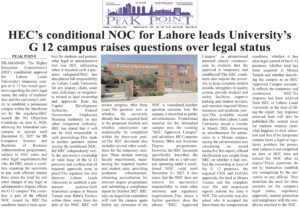
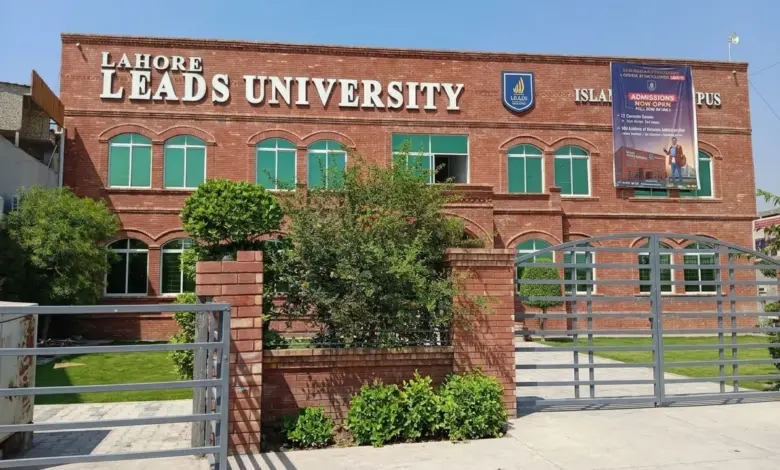
Islamabad: The Higher Education Commission’s (HEC) conditional approval for Lahore Leads University’s temporary campus in G 12 has raised questions regarding the site’s legal status, the safety of students’ fees and the university’s ability to establish a permanent campus within the timeframe set by the regulator.
HEC issued the No Objection Certificate on June 6, 2026, allowing the Islamabad sub-campus to operate until December 31, 2027 for BS Computer Science and Bachelor of Business Administration programmes, subject to HEC rules and other legal requirements.
But why did HEC attach a condition requiring the university to pay each affected student three times the total fee and other charges if any legal or administrative dispute affects the G 12 campus? The condition is part of the official NOC issued by HEC.
The condition raises a basic question for students and parents: what legal or administrative risk was HEC addressing when it required such a payment safeguard?
HEC has also placed full responsibility on Lahore Leads University for any dispute, claim, court case, deficiency or irregularity related to land ownership and approvals from the Capital Development Authority, Federal Government Employees Housing Authority or any other competent authority. HEC has stated that it will not be held responsible in such proceedings.
This leads to another question: before issuing the conditional NOC, did HEC independently verify the university’s ownership or valid lease of the G 12 premises and confirm that all required approvals were in place?
The regulator has also directed Lahore Leads University to establish a permanent purpose-built Islamabad campus at Mouza Tumair near Bahria Enclave within three years from the date of the NOC. HEC will review progress after three years.
The question now is whether the university already has the required land at the proposed location and whether construction can realistically be completed within the three-year period.
The HEC document also includes several other conditions for the temporary campus. These include meeting faculty requirements, maintaining the required teacher and student ratio, providing academic infrastructure, obtaining accreditation for relevant degree programmes and submitting a compliance report by October 2027. HEC says an inspection committee will visit the campus again before any extension of the NOC is considered.
Another question concerns how the campus is described in public advertisements. Promotional material for the Islamabad campus uses the wording “HEC Approved Campus” and advertises BS Computer Science, BBA and Associate Degree programmes.
However, the HEC document specifically describes the Islamabad site as a sub-campus operating under a conditional NOC valid until December 31, 2027. It also states that the NOC does not remove the university’s responsibility to meet other statutory and regulatory requirements.
This raises a further question: does the phrase “HEC Approved Campus” in promotional material clearly communicate to students that the approval is temporary and conditional?
The HEC conditions also require the university to keep complete student records, strengthen its quality system, provide medical and safety facilities, improve parking and student services, and maintain required library resources and academic journals.
The available record also shows that Lahore Leads University issued a circular in March 2026 disavowing an advertisement for admissions to a Multan campus, saying the advertisement was circulating on social media.
For this report, official clarification was sought from HEC on whether it had verified the ownership or lease of the G 12 premises, the required CDA and FGEHA approvals, the land at Mouza Tumair and the complete case file and inspection reports behind the June 6 NOC.
The university was also asked why it accepted the three-times fee compensation condition, whether it has clear legal control of the G 12 premises, whether land has been acquired at Mouza Tumair and whether describing the campus as an HEC Approved Campus accurately reflects the temporary and conditional NOC.
No response had been received from HEC or Lahore Leads University at the time of filing the report. Any response received later will also be published.
The central issue for students remains clear: what happens to their education and fees if the temporary campus faces a legal or regulatory problem, the permanent campus is not completed on time or HEC does not extend the NOC after its expiry?
These questions do not by themselves establish any wrongdoing by the university or any official. They underline the need for clear answers on the campus’s legal status, regulatory approvals, student protection and compliance with the conditions attached to the NOC.