Islamabad: Dr Shahida Rehmani, Member of the National Assembly and Secretary of the Women’s Parliamentary Caucus (WPC), has moved a resolution in the National Assembly reaffirming Parliament’s commitment to safeguarding the dignity, equality and rights of every individual against all forms of workplace harassment and gender-based discrimination.
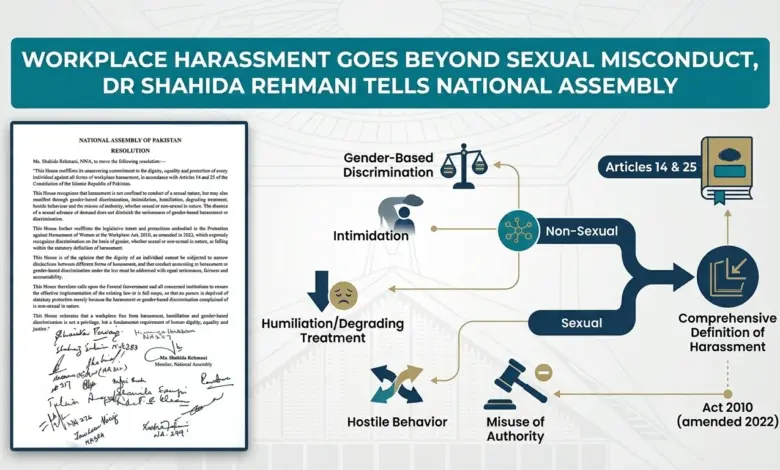
The resolution states that workplace harassment is not confined to conduct of a sexual nature. It may also appear in the form of gender-based discrimination, intimidation, humiliation, degrading treatment, hostile behaviour and misuse of authority, whether sexual or non-sexual.
It reaffirms the legislative intent and protections provided under the Protection against Harassment of Women at the Workplace Act, 2010, as amended in 2022. The law expressly recognises discrimination on the basis of gender, whether sexual or non-sexual, within the statutory framework of harassment.
According to the resolution, the absence of a sexual advance or demand does not reduce the seriousness of gender-based harassment or discrimination. It notes that the dignity of individuals cannot be subjected to narrow distinctions between different forms of harassment, and that all conduct covered by the law must be dealt with equal seriousness, fairness and accountability.
Through the resolution, the National Assembly has been called upon to urge the Federal Government and all concerned institutions to ensure effective implementation of existing legislation in its complete scope. It stresses that no individual should be denied statutory protection merely because the reported harassment or gender-based discrimination is non-sexual in nature.
The move also reflects the wider commitment of the Women’s Parliamentary Caucus to making workplaces across Pakistan free from harassment, intimidation, humiliation and discrimination.
The resolution concludes by reaffirming that a workplace free from harassment, humiliation and gender-based discrimination is not a privilege, but a fundamental requirement of human dignity, equality and justice.