PMDC Accused of Discrimination as Some Unlisted College Graduates Allowed Exams
Inconsistent Policies Jeopardize Careers of Foreign-Trained Pakistani Doctors

109 Pakistani Medical Graduates Stranded as PMDC Policy Reversals Trigger Federal Inquiry
Nadeem Tanoli
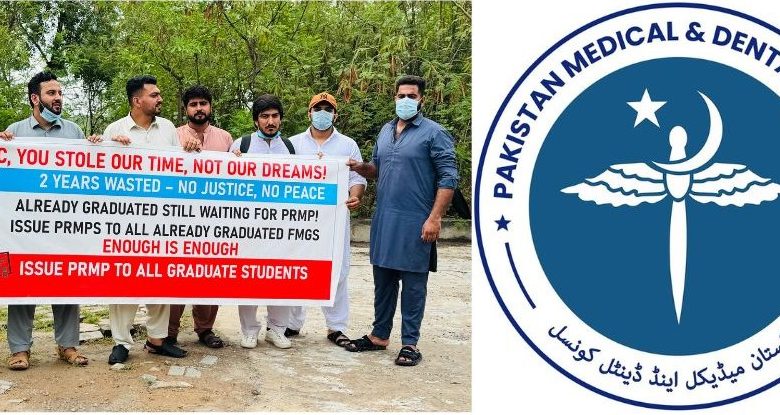
ISLAMABAD: The futures of 109 Pakistani medical graduates from Kyrgyzstan hang in the balance after shifting policies and contradictory actions by the Pakistan Medical and Dental Council (PMDC) left them ineligible to sit for Pakistan’s licensing exam. Their five-year academic journey—initially sanctioned by official recognition—has turned into a bureaucratic dead-end, prompting a parliamentary committee to refer the matter directly to the Ministry of Health, calling PMDC’s conduct a grave injustice.
The students, who began their studies in 2019 at Kyrgyzstan’s Eurasian International University and three other institutions, told the Parliamentary Health Committee that they enrolled under clear rules. At the time, PMDC policy permitted graduates from World Health Organization (WHO)-listed universities to sit for Pakistan’s medical licensing exam. With their universities appearing on those lists, they pursued their degrees with confidence.
However, as their education progressed, so did a wave of regulatory instability in Pakistan. During the COVID-19 era, PMDC was replaced by the Pakistan Medical Commission (PMC), which began issuing multiple categories of recognition lists—green, Category A, and B—sowing widespread confusion among foreign medical students.
In 2022, hope returned when the PMC issued an official pathway recognizing the students’ universities. Under Kyrgyz law, students are barred from migrating during their final semesters, making it impossible to shift institutions. The PMC’s assurance effectively locked them into place under what they believed was legitimate policy guidance from Pakistan.
But in October 2022, the PMC reversed its recognition lists and introduced a new exam-based pathway open to unrecognized institutions. The students adjusted once again, preparing to qualify under this route. However, in 2023, the newly restored PMDC abruptly reinstated the “approved list” requirement, disqualifying all those whose universities were not on the updated registry.
Despite having degrees attested by the Pakistan Embassy and applying for the December 2024 licensing exam, the students were rejected. They discovered that PMDC had allowed candidates from five other unlisted institutions to sit for the exam, while barring them and students from three other similarly placed universities. The sole explanation given: “Your university is not on the list.”
The students countered by presenting documented proof that their institutions were on the WHO list in 2019 and held valid international accreditations, including from the World Federation for Medical Education (WFME) and the Educational Commission for Foreign Medical Graduates (ECFMG).
PMDC, however, told a different story. A senior official described the institutions as substandard, citing an example of one college allegedly operating with just 18 faculty members instead of the required 120. She also claimed the universities were not on the WHO list in 2019 and had only recently come into existence, dismissing the students’ documents as outdated or invalid.
Parliamentary members, including the Minister of Health, expressed greater sympathy for the students. The Minister emphasized that the fault lay not with the students but with PMDC’s repeated policy changes during their course of study. “They can’t change colleges every year,” he noted, criticizing the lack of stability in the regulatory framework.
Other lawmakers questioned the inconsistency of PMDC’s actions—permitting some graduates from unlisted institutions to take the exam while denying others under identical circumstances. The Committee Chairman accused PMDC of perpetrating a “zyadati” (injustice), declaring the regulator’s stance untenable and harmful to the students’ futures.
The case has now been officially referred to the Minister of Health for resolution, bypassing PMDC entirely. The committee also announced it will send a formal letter to the Ministry, seeking urgent intervention and a written timeline for decision-making. Members stressed that the students have already lost valuable time and cannot afford to miss another licensing cycle.
“The Minister will solve this,” the Chairman stated emphatically, as the government moves to break the bureaucratic deadlock that has paralyzed 109 young doctors on the cusp of their careers.