CASS Calls for a Comprehensive and Sustainable Approach to Afghanistan’s Evolving Challenges

Islamabad (peak point).The Centre for Aerospace & Security Studies (CASS) organised a Catalyst Conversation on 17 November 2026 titled ‘Afghanistan, A Decade Ahead: Stability, Fragmentation or Strategic Reorientation? Implications for Pakistan & the Region’. The event examined Afghanistan’s evolving political, security and economic landscape, explored plausible trajectories over the coming decade, and assessed their implications for Pakistan and regional stability. As an independent think tank, CASS regularly convenes such forums to advance informed policy discourse on issues of national and international significance.
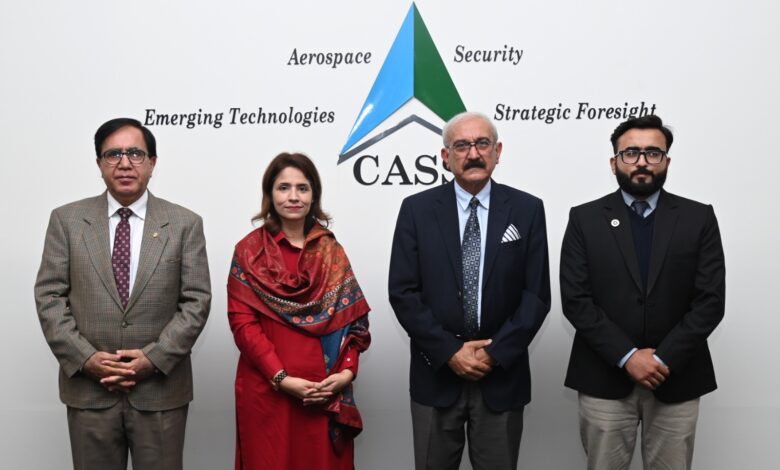
Air Vice Marshal Khawar Hussain (Retd), Director CASS, moderated the session and framed the discussion around the gap between Pakistan’s expectations following the Taliban’s return to power in August 2021 and the subsequent deterioration in bilateral relations. He highlighted persistent security concerns, particularly the threat posed by the Tehreek-e-Taliban Pakistan (TTP), and underscored the need to consider diplomatic, security and regional policy responses within a broader strategic context.
The keynote speaker, Dr Amina Khan, Director of the Centre for Afghanistan, Middle East & Africa (CAMEA) at the Institute of Strategic Studies Islamabad (ISSI), initiated the discussion by examining Afghanistan’s domestic political and security dynamics alongside its regional relationships. She observed that Taliban 2.0 had demonstrated selective pragmatism, prioritising domestic governance and service delivery, particularly through agricultural and economic reforms. Nevertheless, significant shortcomings persist in the areas of human rights and women's rights. She also highlighted gaps in Pakistan's policy approach towards Afghanistan and stressed the need for a comprehensive bilateral framework to address outstanding issues, including security, and economic cooperation. Furthermore, she argued that the Doha Agreement should be regarded as an internationally binding instrument rather than merely a bilateral arrangement, particularly regarding the Taliban's commitment to preventing Afghan territory from being used by terrorist groups against other countries. Drawing parallels with Iran and India's engagement with Afghanistan, she underscored the importance of sustained diplomatic engagement. States, she observed, must learn to coexist with neighbours of different political orientations, as reliance on hard power alone cannot deliver durable solutions.
In his concluding remarks, President CASS, Air Marshal Javaid Ahmed (Retd), underscored the importance of sustained diplomatic engagement with Afghanistan, emphasising the need to account for its evolving political and security landscape. He called for continued intellectual engagement with these issues, reaffirming CASS's commitment to providing a credible and independent platform for discourse on the most consequential security challenges of our time.