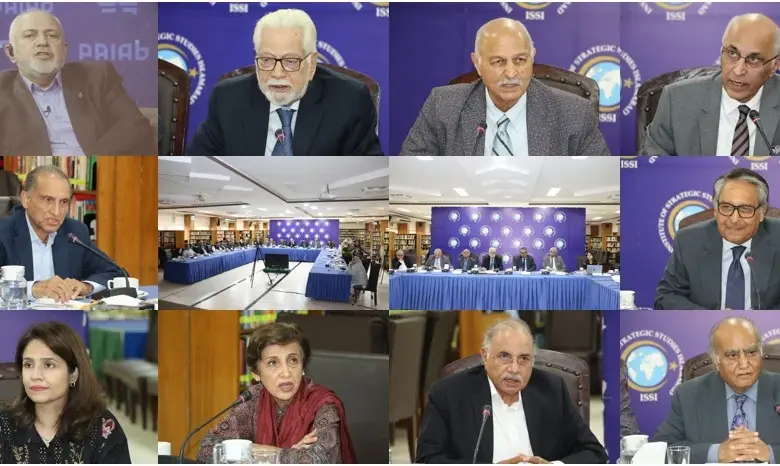
ISLAMABAD: Former Iranian foreign minister Dr Javad Zarif has said that the emerging post-polar world does not automatically guarantee peace and instead places greater responsibility on regional states to pursue dialogue, cooperation and shared prosperity.
“The post-polar world does not give us peace automatically; it gives us greater responsibility. We must move from security against one another towards security with one another, building a regional future based on dialogue, cooperation and shared prosperity,” he said.
Dr Zarif was speaking at a roundtable hosted by the Institute of Strategic Studies Islamabad (ISSI). The event was organised by ISSI’s Centre for Afghanistan, Middle East and Africa (CAMEA) under the Distinguished Lecture Series.
A veteran Iranian diplomat, scholar and academic, Dr Zarif has been closely associated with Iran’s diplomatic engagement on major regional and international issues. He served as Iran’s foreign minister from 2013 to 2021 and played a central role in the negotiations that resulted in the 2015 Joint Comprehensive Plan of Action (JCPOA). He is internationally recognised for his contribution to multilateral diplomacy and international negotiations.
Addressing the roundtable, Dr Zarif said the evolving global order had created both difficulties and openings for regional states. He called for replacing a threat-centred security outlook with a possibility-centred approach rooted in regional ownership, engagement, cooperation and common prosperity.
He said the key question before the international community was not only what kind of world it was entering, but also what kind of future it was willing to build. The future, he argued, was not a fixed destination, but was being shaped by the narratives, institutions, networks and choices of societies.
Reflecting on the region’s experience, Dr Zarif said West Asia had lived through colonialism, partition, sectarianism, occupation, invasion, externally sponsored conflicts, terrorism, sanctions and repeated military aggression. He said the past offered significant lessons on the costs of miscalculation, exclusion, domination and outsourcing security.
However, he cautioned that history could become a prison if societies remained confined to memories of earlier conflicts and grievances. Societies, he said, must face the past honestly in order to recover the possibilities that history had suppressed.
Discussing changes in the international system, Dr Zarif described the present moment as a post-polar world in which power was no longer concentrated in one centre. Instead, he said, it was distributed across regions, societies, markets, technologies, networks and public narratives.
No single state, he maintained, had the ability to control every major outcome, while middle powers and regional states had gained greater strategic agency. Permanent alliances and fixed loyalties, he said, were increasingly giving way to issue-based coalitions and network-based relations. Economic interdependence, technology, information and non-state actors were also playing a growing role in shaping political and security outcomes.
Dr Zarif said this changing environment demanded a new regional political imagination. Security, he stressed, had to become more inclusive because no country could achieve lasting security by creating insecurity for another. He urged states to move from security “against” one another to security “with” one another.
He also spoke at length about his initiative, the Muslim West Asia Dialogue Association (MWADA), describing it as a framework aimed at replacing enmity with amity through dialogue, cultural connections, economic cooperation and, eventually, a regional non-aggression arrangement.
In this context, Dr Zarif underlined Pakistan’s role as an important bridge between West Asia, South Asia and Central Asia. He noted that the wider MWADA framework envisaged the participation of Pakistan, Türkiye and Egypt alongside the Persian Gulf littoral states. He said MWADA should not be seen as a finished or static arrangement, but as an institutional possibility that could develop in line with the needs of participating states.
Referring to Pakistan’s role in facilitating dialogue between Iran and the United States, Dr Zarif appreciated Pakistan’s sincere efforts for diplomacy and de-escalation. He acknowledged Pakistan’s constructive role in bringing the two sides to the negotiating table and said the Islamabad Memorandum of Understanding provided an important framework for dialogue and peaceful resolution of differences.
He also described Pakistan’s diplomatic experience as an asset in handling complex regional dynamics.
Concluding his remarks, Dr Zarif said the past had shown that military superiority alone did not create political legitimacy, sanctions and coercion did not bring stability, and foreign guarantees could not replace regional arrangements.
He urged societies to learn from history without allowing it to dictate the future. He called for a future in which geography was not a sentence, history was not a prison and differences were not used as a justification for permanent conflict. The task, he said, was not simply to predict what comes next, but to build what should come next.
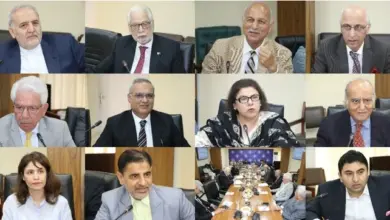
The roundtable was attended by Pakistan’s former foreign ministers, foreign secretaries, ambassadors, senior civil and military officials, leading academics and security analysts.