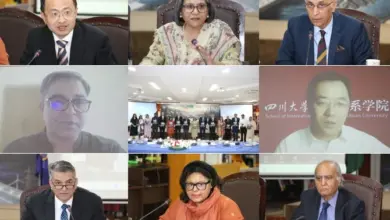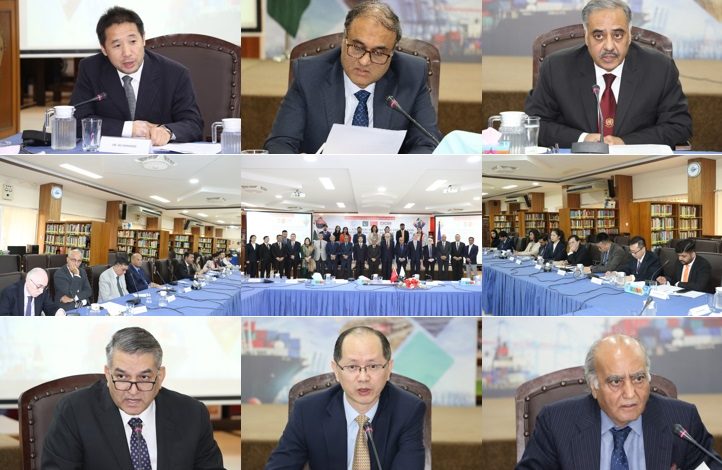
The Institute of Strategic Studies Islamabad hosted the Fourth Pakistan–China Think Tank Forum in collaboration with the China Institutes of Contemporary International Relations, bringing together senior diplomats, scholars and academics from both countries to deepen strategic and practical cooperation amid a shifting international landscape. The CICIR team was led by Dr Hu Shisheng, and discussions placed CPEC Phase II at the centre of future bilateral initiatives.
Director General ISSI Ambassador Sohail Mahmood described the forum as a vital institutional mechanism under the Joint Working Group on International Cooperation of CPEC, serving as an intellectual and policy platform to anticipate challenges and identify paths for the long-term Pakistan–China partnership. He emphasised that CPEC is a comprehensive instrument for socio-economic transformation and regional connectivity, and said Phase II will prioritise industrialisation, technological cooperation, green transition, agricultural modernisation and human resource development while stressing the importance of vocational training and innovation-driven growth.
Ambassador Sohail Mahmood welcomed the Pakistan–China Action Plan 2025–29 and urged timely, concrete outcomes within agreed timelines. He noted that in a world marked by geopolitical competition and economic volatility, the China–Pakistan partnership contributes stability and resilience. He also highlighted the need to align Pakistan’s priorities with China’s global initiatives and urged a forward-looking vision towards the 75th anniversary of diplomatic relations in 2026 and the centenary milestones ahead.
Dr Hu Shisheng reaffirmed the resilience and global relevance of China–Pakistan ties, reflecting on regional developments such as the transition in Afghanistan and wider geopolitical turbulence. He regarded the Action Plan on Building a Closer China–Pakistan Community of Shared Future (2025–2029) and the formal launch of CPEC Phase II as pivotal milestones, and underlined the essential role of think tanks in providing research-based guidance for implementation.
Mr Shi Yuanqiang, Deputy Head of Mission at the Chinese Embassy in Islamabad, highlighted five priority areas for the bilateral partnership including political trust, economic cooperation, people-centred development, security and multilateral coordination. He called on scholars and policymakers to deepen intellectual exchanges and research-driven dialogue to realise the full potential of projects such as CPEC.
Working sessions moderated by Dr Talat Shabbir featured detailed assessments from leading experts. Presenters examined global order shifts, Asia’s strategic resurgence, South Asia’s geostrategic realignment and the stabilising potential of enhanced regional connectivity through CPEC. Contributions from senior diplomats and researchers underscored priorities such as regional peace, Afghanistan stabilisation, energy and industrial cooperation, and leveraging Pakistan’s geographic and demographic strengths for greater people-to-people exchanges.
Dr Talat Shabbir framed the bilateral relationship as a cornerstone of regional stability amid technological disruption and climate and energy challenges, while Ambassador Khalid Mehmood in his vote of thanks reaffirmed mutual trust and the pivotal role of CPEC Phase II in regional economic integration and industrial modernisation.
The forum concluded with a strong reaffirmation of enduring China–Pakistan friendship and strategic partnership. Participants expressed confidence that sustained think-tank engagement will support policy coordination and help translate the vision of a closer China–Pakistan community into tangible outcomes under CPEC Phase II and related initiatives.