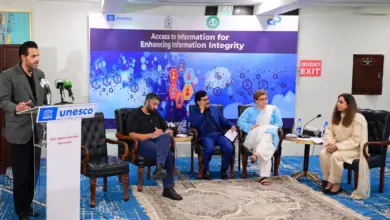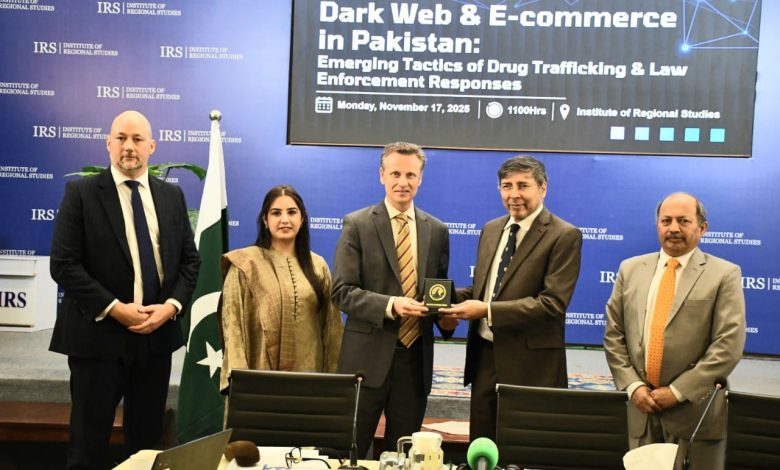
The Institute of Regional Studies convened a special session in Islamabad on Dark Web and E-Commerce in Pakistan to examine emerging tactics of drug trafficking and law enforcement responses. The event, organised by the IRS Cyber Security Program under Ms. Alina Fayaz, brought together diplomats, government representatives and international experts to assess rapidly evolving digital threats and the rise of dark web trafficking.
Ambassador Jauhar Saleem, president of the Institute of Regional Studies, warned that while online platforms create opportunities, their ease of access exposes young people to criminal activity including the online purchase and sale of drugs. He urged urgent investment to strengthen state capacities, train cyber domain specialists and upgrade investigative agencies such as the FIA, stressing that inter-agency collaboration and knowledge-sharing are key to countering sophisticated digital drug-trafficking techniques.
Troels Vester, UNODC country representative, described the Dark Web as a growing, sophisticated enabler of cybercrime that provides anonymity for a widening range of illicit activities. He explained how messaging applications and encrypted channels are being misused for distribution and how criminal networks are adopting e-commerce style operating models, making trafficking more organised and harder for authorities to detect. He emphasised that sellers increasingly use digital payments to evade enforcement and that a coordinated, technology-driven and well-resourced response is essential.
Oliver Gadney from UNODC headquarters highlighted technological tools, investigative methodologies and global best practices for countering dark-net-based crime. He noted the difficulty of tracing online trafficking networks and urged stronger inter-agency cooperation, including measures to disrupt the financial foundations of criminal enterprises. Gadney also underlined the need for law enforcement to adapt continually to fast-evolving digital ecosystems while maintaining compassion toward individuals struggling with drug use.
Ambassador Mansoor Khan, former chair of the UN Commission on Narcotic Drugs, pointed to Afghanistan and Pakistan as major producers and transit routes for opiates that sustain regional drug flows. He warned that educational institutions are increasingly vulnerable and that students have become a major target for distribution networks. Citing alarming figures, he observed that nearly 70 percent of Pakistan’s drug users are under 30, driven by stress, peer pressure and ease of access. He acknowledged the ANF’s efforts but cautioned that established maritime, land and air routes, combined with sophisticated digital networks, continue to enable trafficking.
Concluding the session, Ambassador Saleem reiterated that a holistic approach is required to counter dark web trafficking effectively. He called for stronger border controls, enhanced monitoring mechanisms, public awareness campaigns and coordinated institutional responses that combine technological capability with legal and social measures to protect vulnerable communities and disrupt transnational criminal networks.