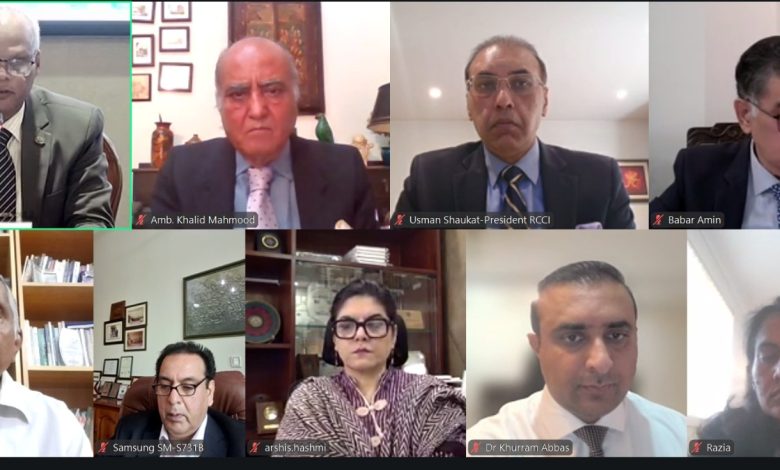
The India Study Centre at the Institute of Strategic Studies, Islamabad, together with the Bangladesh International Institute of Strategic Studies, convened an international webinar on April 20, 2026 to examine the evolving Pakistan Bangladesh dialogue amid the recent political transition in Dhaka and shifting regional dynamics.
The session was jointly chaired by Ambassador Khalid Mahmood, Chairman BoG ISSI, and Major General A. S. M. Ridwanur Rahman, Director General BIISS, and drew participation from former diplomats, academics, policy specialists, business representatives and research scholars. Speakers included Ambassador Babar Amin, Prof. Dr. Moonis Ahmar, Prof. Dr. Arshi Saleem Hashmi, Dr. Usman Shaukat, Dr. Mahfuz Kabir, Dr. Khurram Abbas, Dr. Sufia Khanom, Mr. Raja Amir Iqbal and Dr. Razia Sultana.
Ambassador Khalid Mahmood in his welcome remarks highlighted the growing momentum in Pakistan–Bangladesh relations and recalled historical ties founded on mutual respect and cooperation. He emphasised economic collaboration, institutional linkages and people-to-people contacts as key pillars that can unlock broader sectoral engagement, and underlined a shared commitment to address climate change, food security and sustainable development while advocating revitalisation of SAARC.
Major General Ridwanur Rahman stressed the importance of constructive engagement in an increasingly interdependent South Asia, pointing to persistent political challenges and non-political threats such as climate vulnerability and food insecurity. He urged policymakers to bridge gaps in mutual understanding and to develop pragmatic, actionable recommendations that address sensitive issues with diligence and advance a mutually beneficial partnership.
Dr. Khurram Abbas noted a steady upward trajectory in ties over the past two years, calling this a window for moving beyond symbolic exchanges to substantive cooperation in security, the economy and people-to-people connectivity. He welcomed the collaboration between the two think tanks as timely and meaningful for shaping policy-level dialogue.
On economic cooperation, Dr. Usman Shaukat, Dr. Mahfuz Kabir and Raja Amir Iqbal acknowledged renewed optimism but highlighted structural hurdles to trade expansion. They observed that while leadership aims to raise bilateral trade from roughly USD 1 billion to USD 3 billion within three years, mobility constraints, strict regulatory mechanisms and outdated payment channels persist. The absence of a bilateral FTA or PTA and underuse of multilateral platforms such as SAFTA and the D-8 were cited as impediments, and speakers recommended practical measures including easing visa restrictions, creating joint special economic zones, facilitating digital trade and diversifying export baskets alongside stronger B2B engagement.
Ambassador Babar Amin and Dr. Razia Sultana placed the bilateral relationship in the wider regional context and urged South Asian states to pursue independent regional policies while resisting unilateral agendas of more powerful actors. They called for capitalising on political will in Islamabad and Dhaka to revive SAARC as a platform for regional integration.
Prof. Arshi Saleem Hashmi mapped the security and strategic landscape of South Asia, noting intensifying external footprints and recalibrating policy orientations. She highlighted maritime cooperation potential between Pakistan and Bangladesh and proposed exploring a structured tripartite framework involving China, observing that Beijing’s investments and connectivity initiatives are reshaping regional dynamics and offering smaller states greater strategic space.
Prof. Dr. Moonis Ahmar advanced concrete steps to deepen people-to-people ties such as academic exchanges, on-arrival visa facilities, opening additional consulates, improved maritime transportation and new direct air links that would facilitate greater connectivity between the two countries.
Dr. Sufia Khanom outlined the climate-related challenges facing both states and recommended coordinated plans of action to enhance resilience. The webinar concluded with a vote of thanks from the co-chairs and participants reaffirmed that sustained dialogue and pragmatic cooperation are central to advancing the Pakistan Bangladesh dialogue and delivering tangible benefits to both societies.