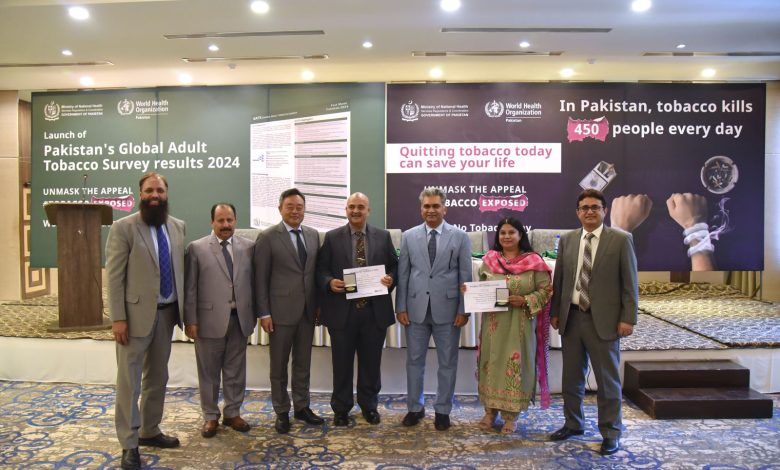
The Global Adult Tobacco Survey 2024 confirms that Pakistan reduced tobacco consumption by 15.7% between 2014 and 2024, reflecting the impact of sustained tobacco control policies under the WHO Framework Convention on Tobacco Control. Despite progress, tobacco use remains at 16.1% of adults aged 15 and above, with an estimated 22.7 million current users, about 163,600 annual deaths, and economic losses exceeding PKR 1,800 billion (around US$6.6 billion).
The nationwide survey, led by the National Institute of Population Studies with the Ministry of National Health Services, Regulations and Coordination, WHO and the CDC Foundation, completed more than 11,000 interviews with a 95.6% response rate. GATS 2024 follows an internationally comparable protocol and provides decade-long trend data to inform Pakistan’s tobacco control planning and monitoring.
Exposure to secondhand smoke fell markedly across measured locations: homes (from 48.3% to 28.8%), workplaces (from 69.1% to 35.9%), restaurants (from 86.0% to 55.2%), public transport (from 76.2% to 45.4%) and schools (from 25.1% to 11.5%), demonstrating important gains in protecting nonsmokers.
At the same time, the survey highlights worrying trends and challenges for tobacco control. Female tobacco use rose slightly by 1.7 percentage points to 5.9%, quit attempts in the past year edged down from 24.7% to 24.1%, and the share of smokers advised to quit during healthcare visits fell from 51.8% to 49.9%. The findings also report that roughly 1,200 children aged 6–15 start smoking every day and that nearly 2 in 5 smokers begin before the age of 10, underscoring the urgency of measures to curb youth uptake.
Since 2014 Pakistan has introduced a package of policy measures to strengthen tobacco control, including higher tobacco taxation during the 2022–2023 fiscal year, larger pictorial health warnings on packaging, a nationwide ban on the sale of loose cigarettes, the National Tobacco Control Strategy 2022–2030, and the establishment of provincial Tobacco Control Cells and Implementation and Monitoring Committees. These steps have contributed to the declines captured by GATS 2024 and form the backbone of ongoing tobacco control efforts.
Health officials and WHO partners emphasised that all tobacco and nicotine products are harmful, and that emerging products such as e-cigarettes, vaping devices and heated tobacco products pose new risks, especially to young people. Secretary Muhammad Aslam Ghauri warned that industry tactics including flavored products and digital advertising require urgent and coordinated policy responses, while WHO Representative Dr Luo Dapeng reiterated global support for Pakistan’s work to protect children and families from tobacco-related harm.
Survey results also point to strong public support for evidence-based measures such as increased taxation, tighter advertising restrictions and expanded cessation services, and many users expressed interest in quitting—signals that can guide future tobacco control programmes and service delivery across Pakistan.
Alongside the GATS presentation, Federal Health Minister Mustafa Kamal met World Bank Vice President for People Mamta Murthi to discuss broader health system priorities, including strengthening primary healthcare, maternal and child health, stunting reduction, telemedicine, and establishing an effective referral system. The Minister highlighted plans for local vaccine production by 2030 and ongoing talks with Indonesia on producing vaccines for thirteen diseases, backed by a newly formulated National Vaccine Policy. The World Bank delegation expressed continued support and invited Pakistan to the Universal Health Coverage Forum 2026.
GATS 2024 offers a clear evidence base for accelerating tobacco control in Pakistan: sustaining taxation and packaging measures, expanding cessation support, protecting young people from novel nicotine products, and aligning health system reforms to reduce tobacco-related illness and economic harm for future generations.