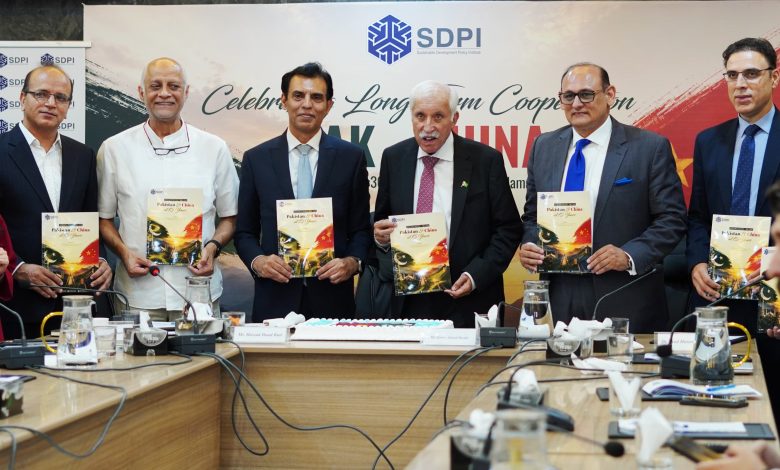
The Sustainable Development Policy Institute launched a report titled “Charting the evolution from CPEC’s first phase to its transformative second phase” as Federal Minister for Investment Qaiser Ahmed Sheikh described the 75-year Pak China diplomatic relationship as an unparalleled model of bilateral cooperation that has endured global upheavals despite persistent bureaucratic hurdles.
Qaiser Ahmed Sheikh highlighted the contrast between China, which lifted some 800 million people out of poverty, and Pakistan, where longstanding administrative bottlenecks continue to stall development. He disclosed that a proposed amendment to attract Chinese textile investment has been awaiting implementation for six months despite prime ministerial approval, underscoring procedural barriers that delay foreign direct investment.
Shi Yuanqiang, Deputy Head of Mission at the Chinese Embassy, praised the resilience of Pak China ties and said leaders in both countries are committed to elevating relations to a people to people level. He welcomed SDPI’s efforts to mark the 75th anniversary and reiterated political support for deeper engagement beyond government channels.
SDPI Executive Director Dr Abid Qaiyum Suleri argued that operationalizing Special Economic Zones is essential but hampered by IMF programme constraints and regulatory uncertainty. He stressed the urgent need to translate government to government goodwill into business to business reality through bureaucratic reform, credible security guarantees and predictable regulation so that Pak China economic cooperation can deliver jobs and industrial growth.
Former AIIB managing director Hamid Sharif noted that China accounts for 53 percent of Pakistan’s FDI and recalled shared sacrifices during early projects such as the Karakoram Highway. At the same time he flagged structural shortcomings: bilateral trade has crossed $45 billion while Pakistan’s exports to China remain about $2.4 billion, exporters have used only 30 percent of preferential concessions, and Chinese B2B investment has largely bypassed Pakistan. Sharif said underperforming SEZs face unclear tax treatment, regulatory unpredictability and layers of red tape, adding that many bureaucrats appear uninterested in bringing meaningful FDI into the country.
Presenting the new report, Dr Khalid Waleed outlined phase two of CPEC as transformative, focused on green energy, industry, technology and mining. He projected USD 30 to 50 billion could flow into SEZs under the next phase and create thousands of jobs if regulatory frameworks are clarified. He urged Pakistan to capitalise on the solar boom, expand electric vehicle adoption and operationalize cooperation through the five Es of Uraan Pakistan to attract targeted Pak China investments.
Dr Hassan Daud Butt of China Energy Engineering Group described the Chinese “flying geese” model where leading partners support lagging ones and pointed to a shared long term vision for economic modernisation toward 2047–49. Panellists also noted positive market signals such as Pakistan’s inaugural Panda Bond being five times oversubscribed. Dr Syed Hasnat Shah from PIDE reflected on seven and a half decades of steady engagement, emphasising how Pakistan and China have remained aligned despite different systems and languages.
The SDPI discussion made clear that while political will and historic ties give Pak China relations strong foundations, the immediate challenge is to remove procedural obstacles and create a business environment that turns strategic partnership into measurable trade, investment and jobs for Pakistan.