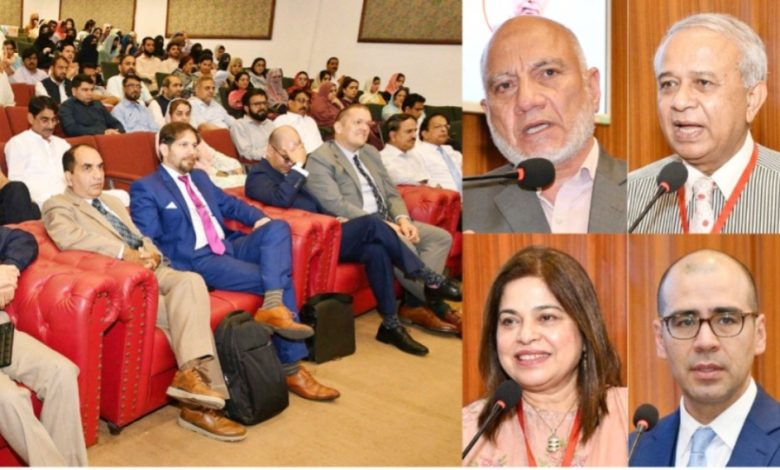
The three-day International Conference & Expo on Life Sciences concluded at Pir Mehr Ali Shah Arid Agriculture University Rawalpindi, showcasing how ICELS 2026 is driving research and policy dialogue on sustainability across Pakistan and beyond. Organised by the Faculty of Sciences at PMAS-AAUR in partnership with Himalaya Hemp & Health (Pvt.) Ltd. and Evolution EduTech Pakistan, the event brought together a broad cross-section of academia, industry and government to address pressing environmental and public health challenges.
Delegates including vice chancellors, senior scientists, policymakers, entrepreneurs, development organisations and students engaged on topics ranging from climate change and biodiversity conservation to food security, biotechnology, sustainable agriculture and water management. The conference format combined technical sessions, industrial exhibitions and international academic exchanges to promote interdisciplinary solutions and practical outcomes.
Kevin Sessink of the U.S. State Department praised ICELS 2026 as a vital platform for strengthening global scientific cooperation and creating opportunities for young researchers through enhanced networking and exposure. His remarks underscored the event’s role in linking Pakistani researchers with international peers and funding avenues.
Prof. Dr. Rahmatullah Qureshi, Chief Organizer and Dean of the Faculty of Sciences, highlighted that over 130 research abstracts were accepted and published in an abstract book with an ISBN in the Himalayan Journal of Botanical Sciences. He noted that ICELS 2026 fostered evidence-based dialogue and interdisciplinary collaboration essential for developing sustainable, science-driven solutions to national and regional problems.
Prof. Dr. Mohammad Akmal, Chairman of the Pakistan Science Foundation, commended the conference’s scientific quality and international relevance. He urged that the policy recommendations emerging from ICELS 2026 be translated into actionable national strategies and confirmed that these guidelines would be factored into future PSF funding priorities and research support initiatives.
A major attraction was the National Expo on Food and Natural Products, which displayed herbal medicines, phytopharmaceuticals, climate-smart agricultural technologies, medicinal plant-based products, natural health formulations, student projects and bio-based entrepreneurial ventures. Delegates and exhibitors used the expo to explore commercialisation pathways and link scientific innovation with market-ready solutions.
ICELS 2026 concluded with a set of policy recommendations aimed at strengthening research funding, promoting sustainable agricultural practices, conserving biodiversity and improving public health outcomes. Organisers and stakeholders committed to follow-up actions to ensure that the conference outcomes inform national research agendas and support practical implementation across Pakistan.