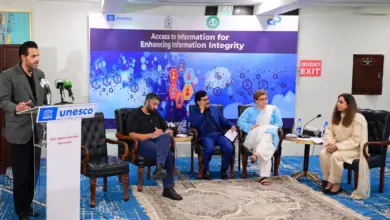
The Institute of Regional Studies partnered with Secours Islamique France Pakistan in Islamabad to convene a high-level science-policy dialogue aimed at translating global climate commitments into practical, regionally relevant implementation pathways. Participants examined lessons from the first Global Stocktake and explored how to move from assessment to on-the-ground delivery in Pakistan.
Ambassador Jauhar Saleem stressed Pakistan’s acute vulnerability to climate-driven disasters despite its negligible share of global emissions, urging an integrated national response that links climate change, water scarcity, environmental degradation and population pressures. He called for scaled-up climate financing, resilient infrastructure investments, public awareness campaigns and more coordinated governance to safeguard long-term resilience.
Mr. Shiraz Shah of UNDP Pakistan highlighted the urgency of converting policy commitments into functioning delivery mechanisms. He advocated for stronger institutional coordination, locally led solutions and integrated policy frameworks that enable communities to adapt while aligning development objectives with climate priorities.
Mr. Thomas Conan from WFP Pakistan warned that mounting climate threats are already undermining food security and livelihoods. He recommended strengthening resilient food systems through climate-smart agriculture, anticipatory action, and expanded social protection to protect vulnerable farmers and stabilize supply chains.
Mr. Muhammad Arif Goheer of GCISC outlined Pakistan’s exposures, including extreme weather, accelerating glacial melt, water stress and rising temperatures. He emphasized the need for robust climate data systems, targeted research and enhanced institutional capacity to inform science-based planning and long-term adaptation measures.
Mr. Amir Khan Goraya of NDRMF focused on risk financing and institutional strengthening as critical enablers of resilience. He urged innovative financing instruments, sustained investment in preparedness and disaster risk reduction, and coordinated action among public agencies, development partners and financial institutions to scale community-level adaptation.
Dr. Altaf Abro of SIF Pakistan called for improved climate governance and innovative risk financing arrangements alongside broad partnerships spanning government, academia, the private sector and local communities. He highlighted the role of green technologies and pragmatic solutions that address both humanitarian and environmental challenges.
Dr. Anjum Rasheed from IRS’s Climate Resilience Program noted that the first Global Stocktake concluded at COP28 underlined a historic assessment of collective progress but also signalled widening adaptation gaps and insufficient finance for vulnerable countries. She urged accelerating implementation, strengthening NDCs, scaling up climate finance and deepening international cooperation to close the gap between pledges and action.
The dialogue reinforced a shared message that effective Climate Action in Pakistan requires coordinated governance, reliable data, sustainable financing and locally tailored solutions. Speakers agreed that moving beyond commitments to sustained implementation will be essential to protect communities, food systems and national development gains.