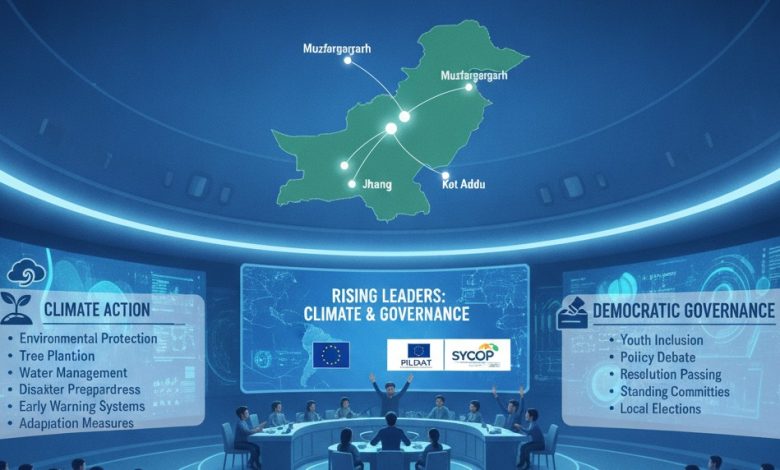
Nearly 200 young leaders from South Punjab convened in Multan from 4 to 11 June to strengthen climate leadership and democratic engagement across their districts. The gathering brought together active members of District Youth Assemblies to deliberate on local climate risks, governance challenges and practical steps for community resilience.
Participants represented four District Youth Assemblies from Muzaffargarh, Layyah, Jhang and Kot Addu, with each DYA comprising 50 members. The programme included a focused two-day module on 10 and 11 June that combined civic education, parliamentary-style debate, expert dialogue, formal voting exercises and digital skills training to prepare young people for sustained civic action.
The activities are part of the three-year initiative Rising Leaders: Youth in Climate Leadership & Governance, co-funded by the European Union and implemented by PILDAT and the Social Youth Council of Patriots (SYCOP). Organisers emphasised practical outcomes, including mechanisms for youth to engage with elected officials and local institutions.
On 10 June sessions examined how climate change is affecting each district, with policymakers and disaster management experts outlining local vulnerabilities and response options. Muhammad Ajmal Khan Chandia, MPA and Parliamentary Secretary for Higher Education, urged youth to take an active role in environmental protection, tree plantation, efficient water management and disaster preparedness. Irfan Sial, Coordinator DDMA Muzaffargarh, and Karamat Ali, Coordinator DDMA Layyah, shared experience on early warning systems, flood emergency response, riverine flooding risks and long-term adaptation measures.
Delegates also engaged with the structure of Pakistan’s democratic institutions, discussing the roles of the legislature, executive and judiciary and the different tiers of government through which decisions affecting communities are made. Sessions reinforced how knowledge of institutional processes strengthens youth capacity to influence policy and accountability.
On 11 June the programme shifted to hands-on training in citizen engagement, including how to file Right to Information requests, work with Standing Committees and prepare to contest or participate in local government elections. Trainers stressed that democratic participation goes beyond the ballot box and highlighted concrete channels for young people to hold institutions accountable.
Addressing the assembly, Jeroen Willems, Head of Cooperation at the European Union Delegation to Pakistan, said young people in South Punjab are among those most affected by climate change and must be empowered as stakeholders in shaping responses. Delegates concluded the event by passing resolutions calling for stronger youth inclusion in local governance and committing to apply their climate leadership skills in their home districts.