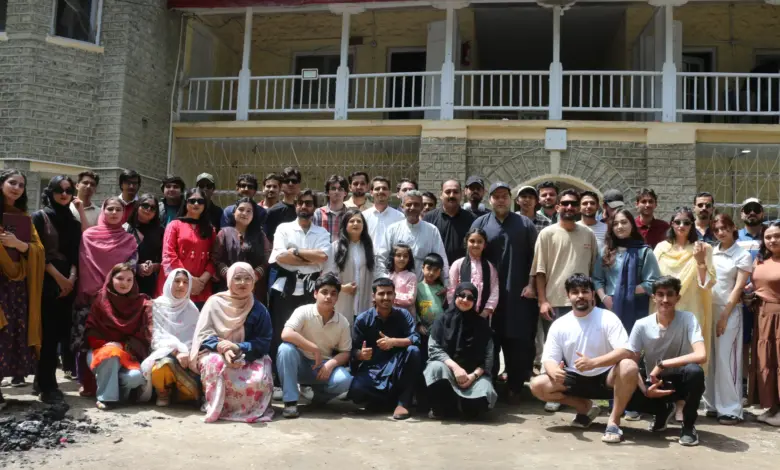
KHANASPUR, GALIYAT: Forty-five young participants from Peshawar completed the three-day PMYDC Regional Youth Climate Summit 2026, producing practical and community-driven proposals to address local environmental challenges.
The summit was organised by IM|Sciences in collaboration with Shaheed Benazir Bhutto Women University, the Directorate of Youth Affairs KP, the Pakistan Development Foundation and Broadify Digital. Participants came from the YDC & GYM Club of IM|Sciences and the GYM Club of SBBWUP.
Designed as a platform for the new generation of climate-conscious leaders, the summit focused on research, teamwork, climate learning and the development of low-budget solutions. The organisers said the programme moved beyond conventional discussions on climate change by encouraging young people to identify real problems in their communities, understand their social and economic dimensions, and propose practical solutions that could be implemented with limited financial resources.
As part of the field research, participants worked in teams along the Pipeline Track and in Ayubia Bazar, where they observed local conditions and engaged with stakeholders. Their research covered waste management and plastic waste, water scarcity and water recharge, tourism-related environmental pressures, deforestation, and changing weather and environmental conditions.
The programme combined field research with expert-led sessions and collaborative solution-building. Dr Waseef Jamal spoke on climate leadership and disaster risk reduction. Mr Mukhtar Ahmed discussed the relationship between poverty and climate-related social and economic shocks. Mr Bilal Sethi addressed climate justice, unequal responsibility and climate finance, while Mrs Zainab Fida focused on water scarcity, groundwater recharge, rainwater harvesting and community-based water management.
The Director of Youth Affairs KP said the summit showed that empowered youth do not merely talk about climate change but go to the ground and create practical, low-cost solutions for their communities. He said institutional collaborations could help build climate-conscious leadership and a sustainable future for Khyber Pakhtunkhwa, adding that the Directorate remained committed to providing platforms where young people could turn ideas into action for a greener and more resilient KP.
Dr Waseef Jamal, Chief Organiser of the PMYDC Regional Youth Climate Summit 2026, said the aim was to transform young people from passive observers of the climate crisis into active problem-solvers within their own communities. He said climate leadership was not built in lecture halls alone, and that the field visits to the Pipeline Track and Ayubia Bazar helped participants understand environmental challenges on the ground.
He said the research, ideas and partnerships developed during the three days would continue to grow, adding that the organisers were committed to supporting the young climate leaders as they carried the work forward. He also thanked the partner institutions, speakers and the Directorate of Youth Affairs KP for supporting youth-led climate action.
Ms Sehrish Zaffar, Deputy Registrar SBBWUP, led her team and also served as a judge for the Climate Innovation Lab, where youth teams presented their proposed solutions. She said it was encouraging to see young people engage directly with communities and understand climate challenges at the grassroots level.
She said the quality of research and creativity of the low-cost solutions presented at the Climate Innovation Lab exceeded expectations. According to her, the participants showed that meaningful climate action does not always require large budgets but needs commitment and innovation. She said the collaboration between IM|Sciences and Shaheed Benazir Bhutto Women University reflected the strength of institutional partnerships in developing climate-conscious youth leadership.
The summit placed special emphasis on teamwork and collaborative problem-solving. After field research and learning sessions, five groups developed proposals addressing the issues they had identified. The participants were encouraged to focus on zero-to-very-low-budget and resource-efficient approaches that could produce meaningful results at the community level.
The group led by Ms Kashmala Amin won the Climate Innovation Lab pitching session. Based on interviews with waste workers, the group identified continuing waste-collection challenges linked with changing weather conditions, increased tourist activity and improper waste disposal.
The winning group proposed the installation of waste-vending machines to encourage people to deposit plastic bottles and other recyclable materials. The collected materials could be linked with eco-friendly businesses, while revenue generated through recycling could be reinvested to expand the initiative.
The innovation component of the summit linked research with action by requiring participants to identify local problems, study their causes and impacts, and then propose interventions based on affordability, community participation and measurable outcomes.
The summit concluded with a cleanliness drive and seed dispersion, enabling participants to put their environmental learning into practice. Certificates were also distributed during the closing programme.
Overall, the PMYDC Regional Youth Climate Summit 2026 provided a platform for young people to move from learning about climate challenges to researching, discussing and designing solutions for them. By combining field research, expert knowledge, teamwork and low-cost innovation, the summit demonstrated how the next generation can contribute practical ideas to environmental challenges without depending only on large-scale or expensive interventions.