Pakistan Seeks APLU Link to Open US University Pathways for Deserving Scholars

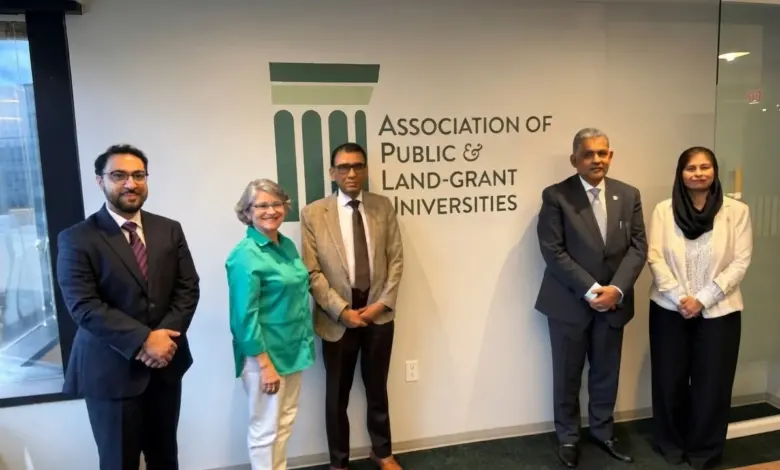
WASHINGTON D.C., Aug 29, 2026: Federal Minister for Federal Education and Professional Training Dr Khalid Maqbool Siddiqui has led a high-level Pakistani delegation to the headquarters of the Association of Public and Land-grant Universities (APLU) in Washington D.C. as part of Pakistan’s efforts to widen international academic opportunities for deserving students.
The delegation held talks with APLU President Dr Waded Cruzado and senior officials to take forward the Pakistan Fund for Education (PFE) / Pakistan Education Endowment Fund (PAK-EEF) initiative. The government-backed programme is aimed at enabling talented and deserving Pakistani scholars, particularly from underserved communities, to pursue postgraduate studies at leading universities in the United States.
APLU is one of the oldest higher education associations in the United States. It represents more than 250 public research universities and land-grant institutions with a combined enrolment of over five million students.
Officials said a possible consortium-level partnership with APLU would give Pakistan a structured and scalable route to engage a large number of leading US public universities instead of pursuing separate agreements with individual institutions.
The Pakistani delegation included Dr Khalid Maqbool Siddiqui; Pakistan’s Ambassador to the United States Rizwan Saeed Sheikh; PAK-EEF Chief Executive Officer Syeda Hajra Suhail; PAK-EEF Chief Internal Auditor Faisal Shahzad; and Bilal Riaz, representative at the Embassy of Pakistan in the United States.
The delegation was received by APLU President Dr Waded Cruzado and Senior Vice President for Governmental Affairs Craig Lindwarm.
During the meeting, Dr Cruzado briefed the Pakistani side on APLU’s structure, membership and broad reach in the US higher education sector. She noted the strong presence of public research universities and land-grant institutions within the association, including those with expertise in agriculture, engineering, STEM, public health and other fields aligned with Pakistan’s academic and development priorities.
APLU’s leadership also underlined the association’s convening role, observing that engagement at the consortium level could support system-wide academic partnerships and help create standardised pathways for international scholars across member institutions.
Presenting the proposed partnership framework, PAK-EEF CEO Syeda Hajra Suhail outlined three main pillars of the initiative.
The first pillar concerns equitable access for deserving scholars. Under this component, PAK-EEF seeks to build a sustainable pipeline for academically outstanding students from marginalised communities and underserved areas of Pakistan. These students would be selected through a rigorous merit-based national process.
The second pillar envisages a bilateral partnership framework. Under this arrangement, participating APLU member universities could offer partial or full tuition fee waivers to students sponsored by PAK-EEF, while PAK-EEF could provide scholarship support of up to US$29,000 per student per year to meet remaining financial requirements.
The third pillar focuses on a virtual outreach platform. Through its network of more than 300 universities and institutions across Pakistan, PAK-EEF would facilitate virtual sessions between Pakistani students and APLU member universities. These sessions would provide information about academic programmes, admission requirements and available scholarship opportunities.
The proposed initiative will initially focus on seven national priority sectors: Artificial Intelligence, Cybersecurity, Data Science, Biotechnology, Environment and Climate Change, Agriculture, and Public Policy and Economics.
Ambassador Rizwan Saeed Sheikh reaffirmed the Embassy of Pakistan’s commitment to facilitating the proposed partnership. He said the Embassy was prepared to mobilise Pakistani diaspora and community networks in the United States to explore the creation of a supplementary fund for PAK-EEF scholars studying at APLU member institutions.
The Ambassador also pointed out that academic arrangements had previously existed between Pakistan and universities and colleges in various US states. He said some of these linkages had become dormant over time and stressed the need to revive and strengthen them, particularly to increase opportunities for talented students from underserved communities.
He assured that the Embassy would continue to act as a diplomatic bridge for revitalising such academic linkages through APLU’s wide network.
APLU leadership responded positively to the Pakistani proposal and expressed strong interest in exploring a consortium-level partnership with PAK-EEF. The meeting noted that APLU’s commitment to access and equity in higher education and PAK-EEF’s mission of supporting deserving students from underserved communities provided a strong basis for future collaboration.
APLU also expressed willingness to share information about its member universities, colleges and partner institutions, especially those with active international engagement programmes and academic strengths matching PAK-EEF’s priority sectors. This, officials said, would help enable targeted outreach and support the development of future institutional partnerships.
Speaking on the occasion, Dr Khalid Maqbool Siddiqui said Pakistan’s objective was to ensure that talent and financial circumstances did not become barriers to world-class education.
He said the proposed engagement with APLU represented an important step towards creating a sustainable international academic pathway for Pakistan’s most deserving scholars.
“APLU’s convening power across more than 250 public universities is exactly the multiplier Pakistan needs. We are not here to knock on 250 doors individually — we are here to build one door that opens all of them for Pakistan’s most deserving young people,” the Federal Minister said.
The meeting was described as an important step in Pakistan’s efforts to build international academic partnerships, expand access to world-class postgraduate education and invest in the country’s talented and deserving young scholars.