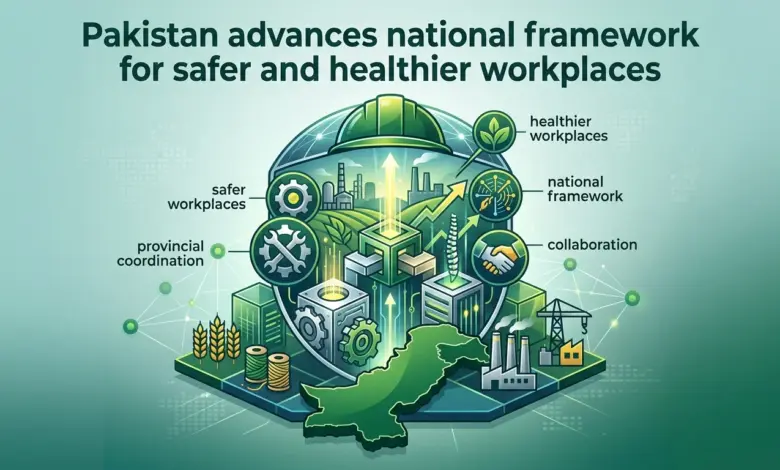
ISLAMABAD: Pakistan is advancing work on a new National Occupational Safety and Health (OSH) Policy aimed at strengthening prevention and making safe and healthy workplaces a reality across the country’s diverse economy.
The National Stakeholders’ Consultation, convened in Islamabad by the Ministry of Overseas Pakistanis and Human Resource Development (MOPHRD) with technical support from the International Labour Organization (ILO), is reviewing the zero draft of the policy and its proposed implementation framework.
The consultation has brought together federal and provincial governments, employers and workers, with input from occupational health and social protection institutions, industry, OSH professionals, academia and other stakeholders.
The proposed policy seeks to extend protection across formal and informal employment. It also recognises the different circumstances of women, young and older workers, persons with disabilities, migrant workers, home-based workers, domestic workers, agricultural workers and platform workers.
“Pakistan is building this policy from the ground up. The process has started with evidence, moved through the provinces and brought employers and workers into the discussion. The aim is not simply to produce another policy document, but to develop a framework that Pakistan’s institutions can implement and workplaces can use,” said Mr Geir T. Tonstol, ILO Country Director for Pakistan.
The initiative comes at a time when occupational safety and health is gaining greater global importance. In 2022, the International Labour Conference recognised a safe and healthy working environment as a fundamental principle and right at work. ILO Conventions No. 155 and No. 187 provide the fundamental international framework for national OSH policy, prevention, institutions and continuous improvement.
For Pakistan, the policy process also responds to a fast-changing world of work, where traditional workplace hazards increasingly intersect with extreme heat and climate change, chemical and biological hazards, technological change, psychosocial risks and new forms of employment.
The zero draft proposes a preventive and forward-looking approach while progressively extending protection to workers who may be harder to reach through conventional OSH systems.
Mr Nadeem Aslam Chaudhry, Federal Secretary, Ministry of Overseas Pakistanis and Human Resource Development, said Pakistan’s economic progress must go hand in hand with the protection of the people who make that progress possible.
“A stronger national OSH framework can support safer workplaces, productive enterprises and Pakistan’s ambition to be a responsible and competitive participant in the global economy,” he said.
The policy is intended to strengthen coherence while respecting Pakistan’s devolved system of labour governance. Provinces will retain responsibility for implementation and enforcement within their jurisdictions, while national coordination can help facilitate shared priorities, exchange of experience, comparable information and engagement with International Labour Standards.
Social dialogue is central to the proposed approach. The participation of the Employers’ Federation of Pakistan (EFP) and the Pakistan United Workers Federation (PUWF), along with federal and provincial governments, is aimed at ensuring that the policy reflects both institutional priorities and the realities faced by enterprises and workers.
The consultation also marks another step in Pakistan’s continuing consideration of the ILO’s fundamental OSH Conventions. The policy is meant to strengthen the legal, policy, institutional and implementation environment and provide a basis for progressive alignment with Conventions No. 155 and No. 187, as well as consideration of their future ratification in line with Pakistan’s national priorities and constitutional arrangements.
Participants at the national consultation will focus on three areas: governance and social dialogue; OSH data systems and reporting; and OSH prevention and workplace management. Their recommendations will feed into further refinement of the policy and implementation framework.
Participants also expressed a collective resolve to promote OSH for all and advocate ratification of the ILO OSH Convention.