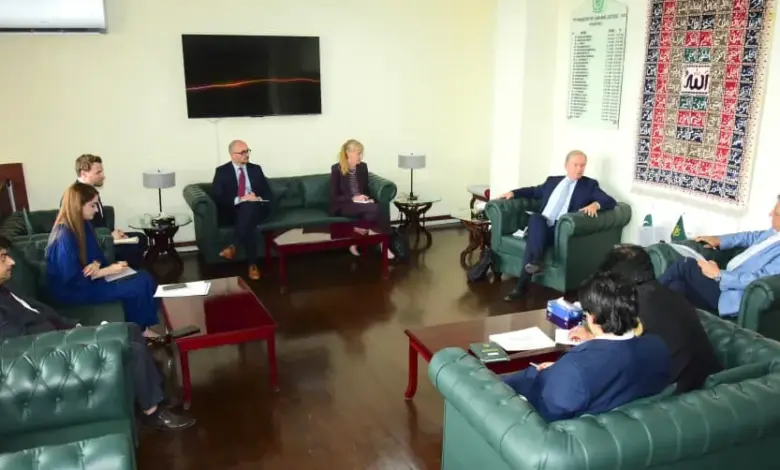
ISLAMABAD, September 14, 2026: Pakistan and Germany on Monday reaffirmed the importance of sustained cooperation on human rights, freedom of religion or belief, rule of law and interfaith harmony during a meeting between Federal Minister for Human Rights Senator Azam Nazeer Tarar and Germany’s Federal Government Commissioner for Freedom of Religion or Belief, Thomas Rachel.
The German commissioner was accompanied by the German Ambassador to Pakistan, H.E. Ms Ina Lepel, according to a press release issued by the Ministry of Human Rights.
The two sides held a detailed exchange of views on matters of mutual interest, including rule of law, human rights, freedom of religion or belief, minority rights, freedom of expression, child marriage, forced marriage, interfaith harmony and Pakistan’s GSP+ framework with the European Union.
Thomas Rachel appreciated Pakistan’s role in promoting peace in the region and its contribution to the principles of the United Nations and the rule of law. He also expressed interest in Pakistan’s legislative and institutional steps for the protection of human rights and fundamental freedoms.
Senator Tarar said Pakistan had faced complex security challenges over the past several decades, particularly due to the impact of wars in Afghanistan, terrorism and extremism. He said these factors had affected Pakistan’s social, cultural and religious environment, adding that the country had paid a heavy human and economic price in the fight against terrorism.
Despite the difficult security environment, the minister said, the government was taking measures to strengthen the legal and institutional framework for human rights, freedom of religion or belief, freedom of expression, political activities, minority rights and the protection of women and children.
Briefing the delegation on the proposed National Commission for Minority Rights, Senator Tarar said that after the relevant legislation, the process for constituting the commission was under way at the parliamentary level. He expressed the hope that the commission would serve as an effective and independent body for protecting minority rights.
The meeting also reviewed recent institutional developments concerning the rights of journalists, along with the role of the National Commission for Human Rights and the National Commission on the Status of Women.
The human rights minister described legislation aimed at preventing child marriage as an important development. He said its core purpose was to protect children, especially young girls, from early marriage, health-related issues and other social difficulties.
Senator Tarar said the European Union’s GSP+ framework was not only a trade facility for Pakistan but also a useful incentive mechanism for promoting human rights, rule of law and institutional reforms.
He said GSP+ requirements provided an additional incentive for reforms linked to human rights and fundamental freedoms in Pakistan, particularly in protecting the rights of vulnerable, disadvantaged and marginalised sections of society. He added that Pakistan did not view GSP+ merely through the lens of trade and business, but also valued its human and social dimensions.
Thomas Rachel underlined the importance of interfaith dialogue and religious tolerance, saying mutual respect among people and communities belonging to different religious and belief backgrounds was essential for global peace.
He said Germany was also home to various religious communities and that improving relations among different faiths required continuous efforts. Religious leaders, he added, had a responsibility to promote respect, tolerance and peaceful coexistence with other religions and groups in society.
Both sides agreed that international cooperation and sustained dialogue were necessary for advancing human rights, freedom of religion or belief, rule of law, interfaith harmony and peace.
The meeting concluded in a cordial, friendly and constructive atmosphere.