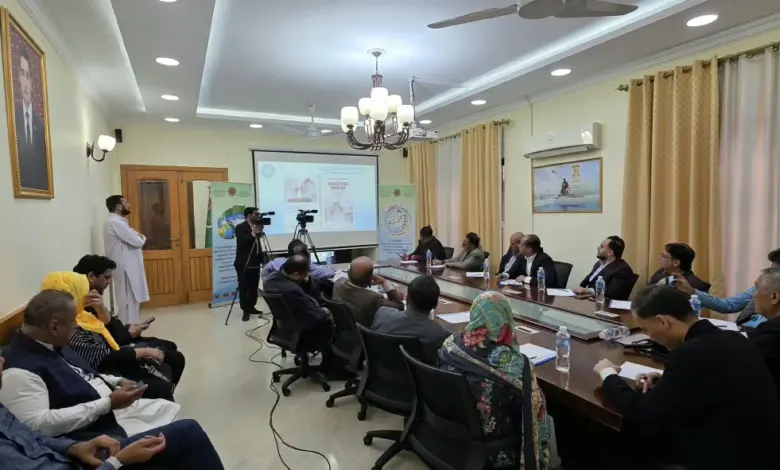
ISLAMABAD: The Embassy of Turkmenistan in Islamabad, during a briefing for Pakistani media on November 6, highlighted the country’s national achievements in 2026, its expanding international engagement and the importance of energy and connectivity cooperation with Pakistan.
Turkmenistan is marking the 35th anniversary of its Independence in 2026, a year announced under the theme, “Independent, Permanently Neutral Turkmenistan—Homeland of Purposeful Heavenly Horses”.
According to the embassy, the year has been marked by important developments in Turkmenistan’s political, economic, cultural and diplomatic life. The country has hosted and participated in major national and international events, including regional summits, investment forums, energy conferences, environmental meetings and initiatives aimed at sustainable development and connectivity.
The briefing placed particular emphasis on Turkmenistan’s relations with neighbouring countries and strategic partners, including Pakistan, especially in energy, transport, trade and regional connectivity.
A key cultural event of the year was the First World Championship of Equestrian Sports and Beauty among Ahal-Teke Horses, held in the Netherlands from September 4 to 6, 2026. The event drew attention to the heritage of Turkmenistan’s Ahal-Teke horses, which are regarded as an important part of the country’s national identity, cultural traditions and historical legacy.
On September 23, a meeting of the Halk Maslahaty, or People’s Council of Turkmenistan, was held at the Maslahat Köşgi Palace in Ashgabat under the chairmanship of the National Leader of the Turkmen people and Chairman of the Halk Maslahaty, Gurbanguly Berdimuhamedov.
During the meeting, Gurbanguly Berdimuhamedov, President Serdar Berdimuhamedov and other speakers reviewed Turkmenistan’s achievements since Independence, priority areas of state development and measures aimed at improving public welfare.
The participants approved several strategic documents later signed by President Serdar Berdimuhamedov. These included the National Strategy for the Industrial Development of Turkmenistan for 2030–2045, the National Concept “International Law and Neutrality of Turkmenistan”, and the State Programme on State Youth Policy in Turkmenistan for the period up to 2031.
Turkmenistan celebrated the 35th anniversary of Independence on September 27 with major events across the country. The main ceremony in Ashgabat included a military parade attended by President and Supreme Commander-in-Chief of the Armed Forces, Army General Serdar Berdimuhamedov. The programme featured military personnel, modern equipment, an aerial parade, a naval parade in the Caspian Sea and cultural performances. The celebrations concluded with a concert and fireworks in the capital.
The embassy also highlighted Turkmenistan’s investment activity during the year. The Turkmenistan Investment Forum 2026 was held in Ashgabat on October 1 and 2, bringing together investors, innovators, financial institutions, policymakers and business leaders. More than 800 delegates and guests attended the forum, representing over 200 companies from more than 40 countries, including Pakistan.
A broad package of bilateral documents, commercial contracts and memoranda of cooperation was formalised by Turkmenistan’s state ministries and concerns during the event. The forum served as a platform for investment opportunities and international business partnerships in key sectors of the national economy.
In October, Turkmenistan also hosted several high-level international meetings in the National Tourist Zone of Avaza. On October 7, the Council of Ministers of Foreign Affairs of the Commonwealth of Independent States held its regular meeting, where participants discussed international and regional developments, foreign policy coordination and cooperation among CIS states. Turkmenistan’s chairmanship of the CIS and the 35th anniversary of the Commonwealth were also noted.
The same day, a high-level meeting of Central Asian states on the rational use of water resources of the Amu Darya and Syr Darya rivers was held in Avaza. Delegations presented national reports on current conditions, challenges and approaches to sustainable use of shared water resources, and developed a common view on further cooperation.
Avaza also hosted the International Women’s Dialogue titled “The Role of Women in Maintaining Peace and Achieving Sustainable Development” on October 7. Participants discussed women’s rights, empowerment, equal opportunities and inclusive national approaches, while stressing the importance of women’s participation in public and state life for achieving the 2030 Agenda for Sustainable Development. A final document was adopted.
Another conference held on October 7 focused on “Demographic Processes and Sustainable Development: Contemporary Challenges and International Experience”. The event discussed demographic management and the inclusion of population-related indicators in long-term socioeconomic planning. A final document was adopted at the end of the conference.
On October 8, Avaza hosted the Eighth Consultative Meeting of the Heads of State of Central Asian Countries and the Republic of Azerbaijan. President of Azerbaijan Ilham Aliyev thanked Gurbanguly Berdimuhamedov for being the first to invite him to take part in the format during their meeting in Avaza in August of the previous year. The 2026 meeting marked Azerbaijan’s first participation as a full-fledged member of the consultative format.
Following the talks, participants adopted the Decision “On the Regulatory Documents of the Consultative Meeting of the Heads of State of Central Asian Countries and the Republic of Azerbaijan” and the Joint Statement of the Eighth Consultative Meeting. Gurbanguly Berdimuhamedov noted that the Consultative Meetings had become an effective platform for addressing regional issues through partnership and had acquired significance beyond the region.
On October 9, the Council of Heads of State of the CIS met in Avaza. President of Iran Masoud Pezeshkian participated for the first time as a special guest. Discussions covered political-diplomatic, trade-economic and cultural-humanitarian cooperation. One key decision was to declare 2029 the “Year of CIS Transport Connectivity”.
The First Caspian Environmental Summit was also held in Avaza on October 9. The summit focused on environmental challenges and international cooperation to protect the Caspian Sea and its surrounding ecosystem. The heads of state adopted a decision reflecting the outcomes of the meeting.
Energy remained a major focus of Turkmenistan’s 2026 agenda. From October 21 to 23, the 31st International Conference and Exhibition “Oil and Gas of Turkmenistan – 2026” was held in Ashgabat, bringing together more than 1,500 delegates from 75 countries and around 450 companies.
The discussions covered development of the Galkynysh gas field, implementation of the Turkmenistan-Afghanistan-Pakistan-India gas pipeline, diversification of natural gas export routes, cooperation in the Turkmen sector of the Caspian Sea, and expansion of gas processing and petrochemical industries. Five bilateral agreements were signed with international partners from China, Malaysia, Kazakhstan and Uzbekistan.
From November 3 to 5, Ashgabat hosted the CIET 2026 International Conference and Exhibition on construction, industry and energy. The event brought together government representatives, international companies, investors, financial institutions, technology providers, manufacturers, architects, engineers and experts. It focused on construction and urban development, industrial modernisation, chemical and petrochemical production, energy development, transport, infrastructure, digitalisation and smart technologies.
The embassy said energy cooperation remained an important pillar of Turkmenistan-Pakistan relations. The two countries share an interest in reliable energy supplies, regional infrastructure and economic connectivity.
The TAPI gas pipeline remains central to this cooperation. The project is designed to transport natural gas from Turkmenistan’s Galkynysh gas field to energy markets in South Asia. Independent assessments cited for the project estimate the Galkynysh field’s reserves at around 27 trillion cubic metres of natural gas.
For Pakistan, the implementation of TAPI is expected to offer more diversified energy supplies, support economic development, strengthen regional economic cooperation, contribute to industrial activity and promote regional stability through shared infrastructure.
The TAPI initiative is also linked with additional regional infrastructure. A 1,635-kilometre fibre-optic communication line is planned along the pipeline corridor through Afghanistan and Pakistan. It is intended to support pipeline monitoring and provide high-capacity telecommunications connectivity between Europe, Asia and Southeast Asia, with proposed transmission capacity of up to 100 Gbps.
The broader programme also includes the Turkmenistan-Afghanistan-Pakistan electricity transmission project. The TAP power line is intended to supply electricity to the TAPI pipeline and associated facilities, while also creating opportunities for exporting up to 3,000 megawatts of electricity through Afghanistan to Pakistan.
The embassy also referred to progress in Turkmenistan-Afghanistan infrastructure cooperation. In September 2024, construction of the Serhetabat-Herat section of the TAPI pipeline was launched, work began on the Turgundi-Sanabar section of the first phase of the Turgundi-Herat railway, and the Nur-ul-Jihad power substation in Herat Province was commissioned as part of the first phase of the TAP electricity transmission project.
On October 20, 2025, Gurbanguly Berdimuhamedov visited Herat Province and launched the next stage of the Serhetabat-Herat gas pipeline. Specialised machinery and equipment, including bulldozers, excavators, loaders, truck cranes, pipelayers, heavy-duty tractors, mobile platform trailers and motor graders, were procured to accelerate construction.
On August 10, 2026, Gurbanguly Berdimuhamedov visited Mary Province and travelled to the Islim-Cheshme border area in Serhetabat district before proceeding to Afghanistan. He held talks with Abdul Ghani Baradar, Deputy Prime Minister of Afghanistan for Economic Affairs. The discussions covered cooperation in the fuel and energy sector and major infrastructure initiatives, including TAPI, the Afghanistan-Turkmenistan-Azerbaijan-Georgia-Turkey transport corridor and the Lapis Lazuli international transport corridor.
Gurbanguly Berdimuhamedov proposed the establishment of a Turkmen-Afghan Commission on Economic Cooperation. A Memorandum of Understanding was also signed between the State Concern Türkmengaz and the State Corporation Afghan Gas.
The embassy said cooperation between Pakistan and Turkmenistan reflected the wider potential of regional partnership between Central and South Asia. Projects such as TAPI, TAP, railway development and fibre-optic connectivity could support energy security, trade, investment and sustainable economic development, while helping connect Central and South Asian markets.