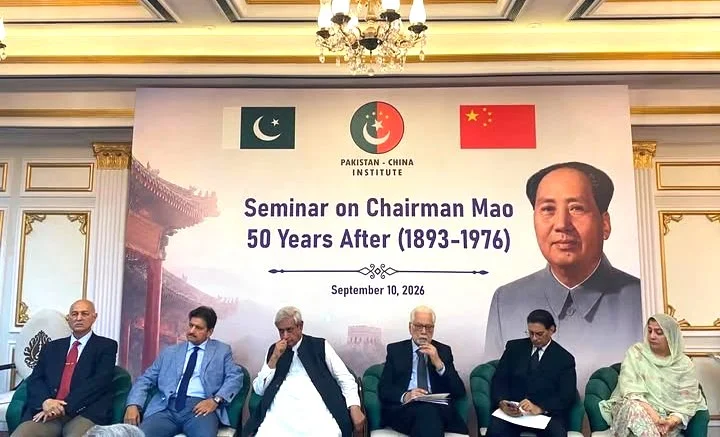
Islamabad, September 10, 2026: Speakers at a special gathering held to mark the 50th death anniversary of Chinese leader Chairman Mao Zedong paid rich tribute to his role in transforming China and influencing global history, describing China as the pivot of Pakistan’s foreign policy and Pakistan’s best friend.
The well-attended event was organised by the Pakistan-China Institute. Its Chairman, Senator Mushahid Hussain Sayed, delivered the keynote address. Prominent journalist Hamid Mir and leading lawyer Salman Akram Raja were among the speakers. Former Speaker of the National Assembly Syed Fakhar Imam attended as chief guest, while the proceedings were presided over by former foreign minister and former ambassador to China Inamul Haq. Senator Sitara Ayaz offered the vote of thanks at the conclusion.
In his keynote speech, Senator Mushahid Hussain Sayed said Chairman Mao was one of the three great figures of the 20th century who shaped the course of history through leadership and vision. He named the other two as Vladimir Lenin, leader of the Russian Revolution, and Quaid-i-Azam Mohammad Ali Jinnah, the Founder of Pakistan.
Calling Mao the builder of new China, Senator Mushahid said that during his quarter-century rule, Mao freed Chinese peasants from feudalism, doubled life expectancy, raised the literacy rate from 20 per cent to 93 per cent, made China a nuclear power through indigenous work in science and technology, and emancipated Chinese women. He said Mao also ensured food, clothing, housing and basic health facilities for the Chinese people, thereby laying the foundation of today’s peaceful, prosperous and powerful China.
Senator Mushahid also described Chairman Mao as the architect of friendship with Pakistan, saying he fully supported Pakistan during the 1965 war against India. He said Mao also supported oppressed causes, including Kashmir and Palestine, as well as liberation movements in Africa.
The senator said Chairman Mao played a decisive role on three major occasions in safeguarding the Chinese Revolution and protecting the interests of China and its people. He said the first such moment came in 1935, when Mao led the Long March, saving the Communist Party and preserving the People’s Liberation Army.
He said the second came in 1966, when Mao launched the Cultural Revolution to save China from the fate of the Soviet Union, as he feared corruption was entering the Chinese system. Senator Mushahid said this helped China avoid the fate that eventually befell the Soviet Union, which broke up in 1991.
He said the third decisive moment came in 1971, when Mao’s opening to America proved to be a diplomatic masterstroke. According to him, the move delinked the United States from the Soviet Union and prevented both powers from ganging up against China.
Other speakers praised Chairman Mao as a genuine revolutionary, a great thinker and philosopher, and a selfless patriot whose focus remained on the welfare of the Chinese people.
Syed Fakhar Imam appreciated China’s governance model and described it as a principal factor behind the country’s rapid economic development in an environment of peace and stability.
Ambassador Inamul Haq lauded Chinese diplomacy under Chairman Mao, calling it a beacon of hope. He said China played a pivotal role in the emergence of the Third World and the Global South.
Senator Sitara Ayaz appreciated Chairman Mao’s services for granting fundamental rights to Chinese women, who are now equal partners with men in China’s phenomenal progress.
The speakers unanimously agreed that China is the pivot of Pakistan’s foreign policy and the best friend of Pakistan.
The event was attended by people from different walks of life, including parliamentarians, policy makers, diplomats, business leaders, students and scholars.