MOHSIN ALI
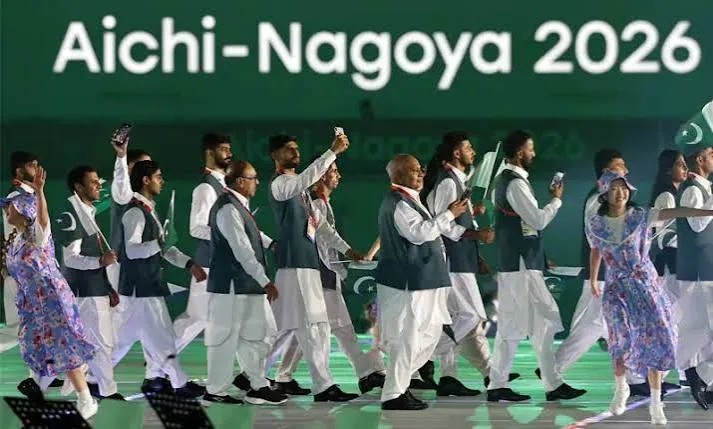
ISLAMABAD: The 20th Asian Games began in Japan’s Nagoya city on Saturday with a bright opening ceremony featuring dance and fireworks, after a troubled build-up marked by operational lapses and logistical complaints.
Five years after the Tokyo Olympics were held in empty venues because of COVID-19 restrictions, Japan welcomed spectators to the Mizuho Park Athletic Stadium for a ceremony that opened on a restrained note before turning into a display of colour, music and celebration.
Emperor Naruhito formally declared the Games open after watching the parade of 45 nations and regions from the dignitaries’ table, where International Olympic Committee chief Kirsty Coventry was also present.
The emperor’s attendance, along with members of the royal family, came under tight security. Organisers had earlier said as many as 10,000 police personnel would be deployed for the ceremony.
“While the world is too often divided by conflict, they (the Asiad athletes) remind us that sport remains a powerful force for peace, understanding and friendship among nations,” Olympic Council of Asia President Sheikh Joaan bin Hamad Al Thani said in his address.
Japan’s father-and-son pair Shigenobu Murofushi and Koji Murofushi, both former Asian Games hammer throw champions, lit the cauldron together after climbing a flight of stairs at the end of the torch relay.
Organisers will be hoping the ceremony helps shift attention away from a difficult lead-up, which saw athletes and officials raise concerns over accommodation and transport arrangements.
Japan’s image for discipline, accuracy and efficiency has come under pressure as the country hosts more than 11,000 athletes competing for 369 gold medals across a large 43-sport programme.
As a cost-saving measure, organisers did not construct a dedicated Games village. Instead, athletes and officials have been accommodated in a combination of hotel rooms, temporary wooden containers and a cruise ship docked in the bay.
Several national delegations, including host Japan, have expressed dissatisfaction with the arrangements. Complaints have included mix-ups and double-bookings, while South Korea said the containers at Garden Pier were too small for their basketball players.
India’s powerful cricket board made its own arrangements for the men’s star-studded cricket squad to stay at a separate hotel because of a tight allocation of beds by the organisers.
Delegations have also complained about long waits for athletes registering on arrival, while buses have reportedly arrived late or taken athletes to the wrong venues.
The Olympic Council of Asia, which organises the quadrennial Games, acknowledged the issues on Saturday but described them as early-stage difficulties.
Directed by Yukihiko Tsutsumi, the opening ceremony began in a quiet tone with classical music and dance on a heart-shaped stage before the parade of nations, which included a delegation from North Korea.
The pace of the show increased later, as dancers in boiler suits highlighted Nagoya’s manufacturing heritage, before fireworks brought the evening to a close.
The theme of the ceremony was “Harmonic Heart Beat”, aimed at conveying Asian unity at an event often affected by geopolitical tensions and historical disputes.
However, hopes for a peaceful Games have already faced setbacks. Taiwan’s delegation temporarily refused to take part in its welcoming ceremony on Friday after sports minister and former Olympic champion Lee Yang was prevented from attending.
In another incident, South Korea’s men’s hockey team were angered when North Korea’s national anthem was played at the stadium before a match instead of their own.
Although competitions in basketball, football and other sports have already started, the first gold medal will be awarded on Sunday, most likely in triathlon.
A major swimming competition also begins in Tokyo on Sunday, with China’s 100 metres freestyle world-record holder Pan Zhanle and 13-year-old Yu Zidi among the names in the programme.
Alongside traditional Olympic disciplines, the Games will feature regional favourites such as kabaddi and sepak takraw, as well as newer events.
Esports will again award medals after debuting at Hangzhou, while teqball, a blend of table tennis and football, and “virtual taekwondo” will appear at the Asian Games for the first time.