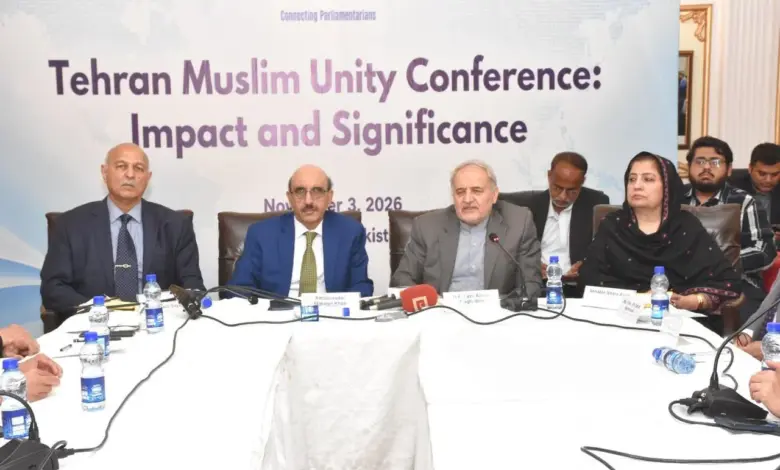
ISLAMABAD, Nov 3, 2026: Speakers at a seminar on the “Impact and Significance of Tehran Muslim Unity Conference” said the Iran war had created an opportunity for regional countries to reshape the region without foreign interference.
The seminar, organised by the International Parliamentarians Congress (IPC), focused on the landmark Tehran Muslim Unity Conference and held a candid discussion on the impact and consequences of the October 21 meeting in Tehran with the Makkah Defence Alliance on Pakistan’s initiative.
In his opening remarks, Senator Mushahid Hussain Sayed said the world was passing through “an era of transformation, turbulence and transition”. He said the “division and decline of the West”, along with the rise of China and the emergence of Muslim middle powers, were among the new global realities.
He identified Pakistan, Turkiye, Iran, Saudi Arabia and Indonesia as Muslim middle powers, saying there was a broad consensus among them that the main threat to the Muslim world came from Israel and that strong Muslim unity was therefore essential.
Referring to Pakistan’s role in recent regional developments, Senator Mushahid quoted Quaid-i-Azam Mohammad Ali Jinnah’s press conference in Cairo on December 19, 1946, where he had said that the “creation of Pakistan would be a source of strength for the Muslims of the Middle East”. He said the Founder of Pakistan had linked Pakistan’s role and destiny with the Muslim world even before the country’s creation, and that this vision had now become a reality.
Senator Mushahid said Pakistan had achieved three major milestones in recent months: the April 7 ceasefire between Iran and the United States, the June 17 Islamabad MOU, and the historic October 21 meeting in Tehran between four Muslim countries.
He said Pakistan had played a role that should have been performed by international organisations such as the United Nations, the OIC, the Arab League or the European Union, but these organisations had failed to deliver.
He said the Islamabad MOU, already agreed upon by Iran and the United States with Pakistan also as a signatory, remained the only viable framework for durable peace, security and stability in the region.
Senator Mushahid also reiterated Pakistan’s principled position of condemning what he called the unprovoked and unwarranted aggression by the United States and Israel against Iran, saying it had destabilised the region and caused a major global energy and economic crisis. He said the “time has come for regional hands to reshape the region’s future, without foreign interference”.
Iranian Ambassador Dr Raza Amiri Mughaddam, in his address, spoke about the historic development of the Iranian Revolution under Imam Khomeini, saying it transformed Iran from what was once called the “second Israel” under the Shah into a bastion of resistance against Zionism.
He referred to the leadership and contribution of Imam Khomeini in mobilising millions of Iranians in support of the Islamic Revolution.
The Iranian envoy also welcomed the Makkah Defence Alliance as a positive step and praised Field Marshal Asim Munir for his initiative to bring Islamic countries together in Tehran on October 26. He said the leadership welcomed the move because if Pakistan, Iran, Turkiye and Saudi Arabia achieved unity and came together, “nobody can harm us”.
Ambassador Masud Khan, former president of Azad Kashmir and former ambassador to the United States and China, reviewed recent developments in the region and described the situation as disastrous and explosive.
He said all sides should adhere to a peaceful settlement of the issue, including the Strait of Hormuz, warning that any other course would have dangerous consequences.
Other speakers included prominent journalist and anchor Nasim Zahra, Admiral (retd) Hasham Siddiqui, former ambassador of Pakistan to Saudi Arabia, and Maj Gen (retd) Zahid Mahmood, Dean of NUST. They spoke on various dimensions of the conflict and its consequences.
The speakers also welcomed Pakistan’s initiative to take the Makkah Defence Alliance delegation to Tehran, saying Muslim unity was the need of the hour and the best way to thwart Netanyahu’s plan of “greater Israel”.