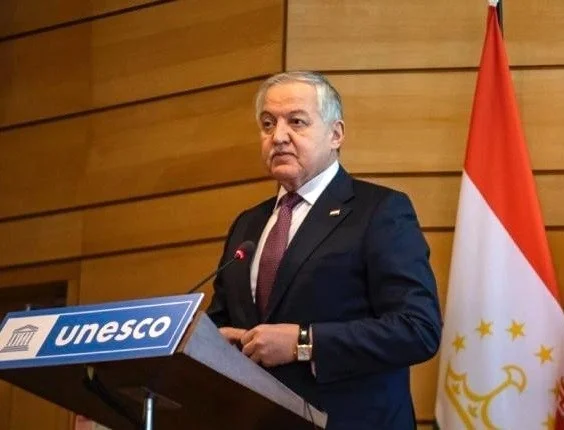
PARIS: An exhibition highlighting the written heritage, arts and culture of Tajikistan has opened at the UNESCO Headquarters in Paris in honour of two eminent Persian-Tajik thinkers, Abu Ali ibn Sina, also known as Avicenna, and Omar Khayyam.
The opening ceremony was addressed by Tajikistan’s Minister of Foreign Affairs, Sirojiddin Muhriddin, who said the holding of the exhibition at UNESCO Headquarters reflected the constructive role and special place of science and culture in the development of international relations and in promoting friendship and respect among nations.
“Our scientific and cultural heritage is not only a record of our historical journey but also one of the principal means of dialogue among nations in today’s world,” he said.
The exhibition features rare examples of written heritage, lithographed works and artefacts of major historical and cultural value. The items include manuscript copies and lithographed books containing the scientific, philosophical and medical works of Abu Ali ibn Sina, as well as collections of the rubaiyat, or quatrains, of Omar Khayyam.
According to the organisers, the displayed material represents different stages in the development of manuscript culture and book printing. The historical examples date from the 15th to the 19th centuries.
The exhibition also presents quatrains by Omar Khayyam rendered in calligraphy by renowned masters of the art. These works follow the traditions of bookmaking and decorative script and reflect the continuing link between science, literature, calligraphy and the book culture of the Persian-Tajik people.
In addition to manuscripts and books, visitors can view examples of Tajik folk crafts, including khotamkori, or fine wooden inlay, and suzani embroidery carrying the image of Shaykh ur-Ra’is Abu Ali ibn Sina. These works have been created by Tajik artisans.
A collection of commemorative and jubilee medals and badges bearing the image of Abu Ali ibn Sina, issued in different periods in honour of the great thinker, is also part of the display.
Speaking at the ceremony, Foreign Minister Muhriddin said the study of written heritage was vital for preserving cultural identity, transferring historical knowledge and developing intellectual and artistic skills.
He said ancient manuscripts and calligraphic works were not only carriers of written knowledge but also important expressions of a nation’s history, art and civilisation. Such works, he added, helped deepen understanding of cultural, literary and historical roots and maintained the connection between the younger generation and earlier generations.
The minister described the exhibition as a mirror of the life of an ancient nation and a chronicle of the historical journey of Persian-Tajik science and culture, whose contributions had enriched humanity for millennia.
He said the lasting legacy of Abu Ali ibn Sina and Hakim Omar Khayyam was a matter of pride not only for the Persian-Tajik people but also a spiritual treasure for all humanity.
Muhriddin expressed gratitude to the UNESCO Secretariat, the Rudaki Association and all those whose contributions helped make the exhibition possible. He also expressed confidence that Tajikistan’s cooperation with UNESCO in preserving and promoting the cultural and historical treasures of the Tajik people would continue for the benefit of international cooperation and dialogue among civilisations.