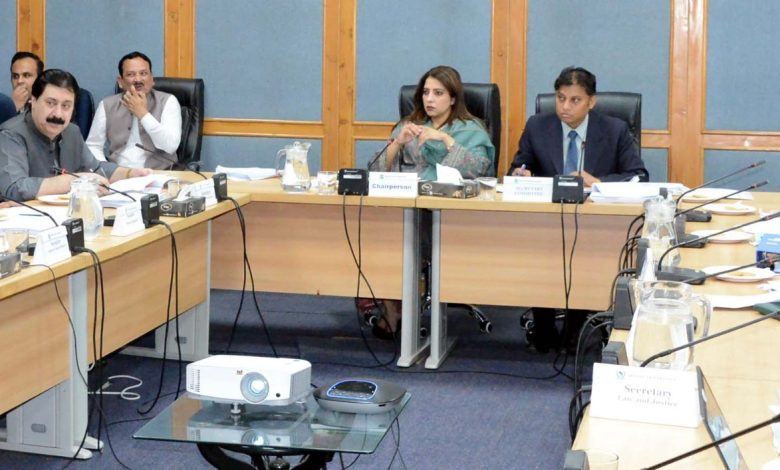
Islamabad (Nadeem Tanoli) A heated meeting of the Senate Standing Committee on Information Technology, focused sharply on controversial appointment in the Ministry of IT and Telecommunication. The reappointment of Mr. Jawad Shirazi as Director General of International Coordination (DG IC) drew serious criticism, overshadowing the Ministry’s overall performance review.
The Ministry, led by Federal Minister Shaza Fatima, presented its achievements and defended the recruitment process. However, committee members raised concerns about a lack of transparency and fairness, especially regarding opportunities for new and deserving talent.
The meeting chaired by Senator Palwasha Mohammad Zai Khan began with a report on how public funds were used. Officials said that the full annual budget under the Public Sector Development Programme (PSDP) had been utilized by the year’s end. They explained that earlier reports of low spending were due to late claims not being reflected at the time. They also provided an update on the Karachi IT Park, which had been delayed due to international challenges but is now being re-tendered.
The discussion then turned to the main issue: the recruitment of the DG IC. Committee members questioned why Mr. Shirazi, who was already holding the position, had been reappointed. Some felt the process was just a formality designed to bring him back, making the nationwide job advertisement meaningless. One member commented, “What’s the point of advertising the job if you were just going to rehire the same person?”
Another key concern was how the job requirements were written. Terms like “or relevant” qualifications and the equal treatment of a PhD and Master’s degree were seen as vague and possibly tailored to favor a specific candidate. Members argued that this approach lowered professional standards and lacked fairness.
The committee also criticized the limited space for new talent, especially from the private sector. They felt the process discouraged young, skilled professionals and unfairly favored those already in government, giving them an edge regardless of their technical qualifications.
In response, the Ministry explained that it had chosen a competitive recruitment process rather than simply renewing the incumbent’s contract. Out of more than 1,400 applicants, 14 were shortlisted. After concerns were raised, an independent expert reviewed the selection process, and three final candidates were chosen—one of them being Mr. Shirazi, along with two private-sector professionals.
The Ministry stated that the final selection was made purely on merit, highlighting that the chosen candidate had degrees from top global universities and experience in diplomacy, policy, and international coordination—skills needed for the role.
Despite the Ministry’s explanation, the committee was not satisfied and postponed the decision. They requested a full report comparing the top 25 shortlisted candidates, their qualifications, and how they were scored.
The meeting also discussed upcoming projects, including the National CERT’s role in cybersecurity and a new initiative to train and certify 500,000 young people in emerging technologies in partnership with companies like Google and Huawei.