No Doctors, No Doors: Islamabad’s BHUs Exposed as Dysfunctional by Senate Committee

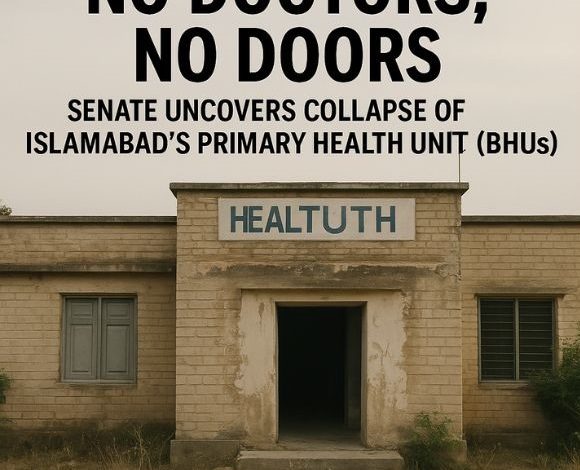
Senate Committee Exposes Neglect of Islamabad’s BHUs, Cites Absence of Doctors and Shocking Conditions
Islamabad: The Senate’s Sub-Committee on Health has raised alarms over the collapse of primary healthcare in Islamabad, following a scathing personal inspection by Member of National Assembly Dr. Zahra Wadood Fatemi. Her report, which revealed that not a single doctor was present in any of the Basic Health Units (BHUs) she visited, triggered outrage and demands for immediate reform. Lawmakers now seek sweeping upgrades, legislative intervention, and urgent staffing to prevent further erosion of public health services in the capital.
Dr. Fatemi personally toured 8 to 10 BHUs across the Islamabad Capital Territory and reported finding no qualified doctors on duty. In many cases, facilities were run by Lady Health Visitors (LHVs) who lacked the credentials to offer full medical services. One such LHV at the Potli Sadya BHU had even labeled herself as “Doctor” on her nameplate, underscoring the extent of unregulated misrepresentation.
The Thanda Pani BHU stood out as a particularly egregious case, described by Dr. Fatemi as “horrifying.” The building lacked basic infrastructure — no doors, no windows — and had been repurposed to house livestock, including goats and cows. Her findings painted a broader picture of a healthcare system in paralysis: derelict, understaffed, and unfit to meet even elementary medical needs.
The committee identified the dysfunction of Islamabad’s BHUs as a key factor behind the overwhelming patient load at major tertiary hospitals such as PIMS and Polyclinic. Lawmakers emphasized that unless basic health services are revived and made accessible, larger institutions will remain dangerously overburdened. The strategy outlined by the committee centers on upgrading all 16 BHUs in the capital to the level of Tehsil or District Headquarter Hospitals (THQ/DHQ) to improve capacity and service delivery.
Two locations — the Tarnol BHU and the Community Center in Bari Imam — were singled out for immediate transformation. The latter, described as a “state-of-the-art building,” remains underutilized and could be quickly converted into a fully functional healthcare facility.
Addressing the critical shortage of doctors, committee convener Dr. Amjad Ali Khan proposed bypassing the conventional Public Service Commission’s sluggish hiring process. He cited Khyber Pakhtunkhwa’s success in passing special legislation to recruit 2,000 doctors on contract for its BHUs and suggested Islamabad could adopt a similar model through cabinet approval. The committee supported the move, emphasizing it could resolve the staffing crisis in weeks rather than years.
Beyond domestic implications, lawmakers warned of the international embarrassment posed by Islamabad’s decaying health infrastructure. Dr. Amjad stressed that the presence of such non-functional, neglected units in the nation’s capital sends a damaging message to visiting diplomats and international observers. “If this is the state of healthcare in Islamabad,” he warned, “what impression does that give of the rest of Pakistan?”
With consensus around a three-pronged solution — infrastructure upgrades, rapid legislative staffing measures, and use of modern but idle public facilities — the committee signaled its intent to push for urgent executive action. Lawmakers agreed that the capital’s BHUs must become a symbol of state efficiency, not systemic collapse.