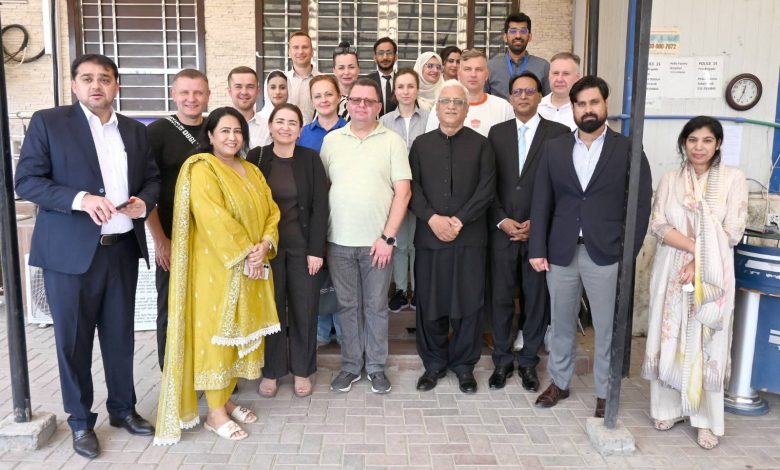
A delegation from the State Border Committee of the Republic of Belarus, accompanied by officials from IOM-Belarus and IOM-Pakistan, visited the SHARP Head Office in Islamabad and were warmly received by Project Director Mr. Aatif Afzal and his team.
Mr. Aatif Afzal outlined SHARP’s evolution and its core work in protection, legal aid, and humanitarian assistance, explaining how these services support vulnerable migrants and detainees across Pakistan. The session benefited from the presence of SHARP’s Chairman and Founder Mr. Liaqat Ali Banori, who brought practical perspectives on border management and the organisation’s broader initiatives.
Effective border management is crucial for ensuring the safety and dignity of migrants and refugees, Mr. Banori said, emphasising that international collaboration and information sharing remain essential to address complex migration challenges. His comments highlighted the central role of coordinated approaches in improving outcomes for people on the move.
Representatives from IRARA also participated and delivered a detailed presentation on their work, creating a constructive exchange of practices. Discussion focused on SHARP’s frontline experience delivering legal aid, protection, and humanitarian assistance, with particular attention to lessons learned in Pakistan and practical measures that can strengthen border management and migrant protection.
Delegates from both sides explored avenues for future cooperation, underscoring the value of strong international partnerships in migration management and the potential for joint programming. Towards the close of the meeting, Ms. Rukhsana Jafar, Senior Livelihood Assistant at SHARP, presented the Talent Beyond Boundaries program and outlined how TBB connects refugees with international employment opportunities, offering a pathway to durable solutions.
The Islamabad meeting reaffirmed SHARP’s role as a national partner for international agencies and demonstrated how shared expertise can improve border management, uphold migrant rights, and expand protection-focused responses across Pakistan.