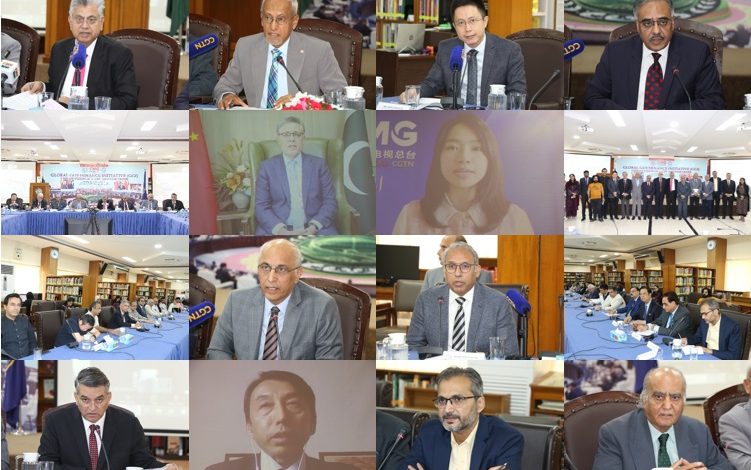
The China-Pakistan Study Centre at the Institute of Strategic Studies Islamabad, together with China Media Group, hosted an international seminar on 29 September 2025 to examine the Global Governance Initiative and its implications for Pakistan and the wider region.
Wang Lei, Country Head of China Media Group, highlighted the media’s responsibility in strengthening communication and mutual trust as the Global Governance Initiative seeks to promote a just international order and a shared future for mankind.
Ambassador Sohail Mahmood, Director General ISSI, welcomed delegates and underscored that the Global Governance Initiative is anchored in five core concepts: sovereign equality, international law, multilateralism, a people-centered approach, and practical results. He noted that the initiative complements China’s earlier global frameworks—the Global Development Initiative, Global Security Initiative, and Global Civilization Initiative—and suggested leveraging the SCO and potential new mechanisms such as a ‘Friends of GGI’ grouping to broaden UN support.
Keynote speaker Maj Gen (R) Fazle Elahi Akbar of FSDS Bangladesh described the Global Governance Initiative as a timely alternative to unilateral approaches, capable of delivering inclusive solutions and practical humanitarian action in crises where existing mechanisms have sometimes fallen short.
Ambassador Khalil Hashmi, Pakistan’s Ambassador to China, reaffirmed Pakistan’s commitment to multilateralism and equitable representation, calling for UN reforms including Security Council changes and better responsiveness from international financial institutions to developing country needs.
Speakers from across policy, research and law enforcement reflected on operational aspects of the Global Governance Initiative. Shakeel Ahmad Ramay of AIERD urged action-driven frameworks for common prosperity. Dr. Akbar Nasir Khan of FIA emphasised protection of victims’ rights and collective accountability, while Dr. Xue Lei from SIIS pointed to institutions such as AIIB and BRICS Bank as platforms for results-oriented cooperation under the GGI approach.
Former envoy Ambassador Moin-ul-Haque and Wang Shengjie, Political Counsellor at the Chinese Embassy, both stressed equality, rule of law and institutional reform to better represent the Global South. They linked GGI to the Belt and Road Initiative and Pakistan’s CPEC, arguing that closer cooperation can accelerate Sustainable Development Goals and regional stability.
Chief Guest Murtaza Solangi highlighted Pakistan’s practical experience in disaster relief, peacekeeping and social protection and urged that the Global Governance Initiative be translated into concrete projects such as early warning systems, second-phase CPEC cooperation, and responsible AI governance. Ambassador Khalid Mahmood, Chairman BoG ISSI, reiterated Pakistan’s support for a more inclusive global governance architecture shaped by its partnership with China.
Opening remarks by Dr. Talat Shabbir noted that the Global Governance Initiative offers forward-looking, people-centered solutions to complex global challenges. The seminar gathered diplomats, scholars, media and policymakers from Pakistan and China to deliberate how the GGI can be operationalised to strengthen multilateral institutions, advance development goals and deliver practical outcomes for the region.