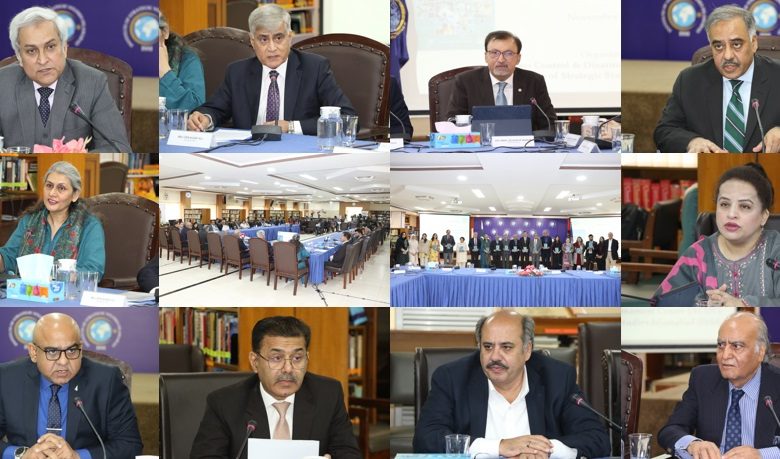
The Arms Control and Disarmament Centre at the Institute of Strategic Studies Islamabad hosted the launch of the new book A New Era of Uncertainty: Emerging Technologies and Strategic Stability, bringing together policymakers, military veterans and academic experts to examine how Emerging Technologies are transforming security across land, sea, air, space and cyberspace. Contributing authors and speakers included Air Commodore (Retd) Khalid Banuri, Dr. Mehreen Afzal, Dr. Zafar Nawaz Jaspal, Major General Ausaf Ali (R), Ms. Tanzeela Khalil and Mr. Zohaib Altaf, while Dr. Asma Shakir Khawaja and Dr. Zahir Kazmi served as discussants. Ambassador Tahir Hussain Andrabi attended as Chief Guest.
Ambassador Tahir Hussain Andrabi described the book as timely and insightful, noting its comprehensive treatment of Emerging Technologies and their implications for arms control and crisis management. He highlighted Pakistan’s active engagement in international forums, including United Nations discussions on responsible AI and appropriate regulation of disruptive technologies.
Ambassador Sohail Mahmood, Director General of ISSI, underlined how advances in AI, quantum computing, hypersonic systems, advanced cyber capabilities and the increasing militarization of space are reshaping deterrence and global power competition. He said the collection serves both as an academic reference and a policy compass for policymakers grappling with the strategic consequences of Emerging Technologies, and he praised the ACDC team led by Director Qasim Mustafa for producing the volume.
Director ACDC Qasim Mustafa explained that the book does not aim to catalogue weapons but rather to analyse how Emerging Technologies such as AI, quantum computing, cyber tools and lethal autonomous systems are altering security partnerships, doctrines and strategic stability. The contributors examine policy options for governing these changes without losing sight of ethical considerations.
Speakers offered focused examinations of specific domains. Air Commodore (Retd) Khalid Banuri emphasised how Emerging Technologies blur the boundaries between peace and conflict and between humans and machines, accelerating military transformation. Dr. Mehreen Afzal outlined AI’s double-edged role in cybersecurity, where it can strengthen defences while also enabling deepfakes, sophisticated phishing and new privacy risks. Major General Ausaf Ali (R) discussed autonomous weapons and AI-enabled drones as low-cost but highly disruptive tools that lower thresholds for conflict and create asymmetric challenges, urging confidence-building measures and robust management mechanisms.
Dr. Zafar Nawaz Jaspal assessed the implications of Emerging Technologies for nuclear deterrence and strategic stability, noting that faster, more precise and more lethal capabilities can both reinforce and undermine deterrence depending on doctrine and controls. Discussants Dr. Asma Shakir Khawaja and Dr. Zahir Kazmi urged ethical innovation, strategic autonomy and doctrinal reform, stressing that technology cannot replace human judgment and that law and strategy must evolve in step with technical change.
Speakers repeatedly referenced South Asia’s delicate strategic balance and the particular urgency for Pakistan to develop doctrines and confidence-building measures tailored to regional dynamics. The launch closed with a vote of thanks from Ambassador Khalid Mahmood, Chairman BoG ISSI, and a group photograph marking the event.